
Salivary amylase begins carbohydrate digestion in the mouth by breaking starch into smaller sugars.

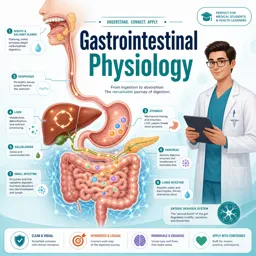
Duration of the online course: 13 hours and 16 minutes
New
Strengthen your clinical foundation with a free GI physiology course—digestion, motility, secretion, liver and bile—plus exercises for fast recall.
Build a clear, exam-ready understanding of how the gastrointestinal system works from the first step of digestion to liver metabolism and intestinal motility. This free online course guides you through the core physiology that links structure to function, helping you connect everyday clinical symptoms with the underlying mechanisms in the mouth, stomach, intestines, and hepatobiliary system.
You will start with foundational concepts of oral physiology, including tooth structure, salivation, and the early stages of carbohydrate digestion. From there, you will follow the path of food through swallowing and into the stomach, learning how gastric secretion is regulated across phases and what signals stimulate or inhibit acid production. The course then expands into the liver, exploring key elements of histology and circulation, why blood supply matters for hepatic function, and how the liver manages nutrients in the fed state through hormonal regulation.
To connect physiology with real-world health and pharmacology, you will also examine biotransformation pathways that help the body process drugs and toxins, along with the logic of bile synthesis, bile acids, and transport mechanisms. By understanding bile’s role in lipid digestion and how jaundice can arise from different disruptions, you will gain a practical framework for interpreting common lab patterns and symptoms.
Finally, the course ties everything together with gastrointestinal motility across the esophagus, small intestine, and large intestine, including how mixing, propulsion, and absorption are coordinated. You will also explore neural and hormonal control, such as the enteric nervous system and hormones like CCK, and revisit digestion in an integrated way—covering carbohydrates, lipids, and proteins from initiation to breakdown and absorption. Short exercises throughout reinforce recall and help you study efficiently for health and physiology coursework.

13 hours and 16 minutes of online video course

Digital certificate of course completion (Free)

Exercises to train your knowledge

100% free, from content to certificate
What does salivary amylase do in digestion?
Salivary amylase begins carbohydrate digestion in the mouth by breaking starch into smaller sugars.
What is the role of bile in fat digestion?
Bile emulsifies dietary fats into small droplets, making them easier for pancreatic lipase to digest and for the intestine to absorb.
Which blood vessels supply the liver, and what do they carry?
The hepatic artery supplies oxygen-rich blood, while the portal vein delivers nutrient-rich blood from the digestive tract.
Ready to get started?Download the app and get started today.
Install the app now
to access the course
Over 5,000 free courses
Programming, English, Digital Marketing and much more! Learn whatever you want, for free.

Study plan with AI
Our app's Artificial Intelligence can create a study schedule for the course you choose.

From zero to professional success
Improve your resume with our free Certificate and then use our Artificial Intelligence to find your dream job.
You can also use the QR Code or the links below.



Free CourseHuman Physiology Lecture
5

(4)

52h21m

50 exercises
Free CourseNeuro Physiology
5
(2)
6h38m
19 exercises
Free CourseCardiovascular Physiology
5
(2)
9h02m
16 exercises
Free CourseAnatomy and Physiology
4.8

(4)
15h19m
24 exercises
Free CourseIntroduction to Physiology
3
(1)
52m
6 exercises
Free CourseRespiratory Physiology
New
9h24m
19 exercises
Free CourseRenal Physiology
New
5h04m
9 exercises
Free CourseEndocrine Physiology
New
8h46m
25 exercises
Carry knowledge in your pocket.
Download the Cursa app.
There are hundreds of free courses available, with a free certificate of completion that is saved in your mobile image gallery.
Download the app to access the Course Completion Certificate for Free.


+ 10 million
students

Free and Valid
Certificate

60 thousand free
exercises

4.8/5 rating in
app stores

Free courses in
video and ebooks
Course comments: Gastrointestinal Physiology
rupangghosh
Good
rupangghosh
Good