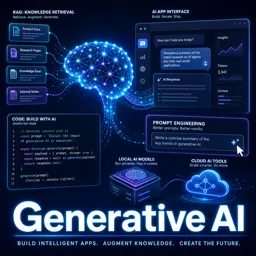
Artificial Intelligence isn’t just about impressive demos—it’s about building systems that make dependable decisions in messy, changing environments. Whether you’re automating document workflows, scoring risks, forecasting demand, or improving customer support, practical AI requires a blend of problem framing, data discipline, modeling choices, and operational thinking. This guide walks through how real-world AI systems are designed, what makes them succeed (or fail), and how to learn the skills step by step.
1) Start with the decision, not the algorithm
Most AI projects go off track because they begin with a model type (“Let’s use neural networks”) rather than a decision to improve (“Reduce late deliveries” or “Detect fraudulent transactions”). A strong starting point is to define:
- What decision will be made? Approve/deny, rank, recommend, flag, route, forecast.
- Who uses it? Customers, internal teams, automated systems.
- How do you measure success? Revenue impact, time saved, error reduction, safety improvements.
- What’s the cost of being wrong? False positives vs. false negatives, user trust, compliance risk.
Once the decision is clear, you can determine whether you need prediction (classification/regression), ranking, clustering, anomaly detection, or a rules+ML hybrid. If you’re building your foundation, explore https://cursa.app/free-online-courses/machine-learning to understand which model families match which business decisions.
2) Data is a product: quality, lineage, and leakage
Real-world AI depends less on clever modeling and more on data reliability. Treat datasets like products with owners, documentation, and quality standards. Key concepts to master:
- Data lineage: Where data originates, how it changes, and what joins/filters were applied.
- Label quality: Human labels are often inconsistent; system-generated labels may be biased.
- Data leakage: When training data accidentally includes information not available at prediction time (a common cause of “great offline results” and poor production performance).
- Representativeness: Training data should resemble real usage—especially across regions, devices, or user segments.
To strengthen this layer, build skills in https://cursa.app/free-online-courses/data-science and consider pairing it with fundamentals from https://cursa.app/free-online-courses/mathematics-for-machine-learning to better reason about bias, variance, and generalization.

3) Choosing the simplest model that meets the goal
In production, simpler models often win because they’re easier to debug, explain, and maintain. A practical approach is to build a baseline first, then increase complexity only if it yields meaningful gains.
- Baselines: Heuristics, rules, linear/logistic regression, decision trees.
- Mid-level: Random forests, gradient boosting (often very strong on tabular data).
- Advanced: Deep learning for images, audio, text, or highly complex patterns.
This doesn’t mean avoiding advanced methods; it means justifying them. When you do need deep models, strengthen your understanding through https://cursa.app/free-online-courses/deep-learning and implementers’ tooling like https://cursa.app/free-online-courses/tensorflow.
4) Evaluation: beyond accuracy
Offline metrics can be misleading if they don’t reflect real-world costs and constraints. Good evaluation connects model performance to outcomes:
- Confusion-matrix metrics: precision, recall, F1, specificity.
- Ranking metrics: MAP, NDCG, hit-rate for recommendation/search.
- Calibration: predicted probabilities should match true likelihoods (critical in risk scoring and triage).
- Robustness tests: performance by segment (geography, device type, new vs. returning users).
- Human-in-the-loop evaluation: whether the AI improves human decisions, not just predictions.
For experiments that affect users, A/B testing and gradual rollouts reduce risk. For deeper grounding on evaluation design, resources from the broader https://cursa.app/free-online-information-technology-courses can help connect AI work with system design and analytics practices.
5) Deployment realities: latency, cost, and integration
Models live inside products and processes. That means engineering constraints shape what’s possible:
- Latency: real-time scoring vs. batch predictions.
- Throughput: traffic spikes and scaling.
- Cost: compute budgets, GPU usage, and storage.
- Integration: APIs, message queues, data warehouses, feature stores.
- Fallbacks: what happens when the model can’t score (timeouts, missing features, outages).
If you’re mapping what to learn next, the https://cursa.app/free-courses-information-technology-online is a practical hub to build from fundamentals into deployable projects.
6) Monitoring and drift: keeping AI useful over time
Production performance changes because the world changes. Monitoring is not optional—it’s how AI stays safe and valuable.
- Data drift: input distributions change (new devices, new behaviors, seasonality).
- Concept drift: the relationship between features and outcomes changes (fraud tactics evolve, markets shift).
- Performance decay: labels arrive late, feedback loops alter behavior, policies change.
Practical monitoring includes input statistics, prediction distributions, latency/errors, and periodic evaluation using newly labeled data. Retaining training data snapshots and model versions makes debugging possible when something breaks.
7) Responsible AI as a build requirement
Responsible AI becomes real when it’s embedded into requirements and review gates:
- Fairness: test for disparate impact; verify that performance is acceptable across relevant groups.
- Privacy: minimize sensitive data use; apply strong access controls and retention policies.
- Explainability: ensure stakeholders can understand key drivers (global and per-decision).
- Safety: define unsafe outputs, add guardrails, and provide escalation paths.
For broader guidance, the https://www.nist.gov/itl/ai-risk-management-framework is a helpful reference for structuring risk thinking across the AI lifecycle.

8) A practical learning path (with portfolio-ready outcomes)
If your goal is career growth, aim for skills that produce credible artifacts: clean notebooks, evaluation reports, reproducible pipelines, and small deployed apps. A focused path could look like:
- Core ML: supervised learning, feature engineering, evaluation (https://cursa.app/free-online-courses/machine-learning).
- Data fluency: wrangling, visualization, experiment design (https://cursa.app/free-online-courses/data-science).
- Implementation: training and serving models (https://cursa.app/free-online-courses/tensorflow).
- Specialization (optional): vision, NLP, or robotics; for vision, explore https://cursa.app/free-online-courses/computer-vision.
- Communication: write short model cards, document assumptions, and present tradeoffs.
To broaden your options, learning https://cursa.app/free-online-courses/r-programming can be valuable for statistics-heavy workflows and clear reporting, especially when collaborating with analysts and researchers.
Conclusion: real AI is a system
AI becomes impactful when it’s treated as a system—connected to decisions, powered by well-governed data, validated with the right metrics, deployed with engineering constraints in mind, monitored over time, and built responsibly. If you learn AI through projects that reflect these realities, you’ll build not only technical skill but also the judgment that employers look for in real-world roles.