Pooling reduces the spatial dimensions of feature maps, lowering computation while retaining important visual features.


Duration of the online course: 3 hours and 13 minutes
4

(1)
Build job-ready computer vision skills with a free online course on CNNs, pooling and dropout, plus quick quizzes and a shareable certificate.
Computer vision sits at the heart of modern AI, powering everything from photo search and quality inspection to medical imaging and autonomous systems. This free online course helps you move from curiosity to confidence by showing how machines learn to interpret images and how convolutional neural networks make that possible. You will develop practical intuition for image processing and the building blocks that turn raw pixels into reliable predictions.
Rather than staying abstract, the course connects key concepts to real model behavior. You will understand why CNNs are so effective for visual tasks, how convolution learns useful patterns like edges and textures, and how those patterns evolve into higher-level features. Along the way, you will explore techniques used to make models faster and more robust, including dimension-reduction strategies and pooling operations that shrink representations while preserving important signals.
Training deep networks can be powerful, but it also brings common challenges such as overfitting and inefficient learning. You will see why methods like dropout matter, how they improve generalization, and what role modern components play in boosting performance in deep architectures. To reinforce learning, short exercises let you check your understanding of the concepts that frequently appear in interviews and day-to-day ML work.
You will also learn the advantage of transfer learning by using pre-trained models such as VGG16, AlexNet, or ResNet. This approach can save time, reduce data requirements, and improve results, especially when you are building prototypes or working with limited labeled images. By the end, you will be able to talk clearly about core CNN ideas, choose sensible architectural ingredients, and understand why certain design decisions are standard across successful computer vision systems.
Explore the best free online machine learning courses with certificates and build job-ready AI skills at your own pace. Learn supervised and unsupervised learning, neural networks, data analysis, Python, and real-world model development through beginner-friendly and advanced classes from trusted learning platforms.

Explore free online Computer Vision courses with certificates and build practical skills in image processing, object detection, facial recognition, deep learning, OpenCV, and neural networks. Learn at your own pace from beginner to advanced levels, strengthen your AI expertise, and earn a certificate to showcase your career-ready knowledge.

3 hours and 13 minutes of online video course

Digital certificate of course completion (Free)

Exercises to train your knowledge

100% free, from content to certificate
What does pooling do in a convolutional neural network for image processing?
Pooling reduces the spatial dimensions of feature maps, lowering computation while retaining important visual features.
Why are CNNs effective for image recognition tasks?
CNNs learn local patterns such as edges, textures, and objects directly from images using convolutional filters.
What is the advantage of using pre-trained models such as VGG16, AlexNet, or ResNet?
Pre-trained models provide learned image features, enabling faster training and strong results with less labeled data.
Ready to get started?Download the app and get started today.
Install the app now
to access the course
Over 5,000 free courses
Programming, English, Digital Marketing and much more! Learn whatever you want, for free.

Study plan with AI
Our app's Artificial Intelligence can create a study schedule for the course you choose.

From zero to professional success
Improve your resume with our free Certificate and then use our Artificial Intelligence to find your dream job.
You can also use the QR Code or the links below.



Free CourseDeep Learning With PyTorch
5
(6)

3h39m

19 exercises

Free CourseMachine Learning tutorial
5
(2)
10h20m
6 exercises
Free CourseGoogle Prompting Essentials
4.8

(4)
3h24m
10 exercises

Free CourseData Science
4.8
(4)
5h58m
38 exercises

Free CourseArtificial intelligence
4.7
(69)
12h40m
7 exercises
Free CourseFundamentals of Artificial Intelligence
4.6
(11)
25h26m
34 exercises
Free CourseGenerative AI
4.6
(5)
1h43m
11 exercises
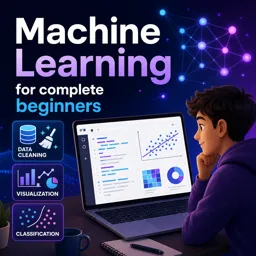
Free CourseMachine Learning for complete beginners
4.6
(9)
1h09m
17 exercises
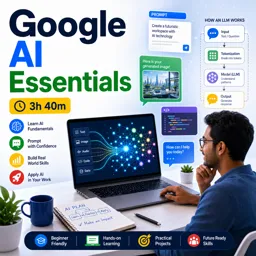
Free CourseGoogle AI Essentials
4.5
(17)
3h40m
13 exercises
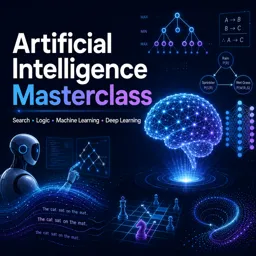
Free CourseArtificial Intelligence Masterclass: Search, Logic, Machine Learning and Deep Learning
4.5
(8)
31h57m
57 exercises
Carry knowledge in your pocket.
Download the Cursa app.
There are hundreds of free courses available, with a free certificate of completion that is saved in your mobile image gallery.
Download the app to access the Course Completion Certificate for Free.


+ 10 million
students

Free and Valid
Certificate

60 thousand free
exercises

4.8/5 rating in
app stores

Free courses in
video and ebooks