Computer vision is a field of AI that enables computers to interpret and analyze images and video.

9

2



Free CourseComputer AI Vision tutorial
4

(1)

3h13m

6 exercises
Free CoursePython for Medical Imaging
New
5h50m
6 exercises
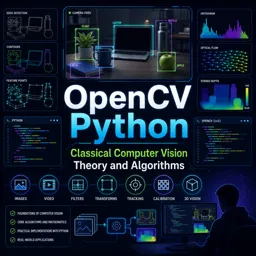
Free CourseOpenCV Python: Classical Computer Vision Theory and Algorithms
New
9h29m
51 exercises
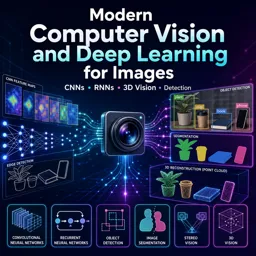
Free CourseModern Computer Vision and Deep Learning for Images - CNNs, RNNs, 3D Vision, Detection
New
31h33m
41 exercises
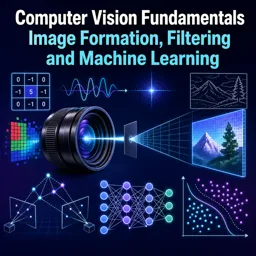
Free CourseComputer Vision Fundamentals: Image Formation, Filtering and Machine Learning
New
15h15m
43 exercises
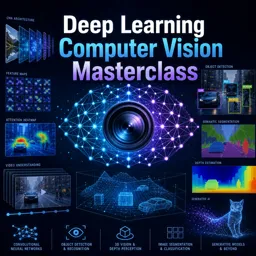
Free CourseDeep Learning Computer Vision Masterclass
3.8

(4)
48h19m
22 exercises
Free CourseComputer Vision: From Image Formation to Neural Radiance Fields
New
21h59m
43 exercises
Free CourseConvolutional Neural Networks for Computer Vision: Deep Learning Lecture Series
New
19h30m
16 exercises
Free CourseConvolutional Neural Networks for Computer Vision: Detection, Recognition
New
6h01m
26 exercises
Exercises

How Computer Vision Works: Key Algorithms and Techniques Behind Machine Perception
Computer Vision enables machines to interpret images using AI. Key techniques include object detection, segmentation, and pose estimation, powering real-world automation.

Building Real-Time Object Detection Systems with Computer Vision
Real-time object detection uses AI to identify and track objects in live video, revolutionizing sectors like automotive, retail, security, and manufacturing.
Discover a practical selection of free online Computer Vision courses designed for students, programmers, data scientists, engineers, and technology professionals. Study essential concepts in image processing, artificial intelligence, machine learning, and deep learning while developing skills that can be applied to academic projects, research, and software development. Every course is free, includes educational exercises, and offers free certification after completion.
These online courses provide accessible learning opportunities for beginners and experienced learners. Lessons may cover digital images, pixels, color models, image enhancement, feature extraction, image classification, and visual pattern recognition. More advanced educational content can introduce convolutional neural networks, transfer learning, object detection, image segmentation, facial recognition, pose estimation, and optical character recognition.
You can also expand your knowledge of popular Computer Vision tools and technologies, including Python, OpenCV, TensorFlow, PyTorch, neural networks, and machine learning algorithms. The included exercises help reinforce theoretical concepts, encourage practical experimentation, and support the development of problem-solving and programming skills.
Computer Vision education can prepare learners to understand how computers identify, process, and interpret visual information. These skills are useful in autonomous vehicles, medical imaging, industrial inspection, security systems, augmented reality, agriculture, document analysis, and intelligent applications. By following structured lessons and completing exercises, you can build a stronger foundation for further studies in AI, deep learning, and visual computing.
To access the courses, exercises, and free certification, it is necessary to install the Cursa application. Android users can install it through Google Play at Download for Android. iPhone users can obtain it from the App Store at Download for iOS / iPhone.
Choose a free Computer Vision course, follow the educational modules at your own pace, complete the proposed exercises, and earn free certification. Begin learning image processing and artificial intelligence online while building valuable technical knowledge for your studies and career.
What is computer vision?
Computer vision is a field of AI that enables computers to interpret and analyze images and video.
What will I learn in a computer vision course?
You can learn image processing, feature extraction, object detection, image classification, segmentation, and deep learning methods.
Do I need Python to learn computer vision?
Python is highly recommended because it is widely used with libraries such as OpenCV, NumPy, PyTorch, and TensorFlow.
What is OpenCV used for in computer vision?
OpenCV is a library for image and video processing, including filtering, feature detection, tracking, and object recognition.
Are CNNs important for computer vision?
Yes. Convolutional neural networks are central to modern image classification, detection, segmentation, and recognition systems.
Can computer vision be used in medical imaging?
Yes. It supports analysis of X-rays, MRI scans, CT images, microscopy, and other medical images.
What are common applications of computer vision?
Applications include facial recognition, autonomous robots, quality inspection, medical imaging, surveillance, augmented reality, and self-driving vehicles.

Complete any course and issue your certificate via the app — at no cost.

Download the app! to have access to more than 4,000 Online Courses + Certificate, all free!
Download the app! 100% free courses.


Carry knowledge in your pocket.
Download the Cursa app.
There are hundreds of free courses available, with a free certificate of completion that is saved in your mobile image gallery.
Download the app to access the Course Completion Certificate for Free.


+ 10 million
students

Free and Valid
Certificate

60 thousand free
exercises

4.8/5 rating in
app stores

Free courses in
video and ebooks