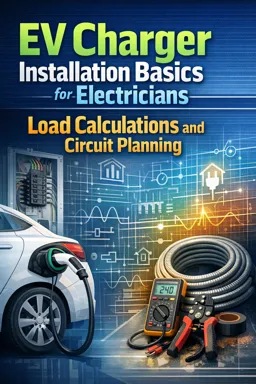

Free ebook for electricians on EV charger load calculations, circuit planning, panel capacity, protection, installation, and commissioning.
Free ebook content
-

EV Charger Installation Basics: Charger Types, Ratings, and Job Scope
+ Exercise: When an EVSE is field-adjustable and can be set to different current limits, what is the key circuit-planning requirement?
-
Load Calculations for EV Circuits: Demand, Continuous Loads, and Service Capacity Checks
+ Exercise: In a dwelling load calculation for adding EV charging, which statement best describes how the EVSE load should be treated and checked?


-
Circuit Planning for EV Chargers: Selecting Voltage, Breaker, and Conductor Size
+ Exercise: An EVSE has a maximum output current of 32 A and will be used for long charging sessions. What is the correct planning approach for selecting the branch-circuit breaker size?
-
Panel and Distribution Considerations for EV Charging Circuits
+ Exercise: Which situation most strongly indicates that adding a garage-adjacent subpanel is a better strategy than trying to install an EV charging breaker in the existing main panel?
-
Cable Routing, Conduit, and Physical Installation for Home EVSE
+ Exercise: When selecting a mounting location for a home EVSE in a garage, which approach best reduces daily cord issues and safety hazards?
-
Protection Devices and Safety Functions in EV Charger Circuits
+ Exercise: An electrician is troubleshooting nuisance trips on an EV charging circuit. Which approach best follows good coordination practices when both upstream GFCI protection and EVSE-integrated ground-fault detection may be present?
-
EVSE Installation Workflow: From Site Walk to Final Terminations
+ Exercise: During an EVSE installation, which practice best helps prevent overheating and nuisance faults caused by loose connections?
-
Commissioning and Functional Checks for Residential EV Charging
+ Exercise: During commissioning of a residential EVSE, what is the best next step if energized voltage measurements at the EVSE supply terminals are outside the expected nominal range?
-
Load Management Options and Upgrade Pathways for Limited Capacity Homes
+ Exercise: In a home with limited service capacity and highly variable loads, which approach best keeps EV charging compliant while still allowing faster charging when household demand is low?
About the free ebook
EV Charger Installation Basics for Electricians: Load Calculations and Circuit Planning
This free ebook provides electricians with a practical foundation for planning residential EV charging installations. It explains how EV charger ratings, charging levels, and job scope affect circuit design before work begins.
Plan circuits with capacity and safety in mind
Learn how to assess service capacity, apply demand considerations, and account for EV charging as a continuous load. The ebook connects load calculations to decisions about voltage, breaker ratings, conductor sizing, panel capacity, and distribution arrangements.
Move from site assessment to commissioning
Explore the installation process from the initial site walk through cable routing, conduit selection, physical mounting, protection devices, final terminations, and functional checks. Guidance also covers common constraints in homes with limited electrical capacity.
Build a clearer installation workflow
- Identify EVSE types, ratings, and installation requirements.
- Evaluate existing service and panel capacity.
- Plan dedicated circuits, conductors, breakers, and routing.
- Consider safety functions and protective devices.
- Review load-management strategies and future upgrade options.
The material is intended to support sound planning and professional decision-making. Always follow applicable electrical codes, manufacturer instructions, permit requirements, and local authority rules.
How is an EV charger treated in a residential load calculation?
EV charging is generally treated as a continuous load, so applicable code rules for continuous loads must be used.
What circuit size is needed for a Level 2 EV charger?
Circuit size depends on the EVSE output rating, continuous-load requirements, conductor ampacity, and local code.
What if a home's electrical service has insufficient capacity for EV charging?
Options may include EV load management, panel or service upgrades, or selecting a lower-rated charging circuit.
This ebook includes:

9 content chapters

Digital certificate of course completion (Free)

Exercises to train your knowledge

100% free, from content to certificate
Ready to get started?

 recommended
In the app you will also find...

Over 5,000 free courses
Programming, English, Digital Marketing and much more! Learn whatever you want, for free.

Study plan with AI
Our app's Artificial Intelligence can create a study schedule for the course you choose.

From zero to professional success
Improve your resume with our free Certificate and then use our Artificial Intelligence to find your dream job.
You can also use the QR Code or the links below.