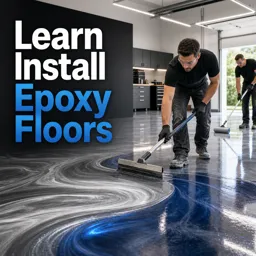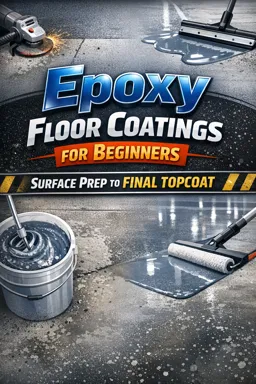


Free ebook on preparing concrete, applying epoxy floor coatings, managing moisture, and selecting durable protective topcoats.
Free ebook content
-

Epoxy Floor Coatings for Beginners: System Basics and Safety Essentials
+ Exercise: Why is it recommended to spread mixed epoxy out promptly instead of leaving it in a deep bucket?
-
Concrete Assessment: Age, Condition, Porosity, and Contamination Checks
+ Exercise: During a water drop absorption test, the water beads strongly for 60 seconds with no darkening. What does this most likely indicate, and what should you do before applying epoxy?
-
Moisture and Vapor Emission Concepts for Epoxy Floor Success
+ Exercise: A plastic sheet test shows condensation droplets under the plastic after 24–48 hours. What is the best next step before applying an epoxy floor coating?


-
Surface Preparation Choices: Grinding vs Acid Etching and When to Use Each
+ Exercise: A slab has shiny/trowel-burned areas and you suspect a prior sealer or curing compound. Which surface-prep choice is most appropriate to create a reliable epoxy bond?
-
Cleaning and Degreasing: Removing Oil, Silicone, and Other Bond Breakers
+ Exercise: During a garage floor cleaning and degreasing workflow, which practice best helps prevent spreading contamination and ensures oily residues are actually removed rather than redistributed?
-
Crack, Joint, and Spall Repair for a Flat, Durable Epoxy Floor
+ Exercise: When a concrete crack shows seasonal opening/closing or repeated re-cracking, what repair approach best reduces epoxy coating issues?
-
Masking, Detailing, and Jobsite Setup for Clean Lines and Efficient Application
+ Exercise: What is the best reason to cut in only a manageable section of the perimeter and roll it out immediately, rather than cutting in the entire perimeter first?
-
Mixing Epoxy Correctly: Ratios, Induction Time, Pot Life, and Batch Planning
+ Exercise: Why is the double-bucket method recommended after mixing epoxy Part A and Part B?
-
Applying Primer and Basecoat: Squeegee and Roller Techniques
+ Exercise: Which approach best prevents lap lines when applying epoxy primer or basecoat?
-
Decorative Flakes and Anti-Slip Additives: Broadcast Methods and Safety Balance
+ Exercise: When adding anti-slip grit to a flake epoxy floor, what approach best maintains cleanability while still improving traction?
-
Environmental Control: Temperature, Humidity, Dew Point, and Ventilation Impacts
+ Exercise: When planning ventilation during epoxy floor application, which approach best balances safety and finish quality?
-
Curing, Recoat Windows, and Surface Readiness Checks
+ Exercise: What is the safest action to take if you are unsure whether you are still inside the recoat window for the next epoxy coat?
-
Topcoats for Epoxy Floors: Polyaspartic and Urethane Application and Performance
+ Exercise: A beginner needs a clear topcoat over an epoxy floor but wants the most forgiving application window to reduce roller marks and lap lines. Which choice best fits this goal?
-
Common Failures: Delamination, Bubbles, Fish-Eyes, Peeling, and How to Prevent Them
+ Exercise: An epoxy floor peels up in sheets, and a controlled scrape at the edge shows the coating releases cleanly from the concrete. Which failure bucket should you investigate first?
-
Maintenance and Long-Term Care of Epoxy Garage and Workshop Floors
+ Exercise: When wet-cleaning an epoxy garage floor, what practice best helps preserve gloss and prevent the surface from becoming a scouring paste?
About the free ebook
Epoxy Floor Coatings for Beginners: Surface Prep to Final Topcoat
This free ebook introduces the practical workflow behind durable epoxy floors for garages, workshops, and similar concrete spaces. It explains how coating performance depends on evaluating the slab, controlling moisture, removing contamination, and choosing a preparation method that creates a sound surface profile.
Build a reliable coating system
Learn the purpose of primers, basecoats, decorative flakes, anti-slip additives, and protective topcoats. The ebook covers correct epoxy mixing, including mix ratios, induction time, pot life, and batch planning, so material is applied while it remains workable.
Prepare concrete before coating
- Check concrete age, porosity, damage, oil, silicone, and existing coatings.
- Understand moisture and vapor-emission risks before applying epoxy.
- Compare grinding and acid etching for appropriate surface preparation.
- Repair cracks, joints, and spalls to support a flatter finished floor.
Apply with control and consistency
Explore masking, jobsite setup, squeegee-and-roller application, flake broadcasting, and environmental controls. Temperature, humidity, dew point, and ventilation can affect adhesion, appearance, and cure results, making jobsite conditions an essential part of the process.
Finish, troubleshoot, and maintain
The ebook explains curing and recoat windows, readiness checks between coats, and the roles of urethane and polyaspartic topcoats. It also helps readers recognize common problems such as delamination, bubbles, fish-eyes, and peeling, along with the preparation and application practices that help prevent them. Finish with maintenance guidance for keeping epoxy garage and workshop floors clean, serviceable, and protected over time.
Use this ebook as a foundational reference for planning and carrying out an epoxy floor coating project with greater safety and confidence.
Why does concrete moisture cause epoxy floor coating failure?
Moisture vapor can weaken adhesion and cause bubbles, blisters, or delamination beneath the coating.
Should concrete be ground or acid etched before epoxy?
Grinding is generally more controllable and effective; acid etching is only suitable for clean, sound concrete when specified.
What causes fish-eyes in an epoxy floor coating?
Fish-eyes are commonly caused by silicone, oil, wax, or other surface contaminants that repel the coating.
This ebook includes:

15 content chapters

Digital certificate of course completion (Free)

Exercises to train your knowledge

100% free, from content to certificate
Ready to get started?

 recommended
In the app you will also find...

Over 5,000 free courses
Programming, English, Digital Marketing and much more! Learn whatever you want, for free.

Study plan with AI
Our app's Artificial Intelligence can create a study schedule for the course you choose.

From zero to professional success
Improve your resume with our free Certificate and then use our Artificial Intelligence to find your dream job.
You can also use the QR Code or the links below.