It covers identifying strong user demand, measuring retention and engagement, choosing early customers, and improving the product before scaling growth.

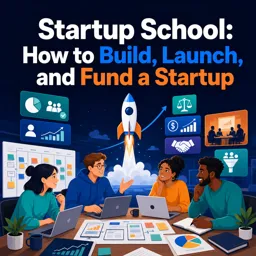
Duration of the online course: 25 hours and 4 minutes
New
Build the skills to launch and fund a startup with this free online course—learn product-market fit, growth, legal basics, and investor-ready strategy.
Turning an idea into a real company takes more than inspiration. You need clear priorities, fast learning loops, and a practical understanding of how startups actually win. This free online course is designed to help you build, launch, and finance a startup by focusing on the decisions that matter most early on: what to build, who to build it for, how to tell whether it’s working, and how to grow without wasting effort.
You will develop a founder’s mindset for execution, learning how to validate assumptions with real users and how to spot the signals of product-market fit. The course emphasizes the discipline of choosing a narrow starting point, shipping quickly, and using measurement to guide iteration. You’ll also explore what it means to do things that don’t scale at the beginning, building momentum through direct customer engagement and careful focus rather than flashy tactics.
Beyond product and traction, the program addresses the fundamentals that keep companies healthy as they grow. You’ll gain clarity on common legal and company-setup mechanics, understand how early equity decisions affect the long term, and learn how to approach hiring and team-building when resources are limited and speed matters. Design, PR, and sales are treated as strategic tools: you’ll see how they fit into an early-stage playbook and when they become worth serious investment.
Fundraising is covered as a means to an end, not the end itself. You’ll learn how to think about timing, what investors look for, and how to communicate your market opportunity in a way that connects to real outcomes. The course also introduces instruments and processes you may encounter, helping you feel prepared for investor conversations and financing decisions. If you want a structured, real-world path from idea to launch to funding, this course will help you move with confidence and focus.

25 hours and 4 minutes of online video course

Digital certificate of course completion (Free)

Exercises to train your knowledge

100% free, from content to certificate
What does Startup School teach about finding product-market fit?
It covers identifying strong user demand, measuring retention and engagement, choosing early customers, and improving the product before scaling growth.
Does the Startup School course explain SAFEs, 83(b) elections, and startup fundraising?
Yes. It introduces startup legal mechanics, 83(b) elections, SAFEs, priced equity rounds, investor outreach, and when to raise venture capital.
What startup growth strategies are covered in Startup School?
The course explores launching an MVP, doing unscalable early work, acquiring initial users, PR and content, sales, hiring, and building product-market fit before growth.
Ready to get started?Download the app and get started today.
Install the app now
to access the course
Over 5,000 free courses
Programming, English, Digital Marketing and much more! Learn whatever you want, for free.

Study plan with AI
Our app's Artificial Intelligence can create a study schedule for the course you choose.

From zero to professional success
Improve your resume with our free Certificate and then use our Artificial Intelligence to find your dream job.
You can also use the QR Code or the links below.



Free CourseOperations Management Course: Strategy, Planning, Quality and Inventory
5

(2)

32h22m

28 exercises
Free CourseBusiness Strategy
4.9
(12)
3h46m
24 exercises
Free CourseStartups Secrets
4.8
(12)
28h02m
14 exercises
Free CourseBusiness Fundamentals for Entrepreneurs
4.8
(5)
23h49m
50 exercises
Free CourseEntrepreneurship course
4.7

(10)
43h30m
43 exercises

Free CourseTechnology Entrepreneurship
4.7
(156)
7h19m
20 exercises

Free CourseLeadership and Team effectiveness
4.6
(18)
34h01m
33 exercises

Free CourseEntrepreneurship 101
4.6
(14)
1h15m
6 exercises
Free CourseBussiness Models and Entrepreneurship
4.5
(4)
21h44m
41 exercises
Free CourseHow to do a Business Plan
4.4
(10)
8h16m
7 exercises
Carry knowledge in your pocket.
Download the Cursa app.
There are hundreds of free courses available, with a free certificate of completion that is saved in your mobile image gallery.
Download the app to access the Course Completion Certificate for Free.


+ 10 million
students

Free and Valid
Certificate

60 thousand free
exercises

4.8/5 rating in
app stores

Free courses in
video and ebooks