Duration of the online course: 32 hours and 22 minutes
New
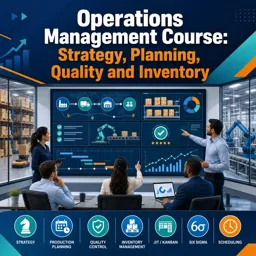
Master operations strategy, planning, quality and inventory in this free online course—boost efficiency, cut costs and earn a certificate-ready skill set.
In this free course, learn about
Operations management basics: role, functions, scope, and system view of operations
Core performance objectives: quality, speed, dependability, flexibility, and cost trade-offs
Production systems types and operations strategy alignment with business goals
Product life cycle decisions; value engineering, DFX, ergonomics, and rapid prototyping
Forecasting concepts; qualitative vs quantitative methods incl. moving average & exponential smoothing
Facility planning and plant location factors; controllable vs uncontrollable considerations
Location evaluation methods: cost-volume analysis and multi-criteria location comparison
Facility layout types, material flow patterns, and layout tools (process charts, etc.)
Production planning & control, process planning, aggregate planning, and capacity utilization
MRP inputs/outputs and how ERP integrates planning and execution across the enterprise
About the free online course
Strong operations separate businesses that merely survive from those that scale with consistency. This free online course builds the practical mindset behind operations management so you can make smarter day‑to‑day decisions across strategy, planning, quality and inventory. Whether you are launching a venture, improving an existing operation, or aiming for roles in production, supply chain or process improvement, you will learn how to design work that flows, measure what matters, and align operations with business goals.
You will connect the core objectives of operations to real managerial choices: how to select the right production approach, shape operations strategy, and design products and processes for value. The course also strengthens your ability to plan with uncertainty by approaching forecasting as a system, choosing methods that fit the context, and translating demand insights into operational actions that support service levels and customer satisfaction.
Facility decisions often lock in costs and performance for years. You will explore how location, layout and material flow influence throughput, lead time, safety and flexibility, giving you a structured way to evaluate trade‑offs before committing resources. From there, the course develops planning and control thinking, including capacity, aggregate planning and scheduling concepts that help you coordinate people, equipment and timelines in a way that protects deadlines and reduces waste.
Quality is treated as a management philosophy rather than a final inspection step. You will develop a clearer grasp of TQM, preventive maintenance, statistical approaches and Six Sigma thinking so you can build reliable processes and continuous improvement habits. Finally, you will bring the end‑to‑end view together through materials and inventory management, including ordering decisions, JIT and pull systems, MRP and ERP, so you can balance availability, cash flow and operational stability. With frequent knowledge checks, this course helps you convert theory into confident decision-making for modern operations.
Course content
Video class: Lecture 01 Operations Management: Basics32m
Exercise: Which set of four objectives is emphasized as the guiding focus of operations management?
Video class: Lecture 02 Operations Management: Objectives32m
Video class: Lecture 03 Operations Management: Functions and Scope32m
Exercise: Which set of four objectives is emphasized as the core focus of operations management?
Video class: Lecture 04 Types of Production Systems34m
Video class: Lecture 05 Operations Strategy34m
Exercise: Which set of four key objectives should operations strategy focus on to meet overall operations management goals?
Video class: Lecture 06 Product Life-Cycle30m
Video class: Lecture 07 Value Engineering Concepts33m
Exercise: Which statement best captures the core idea of value engineering in product design?
Video class: Lecture 08 Design for X (DFX)33m
Video class: Lecture 09 Ergonomics in Product Design37m
Exercise: Which option best describes the main objective of ergonomics in product and system design?
Video class: Lecture 10 Rapid Prototyping: Concept, Advantages32m
Video class: lecture 11 Sales Forecasting34m
Exercise: Which statement best defines forecasting in operations management?
Video class: Lecture 12 Forecasting System36m
Video class: Lecture 13 Qualitative Methods of Forecasting32m
Exercise: In what situation are qualitative forecasting methods most appropriate?
Video class: Lecture 14 Quantitative Methods-I42m
Video class: Lecture 15 Quantitative Methods-II32m
Exercise: In exponential smoothing, which information is primarily needed to compute the next period’s forecast (Ft) using Ft = αDt-1 + (1−α)Ft-1?
Video class: Lecture 16 Facility Planning32m
Video class: Lecture 17 Factors Affecting Plant Location35m
Exercise: Which of the following is classified as an uncontrollable factor affecting plant location decisions?
Video class: Lecture 18 Plant Location: Case Study on Uttarakhand27m
Video class: Lecture 19 Location Evaluation Methods-I29m
Exercise: In cost-volume analysis for plant location selection, which set of inputs is essential to compute and compare total cost across locations?
Video class: Lecture 20 Location Evaluation Methods-II30m
Video class: Lecture 21 Facility Layout and Planning-I33m
Exercise: Which statement best describes a key feature of a process (functional) layout?
Video class: Lecture 22 Facility Layout and Planning-II36m
Video class: Lecture 23 Factors Influencing Plant Layout34m
Exercise: Which plant layout is generally most suitable for producing uniform products in a high-volume, sequential flow (e.g., automobile assembly)?
Video class: Lecture 24 Material Flow Patterns32m
Video class: Lecture 25 Tools and Techniques used For Plant Layout Planning33m
Exercise: Which tool is described as the most comprehensive chart that provides an overall view of the manufacturing activity by showing the sequence of operations and inspections?
Video class: Lecture 26 Production Planning and Control30m
Video class: Lecture 27 Process Planning37m
Exercise: Which of the following is a key benefit of effective Production Planning and Control (PPC)?
Video class: Lecture 28 Aggregate Production Planning38m
Video class: Lecture 29 Capacity Planning: Introduction32m
Exercise: In capacity planning, how is the capacity utilization rate calculated?
Video class: Lecture 30 Capacity Planning: Examples35m
Video class: Lecture 31 Project Scheduling26m
Video class: Lecture 32 Network Diagrams32m
Video class: Lecture 33 Critical Path Method33m
Exercise: In critical path method (CPM), how is the critical path best defined?
Video class: Lecture 34 Critical Path Method: Problems-I30m
Video class: Lecture 35 Critical Path Method: Problems-II28m
Exercise: In Critical Path Method (CPM), what is the key implication of an activity being on the critical path?
Video class: Lecture 36 Program Evaluation and Review Technique (PERT)29m
Video class: Lecture 37 PERT Problems-I31m
Video class: Lecture 38 PERT Problems-II31m
Video class: Lecture 39 Time Cost Trade Off (Crashing)28m
Exercise: In time–cost trade-off (crashing) analysis, which statement best describes how direct and indirect costs typically vary with project duration?
Video class: Lecture 40 Project Network: Crashing Problems37m
Video class: Lecture 41 Production Control30m
Exercise: Which set correctly lists the four main functions of production control?
Video class: Lecture 42 Sequencing32m
Video class: Lecture 43 Sequencing Problems-I34m
Exercise: In production control, which set of four key functions is emphasized to ensure smooth manufacturing and meeting due dates?
Video class: Lecture 44 Sequencing Problems-II34m
Video class: Lecture 45 Master Production Scheduling (MPS)29m
Exercise: Which statement best describes a Master Production Schedule (MPS)?
Video class: Lecture 46 Concept of Quality32m
Video class: Lecture 47 Total Quality Management (TQM)31m
Exercise: In Total Quality Management (TQM), what does the word total primarily imply?
Video class: Lecture 48 Total Productive Maintenance28m
Video class: Lecture 49 Statistical Quality Control (SQC)31m
Exercise: In statistical quality control (SQC), which set correctly represents the three broad categories it encompasses?
Video class: Lecture 50 Six Sigma32m
Video class: Lecture 51 Materials Management26m
Exercise: Which pair of decisions best represents the core purpose of inventory management?
Video class: Lecture 52 Inventory Control32m
Video class: Lecture 53 Economic Order Quantity (EOQ) Models27m
Exercise: In the basic Economic Order Quantity (EOQ) model, at what point is the total inventory cost minimized?
Video class: Lecture 54 Economic Order Quantity (EOQ): Problems29m
Video class: Lecture 55 Production Quantity Model34m
Exercise: In the production quantity model, what is the key difference from the EOQ model regarding how inventory is received?
Video class: Lecture 56 Just In time (JIT)30m
Video class: Lecture 57 Kanban System28m
Exercise: In a Kanban-based pull system, how is production and material movement primarily triggered?
Video class: Lecture 58 Materials Requirement Planning (MRP)-I33m
Video class: Lecture 59 Materials Requirement Planning (MRP)-II31m
Exercise: Which set of inputs is essential for a Materials Requirement Planning (MRP) system to generate planned order schedules?
Video class: Lecture 60 Enterprise Resource Planning (ERP)29m
What operations management topics are covered in this free course?
The course covers operations strategy, product and process design, forecasting, facility location and layout, production planning, project scheduling, quality management, inventory, JIT, MRP, and ERP.
How does the course explain EOQ, JIT, Kanban, and MRP?
It explains how to optimize order quantities with EOQ, reduce waste through JIT, trigger pull-based replenishment with Kanban, and plan material needs using MRP.
Does the operations management course include CPM, PERT, and project crashing?
Yes. It covers network diagrams, critical path analysis, PERT estimation, and time-cost trade-off techniques for shortening project schedules.
Ready to get started?Download the app and get started today.