Non-concentrating collectors absorb sunlight over the same area as the absorber, while concentrating collectors use mirrors or lenses to focus sunlight onto a smaller receiver for higher temperatures.

Duration of the online course: 29 hours and 51 minutes
New
Build in-demand skills in solar, wind and biomass systems with a free online engineering course—learn practical design basics, calculations and energy conversion.
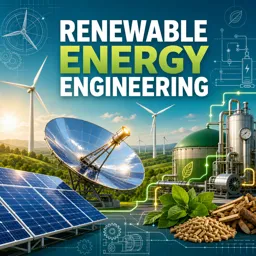
Renewable energy projects succeed when engineering decisions are backed by solid fundamentals, realistic assumptions, and the ability to translate natural resources into usable heat and power. This free online course helps you build that foundation across three major renewable pathways: solar thermal energy, biomass conversion, and wind energy. Designed within Professional Skills and grounded in Mechanical and Industrial Basics, it connects theory to the kind of calculations and design thinking used in real-world applications.
You will learn how solar radiation behaves, why orientation and angle of incidence matter, and how different collector types change performance. Instead of stopping at concepts, the course repeatedly reinforces understanding through worked-style practice that develops confidence with energy balances, useful heat gain, temperature rise, and key performance parameters. You will also explore concentrating approaches such as parabolic collectors, along with practical limitations and trade-offs, then move into thermal energy storage ideas that help renewable systems deliver energy more reliably.
On the biomass side, you will build a clear picture of how composition and properties influence conversion choices, including how heating values are interpreted for fuels. The course explains biochemical and thermochemical routes in a way that supports engineering judgment: when anaerobic digestion makes sense, how biogas systems are categorized, and why feedstock selection affects output. You will also examine combustion, gasification, torrefaction, liquefaction, and pyrolysis, with problem-solving that ties process parameters to usable energy, daily requirements, and practical system sizing.
Wind energy rounds out the curriculum by clarifying turbine terminology, basic theory, and how power extraction is limited by fundamental principles. You will connect concepts such as torque and tip speed ratio to performance and efficiency, building intuition for how turbines are analyzed and compared. By the end, you will be able to approach renewable energy engineering problems with a structured method, a stronger quantitative toolkit, and the vocabulary needed to communicate confidently in clean-energy settings.

29 hours and 51 minutes of online video course

Digital certificate of course completion (Free)

Exercises to train your knowledge

100% free, from content to certificate
What is the difference between non-concentrating and concentrating solar collectors?
Non-concentrating collectors absorb sunlight over the same area as the absorber, while concentrating collectors use mirrors or lenses to focus sunlight onto a smaller receiver for higher temperatures.
What renewable energy systems are covered in this Renewable Energy Engineering course?
The course covers solar thermal collectors and storage, biomass characterization and conversion, biogas and biofuels, gasification and pyrolysis, plus wind turbine theory and power generation.
What is the maximum theoretical efficiency of a wind turbine under Betz's Law?
Betz's Law sets the maximum theoretical wind-power extraction efficiency at 59.3% of the available kinetic energy in the wind.
Ready to get started?Download the app and get started today.
Install the app now
to access the course
Over 5,000 free courses
Programming, English, Digital Marketing and much more! Learn whatever you want, for free.

Study plan with AI
Our app's Artificial Intelligence can create a study schedule for the course you choose.

From zero to professional success
Improve your resume with our free Certificate and then use our Artificial Intelligence to find your dream job.
You can also use the QR Code or the links below.



Free CourseAerospace Engineering
5

(4)

17h32m

20 exercises
Free CourseFluid Mechanics
5
(3)
23h09m
16 exercises
Free CourseManagement - Business Analysis for Engineers
4.8
(84)
31h13m
29 exercises
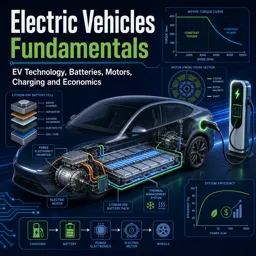
Free CourseElectric Vehicles Fundamentals: EV Technology, Batteries, Motors, Charging and Economics
4.8

(4)
33h11m
39 exercises
Free CoursePrinciple of industrial engineering
4.7
(7)
32h27m
33 exercises
Free CourseMechanical - Metal Casting
4.7
(93)
30h34m
30 exercises
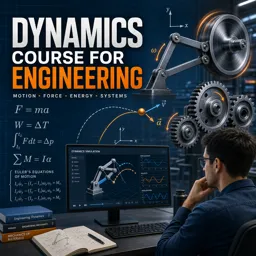
Free CourseDynamics course for Engineering
4.7
(3)
28h05m
30 exercises
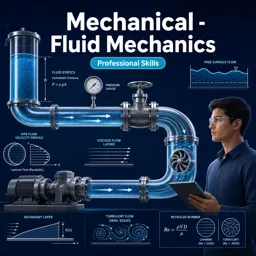
Free CourseMechanical - Fluid Mechanics
4.6
(63)
41h57m
32 exercises
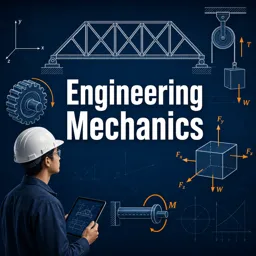
Free CourseEngineering Mechanics
4.6
(7)
40h32m
5 exercises
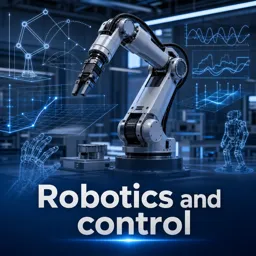
Free CourseRobotics and control
4.5
(4)
21h37m
31 exercises
Carry knowledge in your pocket.
Download the Cursa app.
There are hundreds of free courses available, with a free certificate of completion that is saved in your mobile image gallery.
Download the app to access the Course Completion Certificate for Free.


+ 10 million
students

Free and Valid
Certificate

60 thousand free
exercises

4.8/5 rating in
app stores

Free courses in
video and ebooks