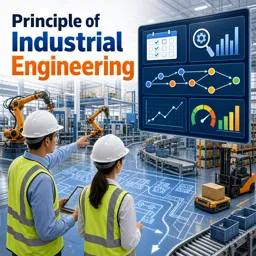
Industrial engineering uses methods such as work study, operations research, production planning, and facility-layout analysis to optimize resources, reduce waste, and improve productivity.

Duration of the online course: 32 hours and 27 minutes
5

(5)
Build industrial engineering skills to improve productivity, layout and plant location decisions. Join this free online course and learn with practical exercises.
Industrial engineering is the discipline that turns complex operations into reliable, measurable, and efficient systems. In this course, you will build a solid foundation in industrial engineering principles, learning how industries evolve, how organizations are designed to execute strategy, and how engineers make decisions that improve output without sacrificing quality. The focus is practical: you will connect core concepts to everyday challenges found in manufacturing and service environments, from organizing work and resources to designing facilities that support smoother flow and better performance.
You will explore the purpose of industrial engineering and the tools commonly used to reduce waste, increase productivity, and support continuous improvement. Along the way, you will develop the vocabulary and mindset needed to analyze processes, understand why certain methods work, and communicate your reasoning inside a technical or cross-functional team. The learning experience is reinforced through exercises that help you check your understanding and apply concepts to realistic scenarios.
A central theme of the course is organizational structure: how roles, coordination mechanisms, and departmentalization shape execution. You will see how different structural choices can accelerate decision-making, improve accountability, or introduce bottlenecks, and how culture influences what structures can achieve in practice. By linking structure to product and process needs, you will learn to recognize when a product-focused approach is helpful, when a process perspective is more effective, and what trade-offs leaders must manage as organizations scale.
The course also addresses plant location and plant layout decisions, which often determine long-term cost, responsiveness, and operational risk. You will understand how engineers evaluate location factors, compare alternative sites, and balance demand coverage with transportation, cost, and operational constraints. From there, you will connect layout types to production volume and variety, learning how facility arrangement influences lead time, material movement, coordination, and overall productivity.
Whether you are starting in mechanical and industrial basics, preparing for operations-related roles, or simply looking to understand how efficient systems are designed, this free online course provides a structured path to think like an industrial engineer and make smarter operational decisions.

32 hours and 27 minutes of online video course

Digital certificate of course completion (Free)

Exercises to train your knowledge

100% free, from content to certificate
What industrial engineering tools are used to reduce waste and improve productivity?
Industrial engineering uses methods such as work study, operations research, production planning, and facility-layout analysis to optimize resources, reduce waste, and improve productivity.
How do engineers choose the best location for a manufacturing plant?
Plant location is evaluated using factors such as customer access, transportation, labor, raw materials, costs, and methods including factor rating, load-distance analysis, and break-even analysis.
Which plant layout is most suitable for high-volume production with limited product variety?
A product, or line, layout is best for high-volume, low-variety production because equipment is arranged in the sequence of operations.
Ready to get started?Download the app and get started today.
Install the app now
to access the course
Over 5,000 free courses
Programming, English, Digital Marketing and much more! Learn whatever you want, for free.

Study plan with AI
Our app's Artificial Intelligence can create a study schedule for the course you choose.

From zero to professional success
Improve your resume with our free Certificate and then use our Artificial Intelligence to find your dream job.
You can also use the QR Code or the links below.



Free CourseAerospace Engineering
5
(4)

17h32m

20 exercises
Free CourseFluid Mechanics
5
(3)
23h09m
16 exercises

Free CourseManagement - Business Analysis for Engineers
4.8
(84)
31h13m
29 exercises

Free CourseElectric Vehicles Fundamentals: EV Technology, Batteries, Motors, Charging and Economics
4.8

(4)
33h11m
39 exercises

Free CourseMechanical - Metal Casting
4.7
(93)
30h34m
30 exercises
Free CourseDynamics course for Engineering
4.7
(3)
28h05m
30 exercises
Free CourseMechanical - Fluid Mechanics
4.6
(63)
41h57m
32 exercises
Free CourseEngineering Mechanics
4.6
(7)
40h32m
5 exercises

Free CourseRobotics and control
4.5
(4)
21h37m
31 exercises
Free CourseEngineering Dynamics
4.5
(4)
39h59m
20 exercises
Carry knowledge in your pocket.
Download the Cursa app.
There are hundreds of free courses available, with a free certificate of completion that is saved in your mobile image gallery.
Download the app to access the Course Completion Certificate for Free.


+ 10 million
students

Free and Valid
Certificate

60 thousand free
exercises

4.8/5 rating in
app stores

Free courses in
video and ebooks
Course comments: Principle of industrial engineering
Durairaju
The course content was clear, practical,
Viola dlomo
it was easy to learn, everything is explained thoroughly and you can always go back for a refresher.