
A rocket accelerates by ejecting mass, so its mass changes continuously and it can generate thrust in space without air or ground contact.

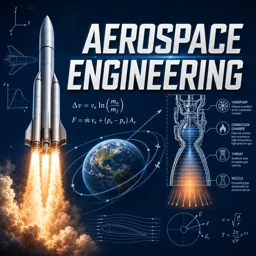
Duration of the online course: 17 hours and 32 minutes
5

(1)
Build in-demand aerospace skills with a free online course on rocket dynamics, orbits, nozzles, and propulsion—learn fast and earn a certificate-ready foundation.
Step into the engineering behind rockets and spacecraft and learn to reason about flight where everyday intuition stops working. This free online course introduces the physical principles that govern motion beyond the atmosphere, helping you connect forces, momentum, and reference frames to the realities of spaceflight. You will gain a solid foundation in how rockets differ from cars, aircraft, or simple projectiles, and why space missions are driven by velocity requirements, orbital mechanics, and careful propulsion design.
You will work through the core ideas that shape modern aerospace engineering, from motion in space and rotational frames of reference to the practical meaning of orbital speed, circular orbits, and geostationary altitude. Instead of treating these as isolated facts, the course builds engineering judgment: how to estimate what it takes to reach orbit, when escape velocity matters, and how mission delta V influences the entire vehicle architecture. This context is essential for anyone considering careers in aerospace, mechanical systems, or adjacent fields that value rigorous modeling and systems thinking.
A major focus is rocket propulsion, including the rocket equation, staging strategies, and propulsion efficiency. You will learn how design tradeoffs affect payload fraction, why upper stages are so influential, and what performance constraints appear at liftoff compared with high-altitude flight. The course then connects theory to hardware through nozzle concepts: throat conditions, expansion for maximum thrust, characteristic velocity, thrust coefficient, divergence losses, and common geometries such as conical and bell nozzles, along with unconventional designs that adapt across altitude.
Finally, you will explore how engineers choose propellants and predict performance, including mixture ratio effects, chamber pressure influences on combustion chemistry and dissociation, and how equilibrium or frozen-flow assumptions change results. The course also introduces solid rocket fundamentals, typical composite propellant composition, gas generation from burning surfaces, and why certain propellant families are preferred in specific mission types. With targeted exercises throughout, you will finish with a practical, confidence-building understanding of how rockets are analyzed and why real-world propulsion decisions look the way they do.

17 hours and 32 minutes of online video course

Digital certificate of course completion (Free)

Exercises to train your knowledge

100% free, from content to certificate
Why is rocket motion different from the motion of a car or a projectile?
A rocket accelerates by ejecting mass, so its mass changes continuously and it can generate thrust in space without air or ground contact.
What is the approximate escape velocity from Earth's surface?
Earth's escape velocity is approximately 11.2 km/s, ignoring atmospheric drag and Earth's rotation.
What condition gives maximum thrust in a rocket nozzle?
Maximum thrust occurs when the nozzle exit pressure matches the surrounding ambient pressure.
Ready to get started?Download the app and get started today.
Install the app now
to access the course
Over 5,000 free courses
Programming, English, Digital Marketing and much more! Learn whatever you want, for free.

Study plan with AI
Our app's Artificial Intelligence can create a study schedule for the course you choose.

From zero to professional success
Improve your resume with our free Certificate and then use our Artificial Intelligence to find your dream job.
You can also use the QR Code or the links below.



Free CourseFluid Mechanics
5
(3)

23h09m

16 exercises
Free CourseManagement - Business Analysis for Engineers
4.8
(84)
31h13m
29 exercises
Free CourseElectric Vehicles Fundamentals: EV Technology, Batteries, Motors, Charging and Economics
4.8

(4)
33h11m
39 exercises
Free CoursePrinciple of industrial engineering
4.7
(7)
32h27m
33 exercises
Free CourseMechanical - Metal Casting
4.7
(93)
30h34m
30 exercises
Free CourseDynamics course for Engineering
4.7
(3)
28h05m
30 exercises
Free CourseMechanical - Fluid Mechanics
4.6
(63)
41h57m
32 exercises
Free CourseEngineering Mechanics
4.6
(7)
40h32m
5 exercises
Free CourseRobotics and control
4.5
(4)
21h37m
31 exercises
Free CourseEngineering Dynamics
4.5
(4)
39h59m
20 exercises
Carry knowledge in your pocket.
Download the Cursa app.
There are hundreds of free courses available, with a free certificate of completion that is saved in your mobile image gallery.
Download the app to access the Course Completion Certificate for Free.


+ 10 million
students

Free and Valid
Certificate

60 thousand free
exercises

4.8/5 rating in
app stores

Free courses in
video and ebooks
Course comments: Aerospace Engineering
Sanket S Anchekar
good