The course explains balance sheets, income statements, cash flow statements, trial balances, and the preparation of financial statements.

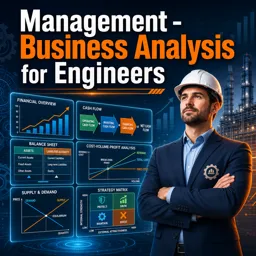
Duration of the online course: 31 hours and 13 minutes
4.8

(81)
Strengthen your business analysis skills for engineering roles with a free online course on finance, strategy and economics—learn to make smarter decisions.
Engineering decisions shape cost, risk, timelines, and long-term performance. This free online course helps you develop business analysis skills tailored for engineers who want to connect technical work to financial outcomes and strategic priorities. You will learn how to think beyond specifications and translate engineering choices into the language of leadership: value, trade-offs, profitability, and competitive advantage.
You will build confidence with core accounting and financial statement concepts so you can read a balance sheet, understand income and cash flow logic, and interpret what financial data is really saying about operational health. By learning the principles behind double-entry thinking and the purpose of tools like trial balances and statement preparation, you gain a structured way to validate numbers, ask better questions, and spot what might be missing from a discussion or report. These foundations are practical for engineers who interact with budgets, capital requests, supplier terms, or cross-functional performance reviews.
The course also supports stronger internal decision-making through management accounting ideas such as cost behavior, cost-volume relationships, break-even reasoning, and variance analysis. With this mindset, you can evaluate process changes, production choices, and resource plans more clearly, and communicate their financial implications without losing the engineering rationale. You will also explore working-capital realities, including the cash conversion cycle and inventory decisions, which often determine whether an operation can scale smoothly or becomes constrained by cash and stock.
To round out the business lens, you will examine strategy and competitive analysis in a way that helps engineers understand the environment their solutions compete in. Concepts like industry forces, value chain thinking, portfolio analysis, core competencies, and growth or positioning models give you frameworks to align technical projects with the firm’s direction. Finally, essential economics ideas—GDP, supply and demand, elasticity, and policy influences—provide context for how markets and macro factors can affect costs, pricing, demand, and investment decisions.
With short exercises reinforcing key ideas, this course is designed to help you collaborate more effectively with finance, operations, and management, and to contribute to decisions with a balanced view of technical feasibility and business impact. If you want to expand your professional skill set and move toward roles that blend engineering with management responsibility, this course gives you the foundations to do it with clarity and credibility.

31 hours and 13 minutes of online video course

Digital certificate of course completion (Free)

Exercises to train your knowledge

100% free, from content to certificate
What financial statements are covered in the Business Analysis for Engineers course?
The course explains balance sheets, income statements, cash flow statements, trial balances, and the preparation of financial statements.
Does the course explain break-even analysis and inventory management?
Yes. It covers cost-volume relationships, break-even volume, cost objects, variance analysis, the cash conversion cycle, and economic order quantity.
Which business strategy models are taught for engineering professionals?
Topics include Porter's Diamond and Generic Strategy models, value-chain analysis, Ansoff Matrix, core competencies, portfolio analysis, and Blue Ocean Strategy.
Ready to get started?Download the app and get started today.
Install the app now
to access the course
Over 5,000 free courses
Programming, English, Digital Marketing and much more! Learn whatever you want, for free.

Study plan with AI
Our app's Artificial Intelligence can create a study schedule for the course you choose.

From zero to professional success
Improve your resume with our free Certificate and then use our Artificial Intelligence to find your dream job.
You can also use the QR Code or the links below.



Free CourseAerospace Engineering
5
(4)

17h32m

20 exercises
Free CourseFluid Mechanics
5
(3)
23h09m
16 exercises

Free CourseElectric Vehicles Fundamentals: EV Technology, Batteries, Motors, Charging and Economics
4.8

(4)
33h11m
39 exercises
Free CoursePrinciple of industrial engineering
4.8
(8)
32h27m
33 exercises

Free CourseMechanical - Metal Casting
4.7
(93)
30h34m
30 exercises
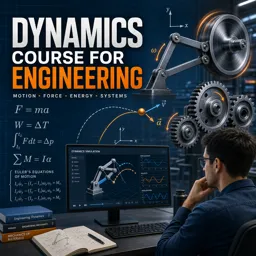
Free CourseDynamics course for Engineering
4.7
(3)
28h05m
30 exercises
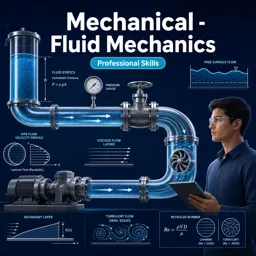
Free CourseMechanical - Fluid Mechanics
4.6
(63)
41h57m
32 exercises
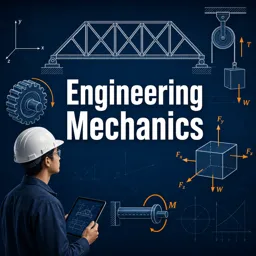
Free CourseEngineering Mechanics
4.6
(7)
40h32m
5 exercises
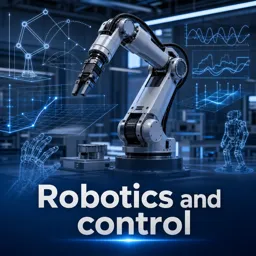
Free CourseRobotics and control
4.5
(4)
21h37m
31 exercises
Free CourseEngineering Dynamics
4.5
(4)
39h59m
20 exercises
Carry knowledge in your pocket.
Download the Cursa app.
There are hundreds of free courses available, with a free certificate of completion that is saved in your mobile image gallery.
Download the app to access the Course Completion Certificate for Free.


+ 10 million
students

Free and Valid
Certificate

60 thousand free
exercises

4.8/5 rating in
app stores

Free courses in
video and ebooks
Course comments: Management - Business Analysis for Engineers
Deep Ranjan Haldar
Nice
Pragasan Govender
very good explanation and excellent teacher. I highly recommend this course
sthembiso Mthembu
Excellent and quality Classes
Ganesh Vilas Katare
Good