
The course covers density, specific gravity, viscosity, compressibility and bulk modulus, surface tension, and Newtonian-fluid behavior.

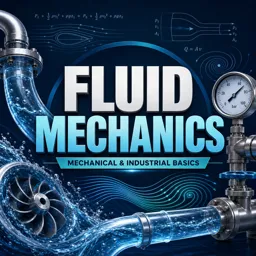
Duration of the online course: 23 hours and 9 minutes
5

(2)
Build strong fluid mechanics skills with a free online course—master fluid properties, viscosity, surface tension, and solve exam-style problems for engineering.
Strengthen your mechanical and industrial fundamentals by learning how real fluids behave and how engineers model them. This free online Fluid Mechanics course is designed for learners who want clarity on core concepts and the confidence to apply them in problem-solving situations common in technical interviews and competitive exams. Instead of memorizing formulas, you will focus on building intuition: what changes when temperature rises, why liquids are treated as nearly incompressible, and how different measures such as dynamic and kinematic viscosity are used in practice.
Throughout the course, the emphasis stays on fluid properties and their engineering meaning. You will connect material properties to measurable outcomes, such as how viscosity trends differ for liquids versus gases, how bulk modulus relates to perceived compressibility, and why specific gravity is useful when comparing fluids. You will also interpret surface tension effects in droplets and interfaces, translating physical behavior into the pressure differences and energy changes that engineers calculate.
To make learning stick, the lessons are paired with targeted questions that check understanding immediately. These exercises push you to reason from definitions, choose correct statements, and handle quantitative setups that reflect real exam patterns. You will practice converting a physical scenario into a workable model, for example when analyzing shear-driven flow between plates or estimating power requirements in viscous motion. By engaging with these guided problems, you develop a disciplined approach to units, assumptions, and linear profiles—skills that carry directly into broader mechanical design and process work.
This course fits within Professional Skills and Mechanical and Industrial Basics because it supports the kind of foundational competence expected from mechanical, civil, chemical, and related engineering learners. By the end, you should be able to explain key property relationships in plain language, predict trends with temperature and material behavior, and solve standard conceptual and numerical questions with fewer surprises. Use it as a refresher, a structured start, or a bridge toward more advanced topics such as fluid statics, fluid dynamics, and machine applications.

23 hours and 9 minutes of online video course

Digital certificate of course completion (Free)

Exercises to train your knowledge

100% free, from content to certificate
What fluid properties are covered in this GATE 2025 Fluid Mechanics course?
The course covers density, specific gravity, viscosity, compressibility and bulk modulus, surface tension, and Newtonian-fluid behavior.
How do temperature changes affect the viscosity of liquids and gases?
As temperature rises, liquid viscosity generally decreases, while the viscosity and kinematic viscosity of ideal gases generally increase.
What is the pressure difference across a liquid droplet due to surface tension?
For a spherical liquid droplet of radius R, the excess internal pressure is 2σ/R, where σ is the surface tension.
Ready to get started?Download the app and get started today.
Install the app now
to access the course
Over 5,000 free courses
Programming, English, Digital Marketing and much more! Learn whatever you want, for free.

Study plan with AI
Our app's Artificial Intelligence can create a study schedule for the course you choose.

From zero to professional success
Improve your resume with our free Certificate and then use our Artificial Intelligence to find your dream job.
You can also use the QR Code or the links below.



Free CourseAerospace Engineering
5
(4)

17h32m

20 exercises

Free CourseManagement - Business Analysis for Engineers
4.8
(84)
31h13m
29 exercises

Free CourseElectric Vehicles Fundamentals: EV Technology, Batteries, Motors, Charging and Economics
4.8

(4)
33h11m
39 exercises

Free CoursePrinciple of industrial engineering
4.7
(7)
32h27m
33 exercises
Free CourseMechanical - Metal Casting
4.7
(93)
30h34m
30 exercises
Free CourseDynamics course for Engineering
4.7
(3)
28h05m
30 exercises
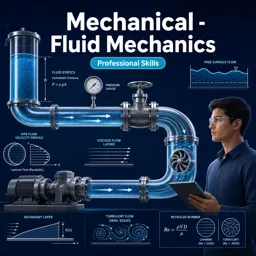
Free CourseMechanical - Fluid Mechanics
4.6
(63)
41h57m
32 exercises
Free CourseEngineering Mechanics
4.6
(7)
40h32m
5 exercises

Free CourseRobotics and control
4.5
(4)
21h37m
31 exercises
Free CourseEngineering Dynamics
4.5
(4)
39h59m
20 exercises
Carry knowledge in your pocket.
Download the Cursa app.
There are hundreds of free courses available, with a free certificate of completion that is saved in your mobile image gallery.
Download the app to access the Course Completion Certificate for Free.


+ 10 million
students

Free and Valid
Certificate

60 thousand free
exercises

4.8/5 rating in
app stores

Free courses in
video and ebooks
Course comments: Fluid Mechanics
Taylor Lindani
great course