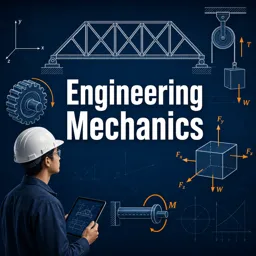
Free Course Image Engineering Dynamics

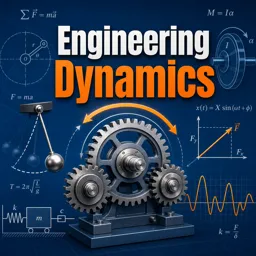
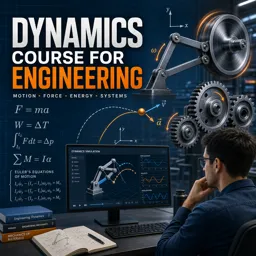
Free online courseEngineering Dynamics

Duration of the online course: 39 hours and 59 minutes

4.5

StarStarStarStarHalf star

(4)

Explore the fundamentals of Engineering Dynamics with MIT's free online course. Cover topics such as Newton's Laws, rotational motion, and mechanical vibrations. Perfect for engineers!

In this free course, learn about

  • Foundations of Dynamics and Newtonian Mechanics
  • Kinematics in Rotating and Translating Frames
  • Torque, Angular Momentum, and Moving Reference Frames
  • Fictitious Forces and Free Body Diagrams
  • Equations of Motion and Rigid Body Dynamics
  • Rotating Rigid Bodies and Angular Momentum
  • Advanced Rotational Dynamics and Energy
  • Introduction to Lagrangian Dynamics
  • Lagrange Equations and Generalized Forces
  • Single Degree of Freedom Vibration
  • Natural Frequencies and Steady-State Response
  • Modal Analysis and Multi-DOF Vibration
  • Advanced Multi-DOF and Continuous Systems

Course Description

The course "Engineering Dynamics" is a comprehensive professional course tailored to individuals pursuing expertise in the field of Engineering and Mechanics. With a total duration of 39 hours and 59 minutes, it provides an in-depth exploration of the foundational and advanced concepts related to dynamics. This course has garnered an impressive 4 out of 5 stars, reflecting its high quality and effectiveness in imparting valuable knowledge to its participants.

The journey begins with an enlightening delve into the "History of Dynamics," setting the stage for understanding how contemporary dynamics concepts evolved over time. Following this, learners are introduced to the principles of "Motion in Moving Reference Frames," providing a crucial foundation for subsequent topics.

One of the core components of the course is a thorough exploration of "Newton's Laws," which are the bedrock of classical mechanics. This section ensures that students have a solid grasp of these fundamental principles before progressing to more complex topics.

The course then advances to examine the "Motion of Center of Mass" and the "Acceleration in Rotating Reference Frames," enhancing understanding of how forces and motions interact in multiple contexts. The subsequent sections cover the "Movement of a Particle in Circular Motion" using Polar Coordinates and delve into the kinematics of particles.

An extensive focus is given to the concepts of "Impulse" and "Torque," providing the analytical tools necessary for understanding rotational dynamics. The topic of "Degrees of Freedom" is pivotal, helping learners to develop accurate Free Body Diagrams essential for problem-solving in dynamics.

To address the complexities associated with non-inertial frames, the course incorporates a detailed discussion on "Fictitious Forces” and addresses the challenging concept of "Rotating Imbalance." These sections demystify how forces manifest differently in rotating frames of reference.

As learners progress, they encounter the "Equations of Motion" and explore the intricate relationships between "Torque" and "Angular Momentum" for rigid bodies. The course further delves into the "Mass Moment of Inertia," which is key to understanding the rotational properties of bodies. Methodologies for solving problems involving rotating rigid bodies are presented, enriching the learner's problem-solving arsenal.

One of the advanced topics covered includes "Four Classes of Problems With Rotational Motion," where learners are trained to tackle diverse rotational dynamics scenarios. This is supplemented by practical examples and illustrations, making complex ideas more accessible.

The latter part of the course transitions into the domain of "Mechanical Vibration." It starts with an introduction to modeling linear systems and explores "Vibration Isolation" techniques, critical for engineering applications. Topics such as "Finding Natural Frequencies" and "Steady State Dynamics" are methodically examined to provide a deep understanding of vibratory systems.

In addition, learners engage with "Modal Analysis," which includes concepts like orthogonality, mass stiffness matrices, and damping. Real-world application is emphasized through a study of the response of 2-DOF systems using transfer functions and the vibration of continuous structures such as strings, beams, and rods.

Throughout the course, several recitations and problem-solving sessions ensure that participants can apply the theoretical knowledge to practical scenarios, fortifying their understanding and skill set. This course is meticulously designed to equip engineers with the knowledge and tools crucial for mastering dynamics in engineering contexts.

Course content

  • Video class: 1. History of Dynamics; Motion in Moving Reference Frames 54m
  • Exercise: _Who was the mathematician that did 20 years of observations to prove that the Earth was the center of the solar system?
  • Video class: 2. Newton's Laws 1h11m
  • Exercise: What is the effect of Earth's rotation on long-range shooting accuracy?
  • Video class: 3. Motion of Center of Mass; Acceleration in Rotating Ref. Frames 1h14m
  • Exercise: _What is the best way to approach a problem in engineering dynamics?
  • Video class: 4. Movement of a Particle in Circular Motion w/ Polar Coordinates 56m
  • Exercise: What is the reason for observed acceleration with no radial force present in a rotating system?
  • Video class: R2. Velocity and Acceleration in Translating and Rotating Frames 47m
  • Exercise: _Where would you assign the rotating, translating frame in a problem involving reference frames?
  • Video class: 5. Impulse, Torque, 1h17m
  • Exercise: What does Coriolis force affect in the motion of a rotating system?
  • Video class: 6. Torque 1h06m
  • Exercise: What is the relationship between angular momentum and torque in rotational motion?
  • Video class: R3. Motion in Moving Reference Frames 41m
  • Exercise: What is the correct formula for finding the coefficient of friction in this dynamics problem?
  • Video class: 7. Degrees of Freedom, Free Body Diagrams, 1h11m
  • Exercise: What is the number of degrees of freedom in the rod against the wall example?
  • Video class: 8. Fictitious Forces 1h12m
  • Exercise: What happens to the surface of the fluid in a box sliding down a slope without friction?
  • Video class: R4. Free Body Diagrams 41m
  • Exercise: What concept from systems of particles can be used to determine total force or momentum?
  • Video class: 9. Rotating Imbalance 1h14m
  • Exercise: What is the primary function of a commercial shaker used in a nuclear power plant?
  • Video class: 10. Equations of Motion, Torque, Angular Momentum of Rigid Bodies 1h09m
  • Exercise: How many independent degrees of freedom are needed to define the motion of the system involving a cart connected to a mass?
  • Video class: R5. Equations of Motion 43m
  • Exercise: How many independent coordinates are needed to describe the motion of the system discussed?
  • Video class: 11. Mass Moment of Inertia of Rigid Bodies 1h09m
  • Exercise: What is the main advantage of finding principal axes of a rigid body?
  • Video class: 12. Problem Solving Methods for Rotating Rigid Bodies 1h11m
  • Exercise: What simplifies the rotation equation for a rigid body with a fixed axis through the center of gravity?
  • Video class: R6. Angular Momentum and Torque 33m
  • Exercise: What indicates a statically balanced object?
  • Video class: 13. Four Classes of Problems With Rotational Motion 1h03m
  • Exercise: Which are the primary equations recommended for dynamics problems?
  • Video class: 14. More Complex Rotational Problems 1h14m
  • Exercise: What is the mass moment of inertia (IzzG) of a uniform stick about its center of mass (G)?
  • Video class: R7. Cart and Pendulum, Direct Method 42m
  • Exercise: What two types of potential energy are primarily discussed in the video?
  • Video class: Notation Systems 06m
  • Video class: 15. Introduction to Lagrange With Examples 1h21m
  • Video class: R8. Cart and Pendulum, Lagrange Method 35m
  • Video class: 16. Kinematic Approach to Finding Generalized Forces 1h13m
  • Video class: 17. Practice Finding EOM Using Lagrange Equations 1h17m
  • Video class: R9. Generalized Forces 44m
  • Video class: 18. Quiz Review From Optional Problem Set 8 37m
  • Video class: 19. Introduction to Mechanical Vibration 1h14m
  • Video class: 20. Linear System Modeling a Single Degree of Freedom Oscillator 1h15m
  • Video class: 21. Vibration Isolation 1h20m
  • Video class: 22. Finding Natural Frequencies 1h23m
  • Video class: R10. Steady State Dynamics 29m
  • Video class: 23. Vibration by Mode Superposition 1h17m
  • Video class: 24. Modal Analysis: Orthogonality, Mass Stiffness, Damping Matrix 1h21m
  • Video class: R11. Double Pendulum System 40m
  • Video class: 25. Modal Analysis: Response to IC's and to Harmonic Forces 1h18m
  • Video class: 26. Response of 2-DOF Systems by the Use of Transfer Functions 1h21m
  • Video class: 27. Vibration of Continuous Structures: Strings, Beams, Rods, etc. 1h12m
  • Video class: R12. Modal Analysis of a Double Pendulum System 52m

This free course includes:

39 hours and 59 minutes of online video course

Digital certificate of course completion (Free)

Exercises to train your knowledge

100% free, from content to certificate

Ready to get started?Download the app and get started today.

Install the app now

to access the course
Icon representing technology and business courses

Over 5,000 free courses

Programming, English, Digital Marketing and much more! Learn whatever you want, for free.

Calendar icon with target representing study planning

Study plan with AI

Our app's Artificial Intelligence can create a study schedule for the course you choose.

Professional icon representing career and business

From zero to professional success

Improve your resume with our free Certificate and then use our Artificial Intelligence to find your dream job.

You can also use the QR Code or the links below.

QR Code - Download Cursa - Online Courses

Course comments: Engineering Dynamics

Jyoti ranjan Behera

hii iam join your class

More free courses at Engineering and Mechanics

Download the App now to have access to + 3300 free courses, exercises, certificates and lots of content without paying anything!

  • 100% free online courses from start to finish

    Thousands of online courses in video, ebooks and audiobooks.

  • More than 48 thousand free exercises

    To test your knowledge during online courses

  • Valid free Digital Certificate with QR Code

    Generated directly from your cell phone's photo gallery and sent to your email

Cursa app on the ebook screen, the video course screen and the course exercises screen, plus the course completion certificate

+ 9 million
students

Free and Valid
Certificate

60 thousand free
exercises

4.8/5 rating in
app stores

Free courses in
video and ebooks