
A gating system delivers molten metal into the mould cavity, while a riser supplies extra molten metal during solidification to compensate for shrinkage.

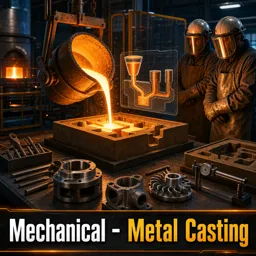
Duration of the online course: 30 hours and 34 minutes
4.7


(91)
Build job-ready metal casting skills with this free online course—learn sand moulding, gating and riser design, defects, and quality control to boost manufacturing know-how.
Metal casting is one of the most important foundations of modern manufacturing, turning molten metal into components that power vehicles, machines, construction systems, and everyday products. This free online course develops practical, industry-relevant understanding of how cast parts are planned, produced, and verified—from the first idea of a component through mould preparation, pouring, solidification, and finishing. If you want a strong start in mechanical and industrial basics, or you work alongside foundry, machining, or production teams and need clearer technical confidence, this course helps you speak the language of casting and make better engineering decisions.
You will learn how different casting routes compare and why process selection matters for cost, accuracy, surface finish, and production volume. The course builds core competence in sand casting by explaining terminology, tooling, and how moulding sands are designed, tested, and controlled for performance. You will also explore patterns, allowances, and the role of cores in creating internal features, linking design choices to real outcomes on the shop floor.
As the course progresses, you gain a solid grasp of gating and risering concepts that directly influence yield and soundness. You will understand how metal flows into the cavity, how feeding combats shrinkage, and how efficiency considerations affect both quality and economics. Common casting defects are treated as engineering problems: you will learn how they form, how to recognize them, and what process and design adjustments help prevent them.
You will also connect materials and process behavior through topics like melting furnaces, molten metal treatment, fluidity, nucleation, and solidification. The course surveys major cast alloys—cast irons and steels, aluminum and magnesium alloys, and copper, zinc, and titanium systems—so you can appreciate why specific alloys are developed and what trade-offs drive their selection. Beyond sand casting, you will understand the principles and applications of die casting, investment casting, continuous casting, centrifugal casting, evaporative pattern casting, plaster moulding, vacuum sealed moulding, and squeeze casting.
Finally, the course emphasizes what happens after pouring: shakeout, fettling, finishing, inspection, testing, and quality control, along with design considerations, economic thinking, and essential environment, health, and safety practices. By the end, you will be able to follow a casting workflow end to end, communicate more effectively with production teams, and evaluate casting choices with clearer technical reasoning.

30 hours and 34 minutes of online video course

Digital certificate of course completion (Free)

Exercises to train your knowledge

100% free, from content to certificate
What is the difference between a gating system and a riser in metal casting?
A gating system delivers molten metal into the mould cavity, while a riser supplies extra molten metal during solidification to compensate for shrinkage.
What are cores used for in sand casting?
Cores create internal holes, cavities, and complex passageways that cannot be formed by the main mould alone.
How does pressure die casting differ from gravity die casting?
Gravity die casting fills the die using gravity, whereas pressure die casting injects molten metal into the die under high pressure.
Ready to get started?Download the app and get started today.
Install the app now
to access the course
Over 5,000 free courses
Programming, English, Digital Marketing and much more! Learn whatever you want, for free.

Study plan with AI
Our app's Artificial Intelligence can create a study schedule for the course you choose.

From zero to professional success
Improve your resume with our free Certificate and then use our Artificial Intelligence to find your dream job.
You can also use the QR Code or the links below.



Free CourseAerospace Engineering
5
(4)

17h32m

20 exercises
Free CourseFluid Mechanics
5
(3)
23h09m
16 exercises
Free CourseManagement - Business Analysis for Engineers
4.8
(84)
31h13m
29 exercises

Free CourseElectric Vehicles Fundamentals: EV Technology, Batteries, Motors, Charging and Economics
4.8
(4)
33h11m
39 exercises
Free CoursePrinciple of industrial engineering
4.7
(7)
32h27m
33 exercises
Free CourseDynamics course for Engineering
4.7
(3)
28h05m
30 exercises
Free CourseMechanical - Fluid Mechanics
4.6
(63)
41h57m
32 exercises
Free CourseEngineering Mechanics
4.6
(7)
40h32m
5 exercises

Free CourseRobotics and control
4.5
(4)
21h37m
31 exercises
Free CourseEngineering Dynamics
4.5
(4)
39h59m
20 exercises
Carry knowledge in your pocket.
Download the Cursa app.
There are hundreds of free courses available, with a free certificate of completion that is saved in your mobile image gallery.
Download the app to access the Course Completion Certificate for Free.


+ 10 million
students

Free and Valid
Certificate

60 thousand free
exercises

4.8/5 rating in
app stores

Free courses in
video and ebooks
Course comments: Mechanical - Metal Casting
Clementinah Nkhabanyane
best course I did today
Kushal Sharma
Best course