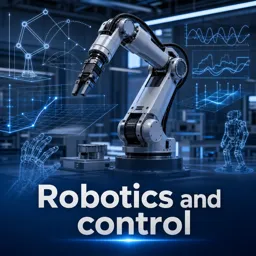
Free Course Image Robotics and control

Free online courseRobotics and control

Duration of the online course: 21 hours and 37 minutes

4.5

StarStarStarStarHalf star

(4)

Learn robotics and control with this comprehensive free online course by IIT Roorkee. Explore kinematics, dynamics, manipulator control, and neural network-based control.

In this free course, learn about

  • Introduction to Robotics and Course Overview
  • Robot Kinematics and Coordinate Transformations
  • Jacobian, Trajectory Planning, and Manipulator Dynamics
  • Stability and Control of Robot Manipulators
  • Biped Robotics and Zero Moment Point
  • Neural Networks and Learning-Based Manipulator Control
  • Redundancy Resolution and Manipulability Analysis
  • Robotic Exoskeletons and Hand Exoskeleton Control
  • Robot-Assisted Percutaneous Interventions and Sliding Mode Control
  • Smart Needles and Flexible Link Kinematics
  • Model-Based Control and Simulation of Robot Manipulators

Course Description

The course titled "Robotics and Control" spans a comprehensive duration of 21 hours and 37 minutes, making it a robust educational experience. As part of the Professional Courses category, situated within the subcategory of Engineering and Mechanics, this program stands as a paramount resource for anyone aiming to dive deep into the world of robotics and control systems.

This meticulously designed course begins with an insightful promo, "Robotics and Control: Theory and Practice," laying the foundation for what's to come. The opening lecture, aptly named "Introduction," sets the stage by familiarizing learners with the key concepts and scope of the course. Subsequent lectures cover essential topics like "Coordinate Frames and Homogeneous Transformations," split into two insightful segments, followed by "Differential Transformations" which delve into the intricacies of converting differential changes between coordinate frames.

Moving forward, the course meticulously examines the "Kinematic Model for Robot Manipulator," allowing learners to understand the fundamentals of robotic movements. Detailed lectures on "Direct Kinematics" and "Inverse Kinematics" provide a dual perspective on calculating the position and orientation of the robot's end-effector. The focus then shifts to the "Manipulator Jacobian" which explores both theoretical and practical examples, ensuring a thorough grasp of the concept.

One cannot overstate the significance of "Trajectory Planning" and the "Dynamics of Manipulator" lectures, the latter extended into multiple sessions to cover both single and multiple degrees of freedom. These lectures pave the way for understanding the "Stability of Dynamical Systems" and various aspects of "Manipulator Control."

In an exciting shift, the course introduces the "Biped Robot Basics," progressing through advanced topics like the "Flat Foot Biped Model" and its extension to the "Toe Foot Model." This foundational knowledge prepares learners for the intricate workings of "Artificial Neural Networks" and how these networks are applied to "Neural Network based control for Robot Manipulator."

The course doesn't stop at traditional robotics but also delves into specialized topics like "Redundancy Resolution of Human Fingers in Cooperative Object Translation" and the "Fundamentals of Robot Manipulability." These segments afford a deeper understanding of human-robot interaction.

A distinct section of the course is dedicated to "Robotic Exoskeletons." It begins with an introduction and delves into the design and development of exoskeletons, particularly focusing on a three-finger model. Subsequent lectures cover the "Force Control of an Index Finger Exoskeleton" and "Neural Control based on Human Subject Intention," showcasing cutting-edge advancements in this field.

The course further expands into "Robot Assisted Percutaneous Interventions," examining real-world applications through experimental insights. This includes a focus on "Smart Needles" and various control modes like "Sliding Mode Control" and "Higher Order Sliding Mode Control."

To round off this comprehensive program, learners are introduced to "Flexible Link Kinematics" and their practical applications in the "Model Based Control of Robot Manipulator." The final lecture on the "Simulation of Robot Manipulators" integrates theoretical knowledge with practical, hands-on simulation experiences, providing a holistic understanding of robotics and control systems.

This course promises a thorough academic journey into the universe of robotics and control, though it awaits its first review. Those who embark on this journey can expect to gain not only theoretical insights but also practical skills that are highly valued in the field of engineering and mechanics.

Course content

  • Video class: Promo: Robotics and Control: Theory and Practice 02m
  • Exercise: Which topic is NOT covered in the first part of the 'Robotics and Control' course offered by IIT Roorkee?
  • Video class: Lecture 01: Introduction 43m
  • Exercise: What is Denavit-Hartenberg (DH) Algorithm used for in robotics?
  • Video class: Lecture 02: Coordinate Frames and Homogeneous Transformations-I 35m
  • Exercise: Which of the following is a correct statement about rotation matrices in the context of coordinate frames in robotics?
  • Video class: Lecture 03: Coordinate Frames and Homogeneous Frames-II 31m
  • Exercise: What is a general rotation matrix used for?
  • Video class: Lecture 04: Differential Transformations 34m
  • Exercise: What is the purpose of differential transformations in the context of coordinate frames in robotics?
  • Video class: Lecture 05: Transforming Differential Changes between Coordinate Frames 30m
  • Exercise: What is the practical use of transforming differential changes between two coordinate frames?
  • Video class: Lecture 06: Kinematic Model for Robot Manipulator 30m
  • Exercise: What is the main purpose of assigning coordinate frames at every joint of a robot manipulator?
  • Video class: Lecture 07: Direct Kinematics 33m
  • Exercise: Which of the following are joint types in the robotic manipulator example discussed?
  • Video class: Lecture 08: Inverse Kinematics 29m
  • Exercise: What is the result of dividing the r_3_2 term by the r_3_1 term in the kinematics equations for a 4-axis robot manipulator?
  • Video class: Lecture 09: Manipulator Jacobian 25m
  • Exercise: What is the primary purpose of the Jacobian matrix in robot manipulators?
  • Video class: Lecture 10: Manipulator Jacobian Example 25m
  • Exercise: Which joints are prismatic in the described robot manipulator?
  • Video class: Lecture 11: Trajectory Planning 26m
  • Exercise: What is the key difference between a path and a trajectory in robot manipulators?
  • Video class: Lecture 12: Dynamics of Manipulator 31m
  • Exercise: Which of the following best describes the Lagrangian (L) in the context of dynamics equations for robot manipulators?
  • Video class: Lecture 13: Dynamics of Manipulator (cont.) 32m
  • Exercise: What equation is used to formulate the dynamics of a two-arm manipulator with uniformly distributed mass?
  • Video class: Lecture 14: Manipulator Dynamics Multiple Degree of Freedom 31m
  • Exercise: What does the term 'n degree of freedom manipulator' refer to in robotic systems?
  • Video class: Lecture 15: Stability of Dynamical System 40m
  • Exercise: What is NOT true about autonomous and non-autonomous systems?
  • Video class: Lecture 16: Manipulator Control 34m
  • Exercise: Which equation represents the classical dynamical model of a robot manipulator?
  • Video class: Lecture 17: Biped Robot Basics and Flat Foot Biped Model 34m
  • Exercise: What is the ZMP in relation to biped robots?
  • Video class: Lecture 18: Biped Robot Flat Foot and Toe Foot Model 42m
  • Exercise: What is the importance of the Zero Moment Point (ZMP) in the context of biped robot stability?
  • Video class: Lecture 19: Artificial Neural Network 34m
  • Exercise: What is a primary function of a neural network in robotics?
  • Video class: Lecture 20: Neural Network based control for Robot Manipulator 38m
  • Exercise: Which statement about neural network-based controllers for robot manipulators is true?
  • Video class: Lecture 21: Redundancy Resolution of Human Fingers in Cooperative Object Translation-I 31m
  • Video class: Lecture 22: Redundancy Resolution of Human Fingers in Cooperative Object Translation-II 26m
  • Exercise: In cooperative object translation motion of the human fingers, what parameter did the research study find to vary both in sign and magnitude across different subjects?
  • Video class: Lecture 23: Fundamentals of Robot Manipulability 26m
  • Video class: Lecture 24: Manipulability Analysis of Human Fingers in Cooperative Rotational Motion. 28m
  • Exercise: What does the manipulability measure represent in the study of the human digits' manipulability analysis in cooperative rotational motion?
  • Video class: Lecture 25: Robotic Exoskeletons: An Introduction 29m
  • Video class: Lecture 26: Introduction to Robotic Hand Exoskeleton 34m
  • Exercise: What is the primary function of a hand exoskeleton?
  • Video class: Lecture 27: Design and Development of a Three Finger Exoskeleton 32m
  • Video class: Lecture 28: Force Control of an Index Finger Exoskeleton 30m
  • Exercise: Which kinematic model of a robotic system is specifically discussed in the lecture?
  • Video class: Lecture 29: Neural Control of a Hand Exoskeleton 30m
  • Video class: Lecture 30: Neural Control of a Hand Exoskeleton Based on Human Subject Intention. 27m
  • Exercise: What is the purpose of developing a learning scheme using surface EMG and EEG signals in the context of neural control for hand exoskeletons?
  • Video class: Lecture 31: Robot Assisted Percutaneous Interventions 30m
  • Video class: Lecture 32: Experiments on Robot Assisted Percutaneous Interventions 32m
  • Exercise: What are the three loops of control strategies discussed in the robot-assisted needling system?
  • Video class: Lecture 33: Sliding Mode Control 28m
  • Video class: Lecture 34: Higher Order Sliding Mode Control 35m
  • Exercise: What is the primary objective of the higher order sliding mode control in percutaneous interventions using a bevel tip needle?
  • Video class: Lecture 36: Smart Needles for Percutaneous Interventions-II 28m
  • Video class: Lecture 35: Smart Needles for Percutaneous Interventions-I 30m
  • Exercise: Which component is NOT typically used as an actuator in smart needles?
  • Video class: Lecture 37: Flexible Link Kinematics-I 36m
  • Video class: Lecture 38: Flexible Link Kinematics-II 36m
  • Exercise: Which of the following boundary condition combinations corresponds to Case 3 for a 2-link planar flexible manipulator as described in the lecture?
  • Video class: Lecture 39: Model Based Control of Robot Manipulator 33m
  • Video class: Lecture 40: Simulation of Robot Manipulators 39m
  • Exercise: Which of the following is a primary sub task of a redundant manipulator in the context of inverse kinematics?

This free course includes:

21 hours and 37 minutes of online video course

Digital certificate of course completion (Free)

Exercises to train your knowledge

100% free, from content to certificate

Ready to get started?Download the app and get started today.

Install the app now

to access the course
Icon representing technology and business courses

Over 5,000 free courses

Programming, English, Digital Marketing and much more! Learn whatever you want, for free.

Calendar icon with target representing study planning

Study plan with AI

Our app's Artificial Intelligence can create a study schedule for the course you choose.

Professional icon representing career and business

From zero to professional success

Improve your resume with our free Certificate and then use our Artificial Intelligence to find your dream job.

You can also use the QR Code or the links below.

QR Code - Download Cursa - Online Courses

More free courses at Engineering and Mechanics

Download the App now to have access to + 3300 free courses, exercises, certificates and lots of content without paying anything!

  • 100% free online courses from start to finish

    Thousands of online courses in video, ebooks and audiobooks.

  • More than 48 thousand free exercises

    To test your knowledge during online courses

  • Valid free Digital Certificate with QR Code

    Generated directly from your cell phone's photo gallery and sent to your email

Cursa app on the ebook screen, the video course screen and the course exercises screen, plus the course completion certificate

+ 9 million
students

Free and Valid
Certificate

60 thousand free
exercises

4.8/5 rating in
app stores

Free courses in
video and ebooks