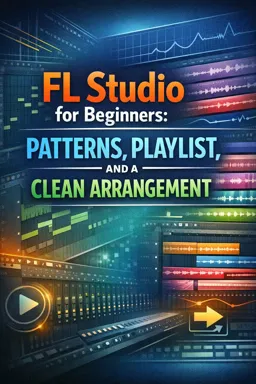
Use the Channel Rack step sequencer to program drum hits, then place the finished patterns on tracks in the Playlist to build an arrangement.

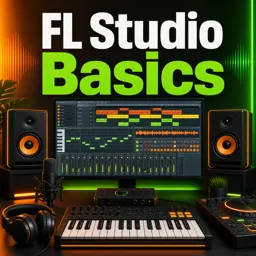
Duration of the online course: 2 hours and 15 minutes
New
Create beats and full songs faster with this free FL Studio course—learn drums, MIDI, mixing, automation, sampling, and mastering basics from day one.
Turn ideas into finished tracks with a practical introduction to FL Studio designed for anyone starting in music production. In this free online course, you will learn to navigate the program with confidence, so the interface stops feeling overwhelming and starts feeling like a creative playground. From the first sessions, the focus is on building real workflow habits: understanding what each main window does, how patterns become an arrangement, and how to move smoothly from sketching a beat to shaping a complete song.
You will develop core production skills by creating drum patterns in the Channel Rack, writing musical parts in the Piano Roll, and building chord progressions with tools that help you make harmonically solid choices even if music theory is not your strength yet. As you arrange in the Playlist, you will learn how to place and reuse your patterns intentionally, turning loops into sections that evolve. Along the way, you will explore how dynamics and movement are created through automation, and how effects can be used creatively to add energy, depth, and character without losing control of the mix.
The course also helps you step beyond programming by introducing MIDI controllers and recording techniques that make performances feel more human. You will learn how to capture MIDI cleanly, tighten timing with quantizing, and reduce common friction such as latency so playing instruments into FL Studio feels responsive. When you are ready to work with audio, you will practice recording directly into your project, handling multiple takes during loop recording, and using sampling tools to slice, tune, and transform recordings into custom sounds that fit your track.
Finally, you will build a foundation in mixing and mastering concepts that translate beyond any single project. You will practice organizing signals through the Mixer, balancing level and stereo placement, and making EQ and compression choices that clarify your sound rather than complicate it. You will also understand the goal of mastering and the importance of preparing a mix before that final stage, so your finished export translates better across speakers and headphones. By the end, you will not only know where things are in FL Studio, but how to keep improving through consistent practice, exploring advanced features gradually, and developing a workflow that supports your musical identity.

2 hours and 15 minutes of online video course

Digital certificate of course completion (Free)

Exercises to train your knowledge

100% free, from content to certificate
How do you create drum patterns and arrange them in FL Studio?
Use the Channel Rack step sequencer to program drum hits, then place the finished patterns on tracks in the Playlist to build an arrangement.
How can I record MIDI in FL Studio without timing problems?
Set up and enable your MIDI controller, reduce buffer-related latency if needed, record with the metronome, and quantize notes to tighten timing.
What FL Studio tools are covered for mixing and mastering a song?
The course covers mixer level and panning control, EQ visualization, compression, automation, stereo balance, and mastering practices such as multiband compression.
Ready to get started?Download the app and get started today.
Install the app now
to access the course
Over 5,000 free courses
Programming, English, Digital Marketing and much more! Learn whatever you want, for free.

Study plan with AI
Our app's Artificial Intelligence can create a study schedule for the course you choose.

From zero to professional success
Improve your resume with our free Certificate and then use our Artificial Intelligence to find your dream job.
You can also use the QR Code or the links below.



Free CourseFree Online DJ Course
5

(1)

2h44m

6 exercises
Free CourseTransitions for Beginner DJ
5
(1)
4h45m
20 exercises
Free CourseHow to DJ for complete beginners
5
(2)
1h59m
13 exercises
Free CourseHow to DJ guide for beginners DJ Phil Harris
5
(1)
2h38m
6 exercises
Free CourseUK-Drill Music Production tutorial
5
(1)
54m
6 exercises
Free CourseFL Studio for Complete Beginners
5
(2)
47m
6 exercises
Free CourseMusic Video production
4.7

(3)
19m
4 exercises
Free CourseLearn Songwriting in 1 Hour
4
(1)
53m
6 exercises
Free CourseAbleton Live 10 Complete Production and Mixing Masterclass
New
20h19m
29 exercises
Free CourseIntroduction to Ableton Live
New
3h07m
28 exercises
Carry knowledge in your pocket.
Download the Cursa app.
There are hundreds of free courses available, with a free certificate of completion that is saved in your mobile image gallery.
Download the app to access the Course Completion Certificate for Free.


+ 10 million
students

Free and Valid
Certificate

60 thousand free
exercises

4.8/5 rating in
app stores

Free courses in
video and ebooks