A deceptive cadence avoids the expected resolution from the dominant chord to the tonic, often moving instead to another chord such as vi.

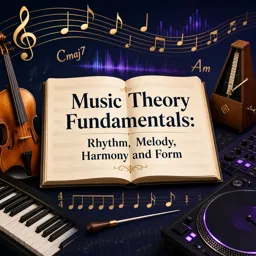
Duration of the online course: 18 hours and 17 minutes
New
Train your ear and build real music skills with this free online course on rhythm, melody, harmony and form—ideal for producers, DJs and creators.
Strong tracks and confident performances start with understanding what you hear. This free online course gives you a clear, practical foundation in music theory, helping you make sense of rhythm, melody, harmony and form in ways you can immediately apply to music production and DJ work. Instead of treating theory as abstract rules, you’ll learn to recognize patterns, predict what comes next, and make intentional creative choices—whether you’re building a beat, shaping a hook, arranging a drop, or refining transitions.
You’ll sharpen rhythmic awareness from basic note values to common groove concepts, including the kinds of timing ideas that show up across jazz, pop and classical traditions. From there, the focus shifts to melody: how scales and musical motion create character, why melodies often sit where they do in a texture, and how composers and songwriters use tension and release to keep listeners engaged. As your ear develops, harmony becomes more approachable—chords stop being mysterious blocks and start sounding like tools you can select, build, and move with purpose.
The course also trains you to hear form, the large-scale structure that makes a piece feel coherent. You’ll learn to identify recurring sections, contrast, variation, and returning themes—skills that translate directly to arranging full-length songs and sets. Along the way, you’ll encounter a wide range of styles and musical eras, building the ability to recognize what defines a sound world quickly and accurately. This broader listening perspective helps you borrow techniques across genres, enrich your influences, and talk about music with greater clarity when collaborating.
With short checks for understanding embedded throughout, you’ll steadily reinforce key ideas without being overwhelmed. By the end, you won’t just know terms—you’ll listen differently, make faster creative decisions, and have a stronger vocabulary for shaping musical energy, emotion and direction.

18 hours and 17 minutes of online video course

Digital certificate of course completion (Free)

Exercises to train your knowledge

100% free, from content to certificate
What is the difference between a deceptive cadence and a regular authentic cadence?
A deceptive cadence avoids the expected resolution from the dominant chord to the tonic, often moving instead to another chord such as vi.
How does rondo form work in classical music?
Rondo form repeatedly returns to a main refrain between contrasting episodes, commonly following patterns such as ABACA.
What is an ostinato in music production and composition?
An ostinato is a short rhythmic, melodic, or harmonic pattern repeated persistently throughout part or all of a piece.
Ready to get started?Download the app and get started today.
Install the app now
to access the course
Over 5,000 free courses
Programming, English, Digital Marketing and much more! Learn whatever you want, for free.

Study plan with AI
Our app's Artificial Intelligence can create a study schedule for the course you choose.

From zero to professional success
Improve your resume with our free Certificate and then use our Artificial Intelligence to find your dream job.
You can also use the QR Code or the links below.




Free CourseFree Online DJ Course
5

(1)

2h44m

6 exercises
Free CourseTransitions for Beginner DJ
5
(1)
4h45m
20 exercises
Free CourseHow to DJ for complete beginners
5
(2)
1h59m
13 exercises
Free CourseHow to DJ guide for beginners DJ Phil Harris
5
(1)
2h38m
6 exercises
Free CourseUK-Drill Music Production tutorial
5
(1)
54m
6 exercises
Free CourseFL Studio for Complete Beginners
5
(2)
47m
6 exercises

Free CourseMusic Video production
4.7

(3)
19m
4 exercises

Free CourseLearn Songwriting in 1 Hour
4
(1)
53m
6 exercises
Free CourseAbleton Live 10 Complete Production and Mixing Masterclass
New
20h19m
29 exercises
Free CourseIntroduction to Ableton Live
New
3h07m
28 exercises
Carry knowledge in your pocket.
Download the Cursa app.
There are hundreds of free courses available, with a free certificate of completion that is saved in your mobile image gallery.
Download the app to access the Course Completion Certificate for Free.


+ 10 million
students

Free and Valid
Certificate

60 thousand free
exercises

4.8/5 rating in
app stores

Free courses in
video and ebooks