Panning moves the camera horizontally, tilting moves it vertically, and zooming changes the lens focal length to narrow attention or reveal more of a scene.

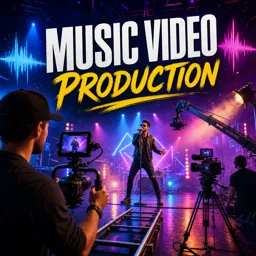
Duration of the online course: 19 minutes
5

(1)
Shoot pro music videos with cinematic camera moves in this free online course—master pans, tilts, dolly, jib and gimbal shots, plus a certificate option.
Great music videos do more than match a beat—they guide the viewer’s eye, shape emotion, and elevate an artist’s presence. This free online course helps you build that visual control by focusing on the camera movements that define modern music video style. Instead of relying on chance or copying trends, you’ll learn how intentional motion creates energy, emphasis, and story, even in a simple performance setup.
You’ll explore practical techniques that filmmakers and creators use to direct attention: smooth panning and tilting to follow action, purposeful zoom choices to reveal a space or highlight a detail, and movement patterns that add rhythm without distracting from the music. By understanding what each move communicates, you’ll be able to plan shots that feel motivated and dynamic rather than random.
The course also dives into production tools that unlock cinematic motion on tighter budgets. You’ll learn when a dolly shot is the right choice for controlled, dramatic movement, how parallax can add depth and visual impact, and why a jib can transform a scene with sweeping angles that a tripod can’t achieve. You’ll also get clarity on what a gimbal is primarily used for and how it helps you capture stable, fluid motion while walking, tracking performers, or moving through a location.
Throughout, the emphasis is on decision-making: choosing the right movement for the moment, anticipating how motion will affect mood, and designing shots that support performance, choreography, or narrative elements. Whether you’re an aspiring music video director, a musician creating content, or a producer expanding into video, you’ll leave with a stronger technical foundation and the creative confidence to shoot footage that looks intentional, polished, and ready for editing into a compelling final cut.

19 minutes of online video course

Digital certificate of course completion (Free)

Exercises to train your knowledge

100% free, from content to certificate
What is the difference between panning, tilting, and zooming in a music video?
Panning moves the camera horizontally, tilting moves it vertically, and zooming changes the lens focal length to narrow attention or reveal more of a scene.
Why use a dolly shot in music video production?
A dolly physically moves the camera through space, creating smooth motion, depth, and parallax between foreground and background elements.
What is a gimbal used for when filming a music video?
A gimbal stabilizes the camera during handheld or moving shots, helping create smooth footage while the operator walks or follows performers.
Ready to get started?Download the app and get started today.
Install the app now
to access the course
Over 5,000 free courses
Programming, English, Digital Marketing and much more! Learn whatever you want, for free.

Study plan with AI
Our app's Artificial Intelligence can create a study schedule for the course you choose.

From zero to professional success
Improve your resume with our free Certificate and then use our Artificial Intelligence to find your dream job.
You can also use the QR Code or the links below.




Free CourseFree Online DJ Course
5
(1)

2h44m

6 exercises
Free CourseTransitions for Beginner DJ
5
(1)
4h45m
20 exercises
Free CourseHow to DJ for complete beginners
5
(2)
1h59m
13 exercises
Free CourseHow to DJ guide for beginners DJ Phil Harris
5
(1)
2h38m
6 exercises
Free CourseUK-Drill Music Production tutorial
5
(1)
54m
6 exercises
Free CourseFL Studio for Complete Beginners
5
(2)
47m
6 exercises

Free CourseLearn Songwriting in 1 Hour
4
(1)
53m
6 exercises
Free CourseAbleton Live 10 Complete Production and Mixing Masterclass
New
20h19m
29 exercises
Free CourseIntroduction to Ableton Live
New
3h07m
28 exercises
Free CourseMusic Theory Fundamentals: Rhythm, Melody, Harmony and Form
New
18h17m
20 exercises
Carry knowledge in your pocket.
Download the Cursa app.
There are hundreds of free courses available, with a free certificate of completion that is saved in your mobile image gallery.
Download the app to access the Course Completion Certificate for Free.


+ 10 million
students

Free and Valid
Certificate

60 thousand free
exercises

4.8/5 rating in
app stores

Free courses in
video and ebooks