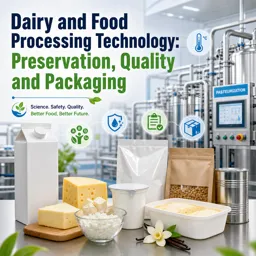
Free Course Image Dairy and Food Processing Technology: Preservation, Quality and Packaging

Free online courseDairy and Food Processing Technology: Preservation, Quality and Packaging

Duration of the online course: 31 hours and 3 minutes

5

StarStarStarStarStar

(1)

Free course on dairy and food processing: preservation, quality, laws, milk science, pasteurization, packaging, and product tech like cheese and ice cream.

In this free course, learn about

  • Course Orientation and Fundamentals of Food and Nutrition
  • Food Storage, Preservation, Additives, and Quality
  • Emerging Food Processing Technologies and Food Regulatory Framework
  • Milk Fundamentals: Properties and Composition Overview
  • Milk Fat: Structure and Properties
  • Proteins and Amino Acids in Milk
  • Milk Carbohydrates, Bioactives, and Enzymes
  • Milk Spoilage, Microbial Growth Factors, and Packaging Basics
  • Milk Pasteurization, Heat Treatment Kinetics, and Unit Operations
  • Market Milk Types and New Dairy Technologies
  • Dairy Products: Cheese and Ice Cream Processing
  • Packaging Systems and Product Manufacturing Flow Charts

Course Description

Learn how dairy and food processing keeps products safe, nutritious, and appealing from farm to fork. Dairy and Food Processing Technology: Preservation, Quality and Packaging is a free online course that connects food science fundamentals with real-world processing decisions in nutrition and health contexts.

Explore what food and nutrients are, how nutritional value is assessed, and how storage conditions influence quality. Understand major preservation approaches, the role of temperature in stability, and how additives are used to support safety and shelf life while maintaining consumer expectations.

Build a clear foundation in quality concepts and emerging processing technologies, then move into the regulatory landscape with food laws, standards, hygiene practices, and essential controls used in industry.

Go deep into milk as a complex raw material by studying physico-chemical properties and key constituents. Follow detailed coverage of milk fat, proteins and amino acids, casein micelles, whey proteins, lactoferrin, carbohydrates, enzymes, and the factors that drive chemical and microbial spoilage.

Strengthen your understanding of dairy operations and packaging by learning pasteurization principles, thermal death time, effectiveness checks, homogenization, centrifugation, and market milk types. Expand into product processing with practical insight into cheese and ice cream manufacturing, mix calculations, cold-chain transportation, and modern packaging systems including modified atmosphere packaging.

Ideal for learners seeking a structured introduction to preservation, quality assurance, and packaging in dairy and food processing, with a strong focus on safety, standards, and applied technology.

Course content

  • Video class: Lecture 1 : Preamble of the Subject 30m
  • Exercise: Why is processing (e.g., boiling) and proper storage important for milk safety and quality, especially in summer?
  • Video class: Lecture 2 : What is Food and Nutrients 35m
  • Video class: Lecture 3 : Nutritional Value of the Nutrients 31m
  • Exercise: Which statement correctly describes pasteurization of milk and how it affects storage?
  • Video class: Lecture 4 : Best Way of Storage of Food Materials 29m
  • Video class: Lecture 5 : Preservation Techniques 31m
  • Exercise: Which parameter is commonly used to evaluate whether blanching has been accomplished effectively?
  • Video class: Lecture 6 : Temperature Quotient and Its Impact 41m
  • Video class: Lecture 7 : Food Additives 29m
  • Exercise: Which statement best defines a food additive?
  • Video class: Lecture 8 : Quality of Food 32m
  • Video class: Lecture 9 : Quality of Food (Contd.) 29m
  • Exercise: In Texture Profile Analysis (TPA), what is cohesiveness?
  • Video class: Lecture 10 : Emerging Technology 29m
  • Video class: Lecture 11 : Emerging Technology (Contd.) 29m
  • Exercise: In high-voltage electric pulse (electroporation) treatment, what is the primary mechanism by which vegetative microbial cells are inactivated?
  • Video class: Lecture 12 : Food Laws - Why? 29m
  • Video class: Lecture 13 : Food Laws of India 29m
  • Exercise: Which option best states the primary purposes of FSSAI?
  • Video class: Lecture 14 : Standards in India 30m
  • Video class: Lecture 15 : Hygiene and Other Controls in India 31m
  • Exercise: Which of the following is a minimum hygiene-related requirement laid down by the Food Products Order (FPO) to maintain hygienic production and quality standards?
  • Video class: Lecture 16 : Physico-Chemical Properties of Milk 31m
  • Video class: Lecture 17 : Milk - What is it 31m
  • Video class: Lecture 18 : Milk - How it looks? 32m
  • Video class: Lecture 19 : Milk - Constituents 30m
  • Exercise: Why is raw milk highly susceptible to microbial spoilage during storage at ambient conditions?
  • Video class: Lecture 20 : Constituents of Milk 33m
  • Video class: Lecture 21 : Milk Fat 34m
  • Video class: Lecture 22 : Milk Fat (Contd.) 31m
  • Video class: Lecture 23 : Milk Fat (Contd.) 28m
  • Exercise: Why does milk fat not have a single true melting point?
  • Video class: Lecture 24 : Milk Fat (Contd.) 30m
  • Video class: Lecture 25 : Protein 28m
  • Exercise: What is the basic building block of proteins?
  • Video class: Lecture 26 : Protein (Contd.) 30m
  • Video class: Lecture 27 : Amino Acids 28m
  • Exercise: Which bond is formed when the carboxyl group of one amino acid reacts with the amino group of another amino acid?
  • Video class: Lecture 28 : Amino Acids (Contd.) 33m
  • Video class: Lecture 29 : Milk Protein 29m
  • Exercise: Which casein fraction is described as the most hydrophobic among the caseins in milk?
  • Video class: Lecture 30 : Casein Micelle 31m
  • Video class: Lecture 31 : Whey Protein 31m
  • Exercise: At what temperature does whey protein typically denature, indicating poorer heat stability than casein?
  • Video class: Lecture 32 : Whey Protein (Contd.) 27m
  • Video class: Lecture 33 : Lactoferrin 29m
  • Video class: Lecture 34 : Carbohydrates in Milk 29m
  • Video class: Lecture 35 : Small Constituents of Milk 30m
  • Exercise: Which milk enzyme is commonly used to evaluate the effectiveness of pasteurization?
  • Video class: Lecture 36 : Enzymes in Milk 30m
  • Video class: Lecture 37 : Chemical and Microbial Spoilage of Milk and Milk Products 29m
  • Exercise: Which statement best describes intrinsic vs. extrinsic factors affecting microbial growth in foods like milk?
  • Video class: Lecture 38 : Extrinsic Factors for Microbial Growth 30m
  • Video class: Lecture 39 : Natural or Other Type of Spoilage 29m
  • Exercise: In milk spoilage, at what lactic acid acidity range does souring occur without curdling?
  • Video class: Lecture 40 : Packaging 30m
  • Video class: Lecture 41 : Milk Pasteurization 30m
  • Exercise: In milk pasteurization, what does the D-value (decimal reduction time) represent?
  • Video class: Lecture 42 : Thermal Death Time 27m
  • Video class: Lecture 43 : Pasteurization Effectiveness 30m
  • Exercise: Which result from the peroxidase test indicates that milk pasteurization has been effective?
  • Video class: Lecture 44 : Milk Pasteurization and Homogenization 30m
  • Video class: Lecture 45 : Milk Pasteurization and Homogenization (Contd.) 32m
  • Exercise: Why is milk chilling done before pasteurization in large-scale milk processing?
  • Video class: Lecture 46 : Milk Homogenization 30m
  • Video class: Lecture 47 : Milk Centrifugation 31m
  • Exercise: In a disc bowl centrifuge used for cream separation, which stream is collected near the inner outlet?
  • Video class: Lecture 48 : Types of Available Milk 30m
  • Video class: Lecture 49 : Types of Available Milk in the Market 30m
  • Exercise: Why does sweetened condensed milk generally not require sterilization?
  • Video class: Lecture 50 : New Technologies in Dairy Industries 32m
  • Video class: Lecture 51 : Cheese 29m
  • Exercise: Which statement best describes cheese by definition?
  • Video class: Lecture 52 : Chedder Cheese 30m
  • Video class: Lecture 53 : Ice Cream 30m
  • Exercise: Which ingredient is primarily added to ice cream to increase its volume (overrun)?
  • Video class: Lecture 54 : Process of Ice Cream Preparation 32m
  • Video class: Lecture 55 : Ice Cream Lolies 38m
  • Exercise: Why is a brine solution (rather than plain water) used in the tank for making ice cream lolies?
  • Video class: Lecture 56 : Over Run and Calculation for Preparing Ice Cream Mix 32m
  • Video class: Lecture 57 : Transportation of Ice Cream vis a vis Frozen Foods 32m
  • Exercise: What is the primary purpose of maintaining a cold chain (≈ −18°C or below) during transportation of ice cream and other frozen foods?
  • Video class: Lecture 58 : Packaging of Food Materials 31m
  • Video class: Lecture 59 : Modified Atmosphere Packaging 30m
  • Exercise: What is the main purpose of Modified Atmosphere Packaging (MAP) for fresh/perishable foods?
  • Video class: Lecture 60 : Flow Chart for Manufacturing Some Dairy and Food Products 31m

This free course includes:

31 hours and 3 minutes of online video course

Digital certificate of course completion (Free)

Exercises to train your knowledge

100% free, from content to certificate

Ready to get started?Download the app and get started today.

Install the app now

to access the course
Icon representing technology and business courses

Over 5,000 free courses

Programming, English, Digital Marketing and much more! Learn whatever you want, for free.

Calendar icon with target representing study planning

Study plan with AI

Our app's Artificial Intelligence can create a study schedule for the course you choose.

Professional icon representing career and business

From zero to professional success

Improve your resume with our free Certificate and then use our Artificial Intelligence to find your dream job.

You can also use the QR Code or the links below.

QR Code - Download Cursa - Online Courses

More free courses at Nutrition and weight loss

Free Ebook + Audiobooks! Learn by listening or reading!

Download the App now to have access to + 5000 free courses, exercises, certificates and lots of content without paying anything!

  • 100% free online courses from start to finish

    Thousands of online courses in video, ebooks and audiobooks.

  • More than 60 thousand free exercises

    To test your knowledge during online courses

  • Valid free Digital Certificate with QR Code

    Generated directly from your cell phone's photo gallery and sent to your email

Cursa app on the ebook screen, the video course screen and the course exercises screen, plus the course completion certificate