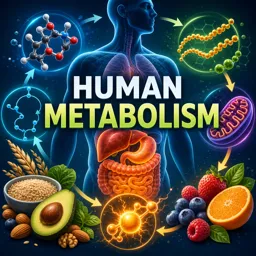
Free Course Image Human Metabolism

Free online course Human Metabolism

Duration of the online course: 14 hours and 23 minutes

5

StarStarStarStarStar

(1)

Master human metabolism to support smarter nutrition and weight-loss goals. Take this free online course and earn a certificate while learning energy pathways.

In this free course, learn about

  • Core steps, enzymes, and ATP/NADH yield of glycolysis
  • How GLUT transporters move glucose into cells and key correct properties
  • Regulation of glycolysis (PFK-1 control; allosteric and hormonal signals)
  • Transition (pyruvate oxidation): pyruvate -> acetyl-CoA via pyruvate dehydrogenase
  • Krebs cycle purpose, key steps, and role of citrate synthase
  • Where ETC occurs (inner mitochondrial membrane) and major complexes overview
  • How cytosolic NADH from glycolysis is shuttled into mitochondria aerobically
  • ATP synthase function and oxygen as the terminal electron acceptor in ETC
  • Glycogenesis vs glycogenolysis: fed vs fasting states and major enzymes
  • Glycogen phosphorylase role and muscle deficiency causing McArdle disease
  • Gluconeogenesis purpose in fasting and its regulation (PFK-1 inhibition signals)
  • When fatty acid synthesis occurs and acetyl-CoA carboxylase makes malonyl-CoA
  • Basics of triglyceride synthesis requirements and triglyceride mobilization hormones
  • Beta-oxidation purpose and fatty acid activation to fatty acyl-CoA

About the free online course

Understanding metabolism changes the way you look at food, energy, and body weight. This free online course in Human Metabolism helps you connect what happens inside your cells with real-life outcomes like energy levels, athletic performance, fat storage, and sustainable weight management. Instead of relying on myths or oversimplified tips, you will build a clear picture of how the body processes carbohydrates and fats, how it makes and uses ATP, and how different metabolic states influence whether you store or mobilize fuel.

You will follow the major pathways that convert nutrients into usable energy, from early glucose processing through the stages that feed the mitochondria and power oxidative metabolism. Along the way, you will see why regulation matters just as much as the pathway itself: small changes in enzymes, hormones, or cellular signals can shift the body toward using glucose, preserving it, or creating it when supplies are low. These insights are essential for anyone interested in nutrition and weight loss, because the body is constantly deciding whether to burn, store, or rebuild fuel depending on demand and availability.

The course also explores how the body manages its energy reserves over time. You will gain a practical understanding of when the body builds glycogen, when it breaks it down, and how glucose can be produced when intake is insufficient. From there, you will dive into lipid metabolism, including how fatty acids are synthesized, how triglycerides are assembled and mobilized, and how beta-oxidation supports energy needs during fasting, exercise, or carbohydrate restriction. With a stronger grasp of these mechanisms, you can better interpret common situations such as post-meal energy shifts, fasting responses, and why different dietary patterns may feel different from person to person.

To reinforce learning, the course includes targeted questions that check your understanding of key steps, locations, and regulatory controls, helping you think like a health professional rather than memorizing isolated facts. By the end, you will have a coherent mental map of human energy metabolism that supports smarter choices, better communication of nutrition concepts, and a more evidence-informed approach to weight management. A certificate is available upon completion.

Course content

  • Video class: Metabolism | Glycolysis 34m
  • Exercise: Which of the following statements about GLUT transporters is correct?
  • Video class: Metabolism | Regulation of Glycolysis 29m
  • Exercise: Which of the following enzymes is primarily responsible for converting glucose to glucose-6-phosphate in the glycolytic pathway?
  • Video class: Metabolism | Transition Stage (Preparatory Phase) 06m
  • Exercise: During the transition step between glycolysis and the Krebs cycle, what happens to pyruvate under aerobic conditions?
  • Video class: Metabolism | Regulation of the Transition Stage 27m
  • Exercise: In the transition stage of metabolism, which enzyme complex is responsible for converting pyruvate into acetyl-CoA under aerobic conditions?
  • Video class: Metabolism | The Krebs Cycle 32m
  • Exercise: What is the primary role of citrate synthase in the Krebs cycle?
  • Video class: Metabolism | Electron Transport Chain: DETAILED | Part 1 29m
  • Exercise: In which part of the mitochondria does the electron transport chain occur?
  • Video class: Metabolism | Electron Transport Chain: DETAILED | Part 2 15m
  • Exercise: Which of the following best describes how NADH produced from glycolysis enters the mitochondria for involvement in the electron transport chain under aerobic conditions?
  • Video class: Metabolism | Electron Transport Chain: DETAILED | Part 3 20m
  • Exercise: What is the significance of ATP synthase in the electron transport chain?
  • Video class: Metabolism | Electron Transport Chain: Overview 31m
  • Exercise: What is the primary role of oxygen in the electron transport chain?
  • Video class: Metabolism | Glycogenesis 36m
  • Exercise: During which metabolic state does glycogenesis primarily occur?
  • Video class: Metabolism | Glycogenolysis 24m
  • Exercise: Which enzyme is primarily responsible for breaking the alpha 1-4 glycosidic bonds in glycogen during glycogenolysis?
  • Video class: Metabolism | Regulation of Glycogen Metabolism 30m
  • Exercise: Which of the following conditions results from a deficiency in the enzyme glycogen phosphorylase specifically in the muscles?
  • Video class: Metabolism | Gluconeogenesis 29m
  • Exercise: What is gluconeogenesis primarily responding to in the human body?
  • Video class: Metabolism | Regulation of Gluconeogenesis 23m
  • Exercise: Which of the following molecules is primarily responsible for the inhibition of phosphofructokinase-1 (PFK-1) during gluconeogenesis regulation?
  • Video class: Metabolism | Fatty Acid Synthesis: Part 1 21m
  • Exercise: When does fatty acid synthesis primarily occur in the body?
  • Video class: Metabolism | Fatty Acid Synthesis: Part 2 (Updated) 37m
  • Exercise: Which enzyme is responsible for converting acetyl-CoA into malonyl-CoA during fatty acid synthesis?
  • Video class: Metabolism | Triglyceride Synthesis 20m
  • Exercise: What is the primary component required for triglyceride synthesis?
  • Video class: Metabolism | Mobilization of Triglycerides 20m
  • Exercise: What hormone is released when blood glucose levels are low?
  • Video class: Metabolism | Fatty Acid Oxidation: Part 1 29m
  • Exercise: What is the primary purpose of beta-oxidation in the human body?
  • Video class: Metabolism | Fatty Acid Oxidation: Part 2 37m
  • Exercise: Which enzyme involved in fatty acid oxidation is responsible for adding a coenzyme A to a fatty acid, converting it into fatty acyl-CoA?
  • Video class: Metabolism | Amino Acid Metabolism 27m
  • Exercise: In the process of amino acid metabolism, what is the primary role of transaminase enzymes?
  • Video class: Metabolism | Urea Cycle 19m
  • Exercise: What is the primary reason ammonia is considered toxic in the human body?
  • Video class: Metabolism | Ketone Metabolism 31m
  • Exercise: Under which condition is the body most likely to utilize ketone bodies as a source of energy?
  • Video class: Metabolism | Pentose Phosphate Pathway 34m
  • Exercise: Which of the following statements about the pentose phosphate pathway is true?
  • Video class: Metabolism | Regulation of Pentose Phosphate Pathway 33m
  • Exercise: What regulatory condition favors the use of the pentose phosphate pathway over glycolysis?
  • Video class: Metabolism | The Metabolic Map: Carbohydrates 11m
  • Exercise: What process describes the conversion of glucose into glycogen during a fed state for storage?
  • Video class: Metabolism | The Metabolic Map: Lipids 14m
  • Exercise: What process describes the breakdown of triglycerides into glycerol and fatty acids in the body?
  • Video class: Metabolism | The Metabolic Map: Proteins 18m
  • Exercise: What is the process called when an amine group from an amino acid is transferred to a keto acid, resulting in the formation of a new amino acid and a new keto acid?
  • Video class: Metabolism | Cholesterol Metabolism 28m
  • Exercise: What is the primary function of HMG-CoA reductase in cholesterol synthesis?
  • Video class: Metabolism | Lipoprotein Metabolism | Chylomicrons, VLDL, IDL, LDL, 1h03m
  • Exercise: In the digestive process, bile salts play a crucial role in emulsifying fats. What property of bile salts makes them effective at emulsifying fats in the intestine?
  • Video class: Metabolism | Nucleotide Synthesis | Purine 44m
  • Exercise: What is the enzyme responsible for adding a phosphate group to ribose 5-phosphate to form phosphoribosyl pyrophosphate (PRPP) during nucleotide synthesis?

This free course includes:

Icon for learning via the audio course

14 hours and 23 minutes of online video course

Icon for the digital course completion certificate

Digital certificate of course completion (Free)

Icon for exercises to practice what you've learned

Exercises to train your knowledge

Icon for courses that are 100% free from start to finish

100% free, from content to certificate

What happens to pyruvate after glycolysis when oxygen is available?

Pyruvate enters the mitochondria and is converted to acetyl-CoA by the pyruvate dehydrogenase complex before entering the Krebs cycle.

Where does the electron transport chain occur, and what does oxygen do?

It occurs in the inner mitochondrial membrane. Oxygen is the final electron acceptor, forming water and enabling ATP production.

What is the difference between glycogenesis, glycogenolysis, and gluconeogenesis?

Glycogenesis stores glucose as glycogen, glycogenolysis releases glucose from glycogen, and gluconeogenesis makes new glucose from non-carbohydrate sources.

Ready to get started?Download the app and get started today.

Install the app now

to access the course
Icon representing technology and business courses

Over 5,000 free courses

Programming, English, Digital Marketing and much more! Learn whatever you want, for free.

Calendar icon with target representing study planning

Study plan with AI

Our app's Artificial Intelligence can create a study schedule for the course you choose.

Professional icon representing career and business

From zero to professional success

Improve your resume with our free Certificate and then use our Artificial Intelligence to find your dream job.

You can also use the QR Code or the links below.

QR Code - Download Cursa - Online Courses

Course comments: Human Metabolism

IA

ILIRJANA AGOLLI

StarStarStarStarStar

Oh Yeah I enjoying a lot. Very anazing presentations. This course was so beautiful and worthy. The questions were challenging me. So interesting !

IA

ILIRJANA AGOLLI

StarStarStarStarStar

Wonderful course

More free courses at Nutrition and weight loss

Free Ebook + Audiobooks! Learn by listening or reading!