Evaluate situs, cardiac position, atrioventricular connections, ventriculoarterial connections, and associated defects in a systematic sequence.

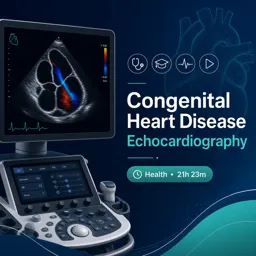
Duration of the online course: 21 hours and 23 minutes
New
Build confidence reading congenital heart echoes with this free online course and quizzes—master key views, Doppler clues, and clinical decision support fast.
Congenital heart disease can look overwhelming on echocardiography, especially when anatomy is complex and small details change clinical decisions. This free online course is designed to help you develop a reliable, repeatable way to evaluate congenital lesions using transthoracic echo and Doppler, so your reports become clearer, your measurements more consistent, and your interpretations easier to defend in real cases.
You will start by strengthening the foundation: how to approach segmental analysis in the right sequence and how to recognize normal echocardiographic anatomy from standard windows. From there, the course guides you through the practical reasoning that separates a quick scan from a high-quality congenital study: choosing the best view for a specific question, identifying what each window can and cannot show, and using color and spectral Doppler to determine hemodynamic significance rather than relying on impressions.
Across a broad range of congenital diagnoses, you will practice the echo clues that matter at the bedside and in the reading room. You will sharpen your ability to assess shunts, valve and outflow tract abnormalities, arch pathology, venous connections, coronary anomalies, and complex conotruncal conditions, while paying attention to pitfalls such as misleading 2D measurements, flow aliasing, and orientation-dependent color findings. Clinical scenarios emphasize not just recognition, but what the finding implies for physiology, urgency, and next steps in imaging.
The learning experience is reinforced with questions and exercises that test interpretation and decision-making, helping you transform passive watching into active mastery. Whether you are a trainee building a framework, a sonographer refining technique, or a clinician who needs faster pattern recognition, this course supports a more confident approach to congenital echocardiography and clearer communication within the multidisciplinary team. Complete the activities to validate your progress and strengthen your day-to-day performance in congenital echo assessment.

21 hours and 23 minutes of online video course

Digital certificate of course completion (Free)

Exercises to train your knowledge

100% free, from content to certificate
What is the correct sequence for segmental analysis in congenital heart disease echocardiography?
Evaluate situs, cardiac position, atrioventricular connections, ventriculoarterial connections, and associated defects in a systematic sequence.
Which echocardiographic view best assesses the SVC and IVC rims of a secundum atrial septal defect?
The subcostal bicaval view is primarily used to assess the superior vena cava and inferior vena cava rims.
What is the hallmark echocardiographic feature of transposition of the great arteries?
The aorta arises from the right ventricle and the pulmonary artery arises from the left ventricle, creating ventriculoarterial discordance.
Ready to get started?Download the app and get started today.
Install the app now
to access the course
Over 5,000 free courses
Programming, English, Digital Marketing and much more! Learn whatever you want, for free.

Study plan with AI
Our app's Artificial Intelligence can create a study schedule for the course you choose.

From zero to professional success
Improve your resume with our free Certificate and then use our Artificial Intelligence to find your dream job.
You can also use the QR Code or the links below.



Free CourseOphthalmology
5

(7)

4h22m

15 exercises
Free CourseNeurosurgery training
5
(2)
9h15m
13 exercises
Free CourseCadiology training
5
(5)
8h18m
14 exercises
Free CourseUltrasound Physics for Radiology: Fundamentals, Doppler and Artifacts
5
(2)
6h08m
24 exercises

Free CourseMicrobiology
4.7

(11)
8h26m
7 exercises
Free CourseNeuro Pathology
4.7
(3)
16h55m
18 exercises
Free CourseRenal Pathology
4.7
(3)
14h06m
11 exercises
Free CourseECG Interpretation and Clinical Application: Electrocardiogram Essentials
3.8
(4)
9h21m
20 exercises
Free CourseEmbryology
New
12h03m
19 exercises
Carry knowledge in your pocket.
Download the Cursa app.
There are hundreds of free courses available, with a free certificate of completion that is saved in your mobile image gallery.
Download the app to access the Course Completion Certificate for Free.


+ 10 million
students

Free and Valid
Certificate

60 thousand free
exercises

4.8/5 rating in
app stores

Free courses in
video and ebooks