It should produce a 10 mm vertical deflection, confirming standard gain calibration.

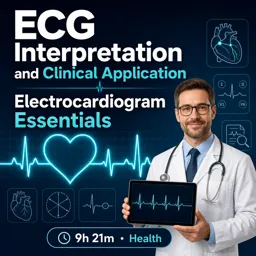
Duration of the online course: 9 hours and 21 minutes
New
Build confident ECG interpretation skills with a free online course covering rhythm, ischemia, MI and conduction blocks—practice clinically and earn a certificate.
Electrocardiograms are among the fastest, most accessible clinical tests, yet many learners feel uncertain when faced with real tracings. This course helps you turn the 12-lead ECG from a confusing collection of lines into a practical tool for bedside decision-making. You will strengthen the fundamentals that make interpretation reliable, then connect those basics to common presentations such as chest pain, palpitations, syncope, and dyspnea.
You will start with how the heart generates electrical signals and how those signals appear on paper, building a clear mental model of depolarization, repolarization, and the meaning of each waveform, interval, and segment. From there, you will learn how the lead system views the heart from different angles, why proper electrode placement matters, and how calibration and recording technique can change what you think you are seeing. With this foundation, concepts like vectors and axis become easier to understand and apply.
The course emphasizes clinical application. You will practice recognizing normal sinus rhythms and the patterns that define bradyarrhythmias, tachyarrhythmias, AV blocks, and bundle branch blocks, including how to distinguish look-alike findings that often cause errors. You will also connect physiology to pathology, exploring how action potential changes lead to arrhythmias, and how ischemia and injury evolve into myocardial infarction on an ECG. Beyond acute coronary syndromes, you will learn to spot changes linked to chamber enlargement, heart failure, electrolyte disturbances, and the QT effects seen with many medications.
Throughout, the included questions reinforce pattern recognition and reasoning, helping you move from memorization to structured interpretation. By the end, you should feel more prepared to analyze an ECG systematically, communicate findings clearly, and understand when an abnormal tracing suggests urgency. As a free online learning option in health and medical topics, it is well suited for students, nurses, paramedics, and clinicians who want a practical, step-by-step approach to ECG essentials and real-world clinical relevance.

Explore free online cardiology courses and build essential knowledge of heart health, cardiovascular diseases, diagnosis, treatment, ECG interpretation, and patient care. Learn at your own pace with accessible lessons for students, healthcare professionals, and lifelong learners, and earn a free certificate upon successful course completion.

Explore free online Cardiovascular Physiology courses and build a deeper understanding of heart function, blood flow, cardiac cycles, circulation, and vascular regulation. Learn at your own pace with accessible lessons designed for students, healthcare professionals, and curious learners, and earn a certificate upon completion.

9 hours and 21 minutes of online video course

Digital certificate of course completion (Free)

Exercises to train your knowledge

100% free, from content to certificate
What does a 1 mV calibration signal look like on a standard ECG tracing?
It should produce a 10 mm vertical deflection, confirming standard gain calibration.
Which ECG leads show a septal myocardial infarction?
Septal changes are assessed in contiguous leads V1 and V2.
How can Mobitz type I and Mobitz type II AV block be distinguished on ECG?
Mobitz I shows progressive PR prolongation before a dropped QRS; Mobitz II has fixed PR intervals with sudden dropped QRS complexes.
Ready to get started?Download the app and get started today.
Install the app now
to access the course
Over 5,000 free courses
Programming, English, Digital Marketing and much more! Learn whatever you want, for free.

Study plan with AI
Our app's Artificial Intelligence can create a study schedule for the course you choose.

From zero to professional success
Improve your resume with our free Certificate and then use our Artificial Intelligence to find your dream job.
You can also use the QR Code or the links below.



Free CourseOphthalmology
5

(7)

4h22m

15 exercises
Free CourseNeurosurgery training
5
(2)
9h15m
13 exercises
Free CourseCadiology training
5
(5)
8h18m
14 exercises
Free CourseCongenital Heart Disease Echocardiography
5
(1)
21h23m
22 exercises
Free CourseUltrasound Physics for Radiology: Fundamentals, Doppler and Artifacts
5
(2)
6h08m
24 exercises

Free CourseMicrobiology
4.7

(11)
8h26m
7 exercises
Free CourseNeuro Pathology
4.7
(3)
16h55m
18 exercises
Free CourseRenal Pathology
4.7
(3)
14h06m
11 exercises
Free CourseEmbryology
New
12h03m
19 exercises
Carry knowledge in your pocket.
Download the Cursa app.
There are hundreds of free courses available, with a free certificate of completion that is saved in your mobile image gallery.
Download the app to access the Course Completion Certificate for Free.


+ 10 million
students

Free and Valid
Certificate

60 thousand free
exercises

4.8/5 rating in
app stores

Free courses in
video and ebooks