If you are learning to program, sooner or later you will encounter the term Object-Oriented Programming, often abbreviated as OOP. It is one of the most influential approaches in software development and is used in popular languages such as Java, Python, Ruby, and C#. This guide explains what OOP is and why it matters, in beginner-friendly terms.
What Is Object-Oriented Programming?
Object-oriented programming is a way of organizing code around objects rather than just a list of instructions. An object is a self-contained unit that combines data (information) and behavior (actions) in one place.
Think of it like modeling the real world. A car, for instance, has properties (color, speed, brand) and actions (accelerate, brake, turn). In OOP, we can represent that car as an object with those same properties and actions.
Classes and Objects
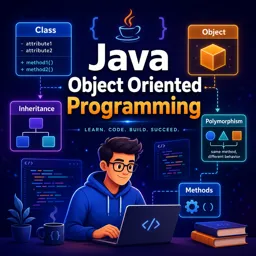
Two of the most important concepts in OOP are classes and objects:
- Class: a blueprint or template that defines what properties and actions something will have.
- Object: a specific instance created from that blueprint.
For example, “Car” could be a class describing the general idea of a car. A specific red sports car would be an object — an actual example built from the Car blueprint.
The Four Core Principles of OOP
Object-oriented programming is often described through four key principles:
| Principle | What It Means |
|---|---|
| Encapsulation | Bundling data and the actions that work on it together, while hiding internal details from the outside. |
| Abstraction | Showing only the essential features and hiding unnecessary complexity. |
| Inheritance | Allowing a new class to reuse and build upon the properties of an existing class. |
| Polymorphism | Letting different objects respond to the same action in their own way. |
Why Do Developers Use OOP?
OOP became popular because it helps manage complexity in large programs. Some of its main benefits include:
- Reusability: classes can be reused across projects, saving time.
- Organization: code is grouped in logical, self-contained units.
- Maintainability: changes are easier to make without breaking unrelated parts.
- Scalability: large systems become easier to expand and understand.
A Simple Example in Words
Imagine you are building an app for a library. Instead of scattering data everywhere, you might create a “Book” class with properties like title and author, and actions like “borrow” and “return.” Every book in the library becomes an object of that class. This keeps your code organized and makes it easy to add new features later, such as tracking due dates.
Is OOP Always the Best Choice?
OOP is powerful, but it is not the only way to write software. Other approaches, such as procedural or functional programming, are better suited to certain tasks. Skilled developers learn to choose the right tool for the job. Still, understanding OOP is essential, because it appears in so many languages and real-world projects.
Conclusion
Object-oriented programming provides a structured, intuitive way to model problems by combining data and behavior into objects. By mastering concepts like classes, objects, and the four core principles, you build a foundation that applies across many programming languages and career paths.
If you want to strengthen your programming skills, Cursa offers free courses on programming logic and popular languages that can help you turn these concepts into real, working code.