Algebra gets much easier when you stop thinking of it as a list of rules and start treating it like a skill stack. Each topic builds a specific “tool” (like manipulating expressions, solving equations, or modeling relationships), and later topics simply combine those tools in new ways. This roadmap organizes algebra into clear stages so you can choose the right starting point, study efficiently, and track progress as your confidence grows.
1) Choose your starting level (quick placement check)
Use these checkpoints to decide where to begin—no long diagnostic needed.
Start with pre-algebra if you want to be faster at: fractions, negative numbers, ratios, percent, order of operations, and translating word problems into arithmetic steps.
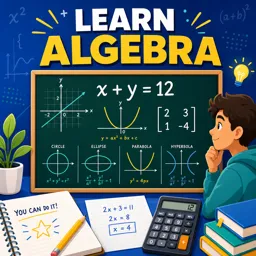
Start with algebra basics if you can do arithmetic confidently and want to master: simplifying expressions, solving one-step/two-step equations, coordinate plane basics, and slope as a “rate of change.”
Start with intermediate algebra if you’re comfortable solving linear equations and want to level up with:factoring, rational expressions, radicals, and more structured function work.
Start with advanced algebra if you’re ready for: complex numbers, deeper polynomial techniques, logarithms/exponentials, and multi-topic problem sets that require strategy.
To browse the broader learning area, you can also explore https://cursa.app/free-online-basic-studies-courses, then jump directly into the https://cursa.app/free-courses-basic-studies-online subcategory.
2) Stage One: Pre-Algebra skills that remove 80% of friction
Many learners struggle in algebra not because algebra is hard, but because earlier arithmetic skills slow everything down. Prioritize these micro-skills first:
Fraction fluency: simplifying, finding common denominators, and understanding that dividing by a fraction means multiplying by its reciprocal.
Signed numbers: adding/subtracting negatives, and recognizing how sign changes propagate in multiplication and division.
Percent and ratio translation: converting between “x% of y,” decimals, and fraction forms; setting up proportion equations cleanly.
Word-to-math translation: identifying what’s unknown, labeling it, and writing one equation that matches the story.
These show up everywhere later—especially in solving equations with coefficients, simplifying rational expressions, and interpreting rates.

3) Stage Two: Algebra basics—learn the “language” of manipulation
Algebra basics is where you learn to rewrite statements without changing their meaning. The goal is not memorizing steps, but understanding which transformations are allowed.
Core competencies to master:
Expression simplification: combining like terms, distributing, factoring out a greatest common factor, and using exponent rules correctly.
Equation solving: solving linear equations by applying inverse operations; checking solutions to avoid silent mistakes.
Coordinate plane + slope: interpreting slope as “change in y over change in x,” not just a formula; reading intercepts as meaningful quantities.
If you want a structured set of free lessons to work through, the https://cursa.app/free-online-courses/algebra-basicscollection is a good hub for this stage.
4) Stage Three: Intermediate algebra—patterns, factoring, and rational thinking
Intermediate algebra is where algebra starts feeling like puzzle-solving. Instead of just “do the same steps,” you choose among techniques based on structure.
Topics that unlock the next level:
Factoring as reverse distribution: common factor, difference of squares, trinomials, and factoring by grouping (when applicable).
Rational expressions: simplifying by factoring, identifying restrictions, and understanding why some “cancellations” are illegal.
Radicals and exponents: rewriting expressions to a comparable form, rationalizing denominators when needed, and avoiding extraneous solutions.
Functions as machines: domain/range intuition, function notation, and interpreting function changes from tables and graphs.
For curated practice at this level, explore https://cursa.app/free-online-courses/intermediate-algebra.
5) Stage Four: Advanced algebra—build strategy, not just technique
Advanced algebra rewards planning. You’ll often have multiple valid approaches, and your job is to pick the one that’s simplest and least error-prone.
High-impact skill moves:
Polynomial behavior: understanding zeros/roots, multiplicity ideas, and how algebraic form connects to graph behavior.
Exponential and logarithmic reasoning: rewriting to the same base, using log rules as structured rewrites, and recognizing growth/decay models.
Complex numbers (when they appear): treating i as a consistent algebraic object; using conjugates to simplify expressions.
Multi-step modeling: turning a real scenario into a function, solving for parameters, and interpreting the result in context.
A focused path through https://cursa.app/free-online-courses/advanced-algebra helps keep the workload organized and goal-driven.
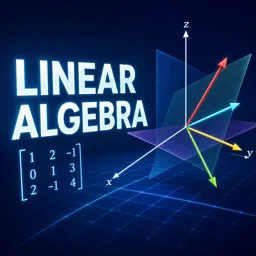
6) Stage Five: Linear systems and matrices—your bridge into linear algebra
Many learners meet linear algebra and think it’s a brand-new subject. In reality, it’s an organized way to solve and reason about many linear equations at once.
What to learn before matrices feel natural:
Systems of equations: elimination/substitution, interpreting “one solution vs infinite vs none,” and connecting solutions to intersections on graphs.
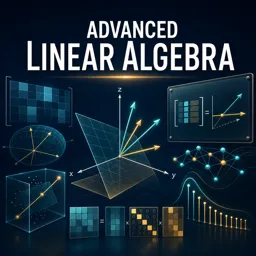
Matrix representation: seeing a system as a single object; understanding row operations as legal equation transformations.
Vectors as structured lists: interpreting (x, y, z) as a point, a direction, or a set of coefficients depending on context.
When you’re ready, the https://cursa.app/free-online-courses/linear-algebra subject area is the natural next step and pairs well with strong equation-solving habits.
7) How to study algebra efficiently (a weekly loop that works)
A consistent loop beats marathon sessions. Try this repeatable pattern:
1) Learn (short): watch/read one concept, then summarize it in your own words.
2) Drill (targeted): do 8–15 problems focused on one skill (e.g., only distributing, only factoring trinomials).
3) Mix (realistic): do 6–10 mixed problems so you practice choosing the method, not just executing it.
4) Reflect (fast): write down your top 2 error types (sign mistakes, lost denominators, wrong factoring pattern) and create a mini-checklist for next time.
For additional practice inspiration and explanations, you can also explore external open learning references like https://www.khanacademy.org/math or problem libraries such as https://artofproblemsolving.com/ (especially helpful once you reach intermediate/advanced topics).

8) Common sticking points (and what to do instead)
Some difficulties are so common they’re almost predictable. Here are quick corrections that save hours:
“I keep making sign errors.” Slow down only at sign-changing steps (distributing negatives, subtracting polynomials, moving terms). Circle negatives before you start simplifying.
“Factoring feels like guessing.” Treat factoring as pattern recognition plus verification: propose factors, then multiply back to confirm.
“I don’t know which method to use.” Build a decision habit: linear vs quadratic vs rational vs radical. Classify first, solve second.
“I can do problems in a section, but fail mixed reviews.” Add mixed practice every week; algebra is as much about choosing tools as using them.
9) Where to go next (optional enrichment)
If you enjoy abstraction and want to see how algebra connects to broader mathematics, two popular directions are:
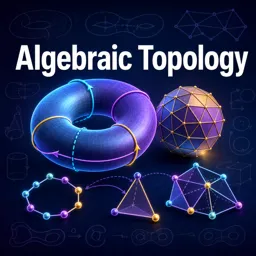
Topology (intuitive ideas about shape and continuity) — explore https://cursa.app/free-online-courses/topology.
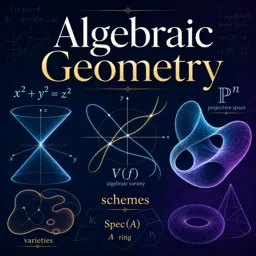
Algebraic geometry (equations describing geometric objects) — explore https://cursa.app/free-online-courses/algebraic-geometry.
These aren’t required for typical algebra mastery, but they can be motivating if you like seeing the “big picture.”
Build your plan in one sentence
Pick your starting stage, study 3–5 times per week using the learn–drill–mix–reflect loop, and advance only when you can solve mixed sets with consistent accuracy. Then use the Algebra course lists to keep the content free, structured, and goal-driven: https://cursa.app/free-courses-basic-studies-online, https://cursa.app/free-online-courses/algebra-basics, https://cursa.app/free-online-courses/intermediate-algebra, https://cursa.app/free-online-courses/advanced-algebra, and https://cursa.app/free-online-courses/linear-algebra.