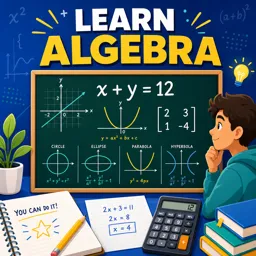
Algebra becomes much easier when you stop thinking of it as a list of rules and start treating it like a skill you build in layers. A good learning path doesn’t just move from “easy” to “hard”—it reinforces the same core ideas (variables, expressions, equations, functions) in increasingly powerful settings. This guide lays out a practical route through algebra topics so you can study efficiently, avoid common plateaus, and earn free certifications along the way.
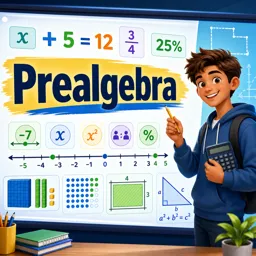
Start with pre-algebra: build fluency, not just familiarity
Pre-algebra is where most learning gaps hide. The goal is quick, accurate manipulation of numbers and symbols so later steps don’t feel overwhelming. Spend time until these are automatic:
Key skills to master early:
- Number sense: integers, fractions, decimals, percent conversions
- Order of operations: evaluating expressions correctly
- Properties: distributive, associative, commutative (and when they do not apply)
- Signed arithmetic: negatives and absolute value without hesitation
- Ratio and proportion: unit rates and scaling
If you want a structured entry point, the Algebra subcategory is a useful hub for browsing free course options and matching your starting level: https://cursa.app/free-courses-basic-studies-online.
Algebra basics: learn the “equation toolkit”
This stage is about solving and rewriting. The most important shift is understanding that you can transform an equation as long as you do the same thing to both sides. Focus on repeatable processes:
- Simplifying expressions: combining like terms, distributing, factoring out a GCF
- Solving linear equations: one variable, multi-step, with fractions
- Rearranging formulas: solving for a specific variable (a critical real-world skill)
- Coordinate basics: plotting points and reading graphs
To practice this layer with focused modules, explore: https://cursa.app/free-online-courses/algebra-basics.
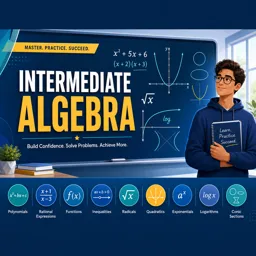
Intermediate algebra: functions, systems, and “why” patterns emerge
Intermediate algebra is where algebra starts to feel like a connected language. You’re no longer solving isolated exercises—you’re analyzing relationships. Prioritize topics that unlock many others:
- Functions: notation (f(x)), domain/range, interpreting graphs
- Systems of equations: substitution, elimination, and what solutions mean graphically
- Quadratics: factoring, completing the square, quadratic formula
- Exponents and radicals: rules, simplification, rational exponents
- Rational expressions: restrictions, simplification, and equation solving
If you want a coherent next step after fundamentals, start here: https://cursa.app/free-online-courses/intermediate-algebra.

Advanced algebra: transformation thinking and general methods
“Advanced” often means you’re working with more general forms, multi-step reasoning, and techniques that apply across many problem types. Instead of memorizing many separate tricks, look for unifying ideas:
- Polynomials: division, remainder theorem, end behavior
- Exponential and logarithmic functions: inverse relationship, solving equations
- Sequences and series: arithmetic vs. geometric patterns
- Complex numbers: arithmetic and interpretation in equations
- Modeling: translating word problems into expressions and constraints
Browse advanced topic tracks here: https://cursa.app/free-online-courses/advanced-algebra.
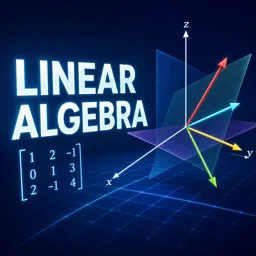
Linear algebra: when algebra becomes a powerful framework
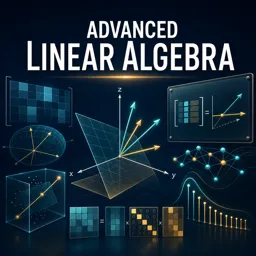
Linear algebra is different: it’s algebra with vectors and matrices, built for scaling up problems. It’s essential in data science, engineering, computer graphics, optimization, and machine learning. The key is to keep a geometric intuition alongside the computations:
- Vectors: magnitude, direction, dot product
- Matrices: multiplication, inverses, solving linear systems
- Linear transformations: rotations, scalings, projections
- Eigenvalues/eigenvectors: “special directions” a transformation preserves
Start exploring linear algebra courses here: https://cursa.app/free-online-courses/linear-algebra.
A weekly study structure that actually works
A common reason learners stall is spending too much time watching lessons and too little time doing retrieval practice. A simple structure:
- Learn (30–40%): short lessons + worked examples
- Practice (50–60%): mixed problem sets, timed sections, error logs
- Review (10%): revisit the hardest missed problems after 48–72 hours
Use a “mistake notebook” where each entry has: (1) what you did, (2) why it was wrong, (3) the correct method, (4) a similar practice problem you create yourself. This turns errors into a system for improvement.
Placement checkpoints: how to know where to start
If you’re unsure of your level, use these quick checks:
- Start with pre-algebra if fractions/negatives feel slow or confusing.
- Start with algebra basics if you can compute confidently but struggle to solve multi-step equations.
- Start with intermediate algebra if linear equations are easy but quadratics and functions feel unclear.
- Start with advanced algebra if you’re comfortable with quadratics/systems and want deeper function work and methods.
- Start with linear algebra if you’re ready for vectors/matrices and want a new framework (not just harder equations).
Extend your learning: broader math foundations
Algebra improves faster when it’s connected to a broader base of math study habits and foundational topics. If you want to explore adjacent basics, the Basic studies category can help you round out prerequisites: https://cursa.app/free-online-basic-studies-courses.

Optional curiosity route: when algebra meets higher math
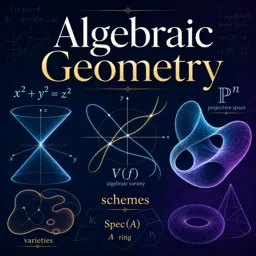
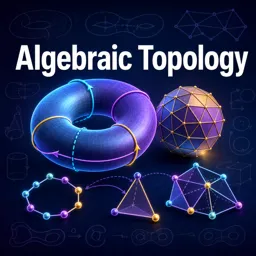
Some learners like to peek ahead. If you enjoy abstract structures and the “shape” of mathematical ideas, you may eventually explore topics like topology and algebraic geometry. These are not required for mastering algebra, but they can be motivating long-term directions:
- Topology: https://cursa.app/free-online-courses/topology
- Algebraic Geometry: https://cursa.app/free-online-courses/algebraic-geometry
Next step: choose your track and collect wins
Pick one level, commit to steady practice, and aim for short certifications as milestones. Progress in algebra is surprisingly non-linear: a few weeks of consistent, mixed practice often creates a “sudden” leap in confidence. Start by selecting a course set in the Algebra subcategory, then move forward one layer at a time: https://cursa.app/free-courses-basic-studies-online.
For additional practice support outside your courses, you can also use open learning resources like https://www.khanacademy.org/math/algebra to get extra exercises and instant feedback while you work through your certification path.