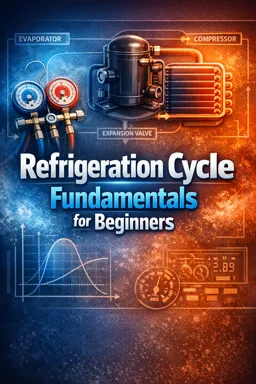

Free ebook on refrigeration cycle fundamentals, covering refrigerant pressure, temperature, superheat, subcooling, and core HVAC components.
Free ebook content
-

Refrigeration Cycle Fundamentals: What the Vapor-Compression Cycle Does
+ Exercise: In the vapor-compression refrigeration cycle, what role does the compressor play in making it possible to reject heat to a warmer environment?
-
Refrigeration Cycle Fundamentals: Refrigerant States and Saturation Concepts
+ Exercise: At a point in a refrigeration system, the measured pressure is 200 kPa and the measured temperature is -10°C. Using the saturation relationship, which conclusion is correct?
-
Refrigeration Cycle Fundamentals: Pressure–Temperature Relationships You Must Read Correctly
+ Exercise: When calculating liquid-line subcooling, which subtraction order correctly compares measured line temperature to saturation temperature from pressure?


-
Refrigeration Cycle Fundamentals: The Compressor’s Role and What Changes Across It
+ Exercise: Which statement best describes what the compressor does to the refrigerant in a vapor-compression system and why?
-
Refrigeration Cycle Fundamentals: Condenser Heat Rejection and Subcooling
+ Exercise: In an air-cooled condenser, what does measured subcooling indicate about the refrigerant leaving the condenser and why is it helpful for the metering device?
-
Refrigeration Cycle Fundamentals: Metering Devices and the Expansion Process
+ Exercise: When the cooling load increases, which response best describes how a TXV/TEV helps keep evaporator feeding close to ideal?
-
Refrigeration Cycle Fundamentals: Evaporator Heat Absorption and Superheat
+ Exercise: A technician measures suction pressure and converts it to a saturation temperature of 32°F. The suction line temperature at the same location is 42°F. What does this result indicate about evaporator operation?
-
Refrigeration Cycle Fundamentals: Putting It Together on a Simple Cycle Diagram
+ Exercise: In a simple refrigeration cycle diagram, which component is the only place where work is added to the refrigerant, and between which state points does this occur?
-
Refrigeration Cycle Fundamentals: Reading Real-World Measurements Without Getting Lost
+ Exercise: In a refrigeration snapshot, you calculate a relatively high superheat while subcooling is still positive and moderate. What does this combination most directly suggest about system operation?
-
Refrigeration Cycle Fundamentals: Common Misconceptions and Concept Checks
+ Exercise: When interpreting superheat and subcooling readings, which approach best matches correct cause-and-effect reasoning in a vapor-compression system?
About the free ebook
Refrigeration Cycle Fundamentals for Beginners
Build a clear, practical understanding of the vapor-compression refrigeration cycle with this free ebook for aspiring HVAC and refrigeration professionals. Learn how refrigeration systems move heat, why pressure and temperature are closely linked, and how each major component contributes to cooling.
Understand the cycle with confidence
The ebook explains refrigerant states, saturation, pressure-temperature relationships, compression, condensation, expansion, and evaporation in straightforward language. It connects core theory to the measurements technicians encounter in real equipment, helping you interpret system behavior without relying on guesswork.
Connect components to system performance
- Compressor: Understand how it raises refrigerant pressure and temperature.
- Condenser: Learn how heat rejection and subcooling occur.
- Metering device: See why pressure drops during expansion.
- Evaporator: Explore heat absorption and the purpose of superheat.
Apply concepts to field readings
Use a simple cycle diagram to connect low-side and high-side conditions. The material clarifies how to read pressure and temperature measurements, distinguish refrigerant conditions, and avoid common misunderstandings about cooling systems.
Who this ebook supports
It is designed for learners developing foundational professional skills in refrigeration and air conditioning, including those preparing to understand service procedures, equipment operation, and basic diagnostic discussions.
Learn the principles behind effective refrigeration before moving on to advanced troubleshooting and system analysis.
What is the purpose of the vapor-compression refrigeration cycle?
It transfers heat from a cooled space to another location through compression, condensation, expansion, and evaporation.
What is the difference between superheat and subcooling?
Superheat is vapor temperature above saturation; subcooling is liquid temperature below saturation at a given pressure.
Why must refrigeration pressure readings be matched with temperature?
Pressure determines refrigerant saturation temperature, so both readings are needed to identify the refrigerant state.
This ebook includes:

10 content chapters

Digital certificate of course completion (Free)

Exercises to train your knowledge

100% free, from content to certificate
Ready to get started?

 recommended
In the app you will also find...

Over 5,000 free courses
Programming, English, Digital Marketing and much more! Learn whatever you want, for free.

Study plan with AI
Our app's Artificial Intelligence can create a study schedule for the course you choose.

From zero to professional success
Improve your resume with our free Certificate and then use our Artificial Intelligence to find your dream job.
You can also use the QR Code or the links below.