
Flowing dry nitrogen displaces oxygen inside the tubing, preventing scale formation that can clog metering devices and damage compressors.

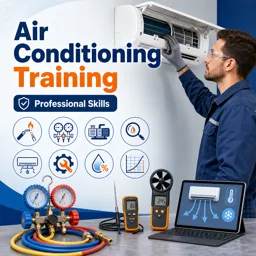
Duration of the online course: 10 hours and 15 minutes
4.6


(5)
Build in-demand HVAC skills with a free air conditioning course—learn installation best practices, troubleshooting, charging and airflow to work smarter, faster.
Upgrade your hands-on HVAC capabilities with practical training focused on how modern air conditioning systems are installed, verified, and serviced in the real world. This course is designed for anyone building professional skills in refrigeration and air conditioning, whether you are stepping into the trade, leveling up for better job opportunities, or aiming to reduce callbacks and improve reliability on every install.
You will learn to approach AC work with a process-first mindset: prepare the system correctly, protect equipment during installation, and validate performance with confident testing. From clean brazing techniques and the importance of flowing nitrogen, to pressure testing and leak checking that catch problems early, the course emphasizes habits that prevent contamination, protect components, and improve long-term system efficiency.
Good installations are verified, not guessed. That is why evacuation and vacuum best practices are treated as essential skills, helping you achieve fast and reliable results without shortcuts that can lead to moisture, non-condensables, and performance issues. You will also see why airflow must be confirmed before charging, how to interpret static readings properly, and how to build a consistent workflow that ties measurements to real system behavior.
Troubleshooting is a core theme throughout. You will practice a clear diagnostic mindset that starts broad, narrows logically, and then widens again to confirm the true cause. Along the way, the training connects pressures, temperatures, saturation concepts, and refrigerant charge adjustments to what you actually observe in the field, improving both speed and accuracy when resolving comfort complaints.
Modern equipment demands modern methods. The course includes key considerations for inverter-driven, ductless, and VRF-style systems, including service valve practices, oil return awareness, and charging strategies that reduce risk and protect performance. Maintenance is addressed with a focus on mini-split cleaning and how to verify results without unnecessary refrigerant loss.
Finally, you will strengthen your understanding of comfort beyond temperature by learning the practical side of psychrometrics, humidity, and moisture control. By connecting diagnostics to building conditions, you will be better prepared to prevent issues like duct and vent sweating and to deliver solutions that keep occupants comfortable and systems operating efficiently.

10 hours and 15 minutes of online video course

Digital certificate of course completion (Free)

Exercises to train your knowledge

100% free, from content to certificate
Why should nitrogen be flowed while brazing modern air-conditioning systems?
Flowing dry nitrogen displaces oxygen inside the tubing, preventing scale formation that can clog metering devices and damage compressors.
What is the best way to evacuate a newly installed residential split AC system?
Use large-diameter evacuation hoses, remove valve cores when appropriate, connect directly to the system, and verify a stable deep vacuum with a micron gauge.
How should a newly installed inverter or ductless system be charged?
Charge by the manufacturer’s specified refrigerant weight, using a scale and the required adjustment for line length; do not rely on pressure alone.
Ready to get started?Download the app and get started today.
Install the app now
to access the course
Over 5,000 free courses
Programming, English, Digital Marketing and much more! Learn whatever you want, for free.

Study plan with AI
Our app's Artificial Intelligence can create a study schedule for the course you choose.

From zero to professional success
Improve your resume with our free Certificate and then use our Artificial Intelligence to find your dream job.
You can also use the QR Code or the links below.



Free CourseRefrigeration and Air conditioning
5
(4)

9h11m

6 exercises
Free CourseRefrigeration and air-conditioning
5
(1)
17h58m
30 exercises
Free CourseFundamentals of HVAC
5
(2)
58m
6 exercises
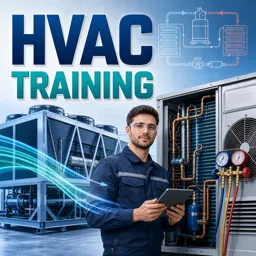
Free CourseHVAC training
5
(3)
4h01m
8 exercises
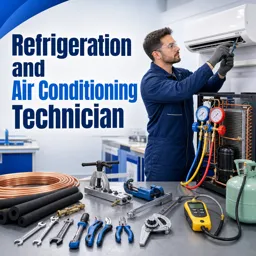
Free CourseRefrigeration and Air Conditioning Technician
4.8
(4)
1h18m
Free CourseIntroduction to market HVAC and Refrigeration
4.7
(3)
1h04m
6 exercises
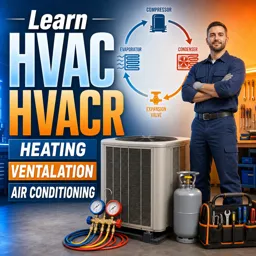
Free CourseLearn HVAC HVACR Heating Ventalation Air Conditioning
4.3
(7)
34h21m
43 exercises
Carry knowledge in your pocket.
Download the Cursa app.
There are hundreds of free courses available, with a free certificate of completion that is saved in your mobile image gallery.
Download the app to access the Course Completion Certificate for Free.


+ 10 million
students

Free and Valid
Certificate

60 thousand free
exercises

4.8/5 rating in
app stores

Free courses in
video and ebooks
Course comments: Air Conditioning Training
Nick Brooks
I actually already had the HVAC School app, so already familiar. However I am self taught with HVAC already replacing the Capacitor and the Contactor.
Kierra
I love it so far