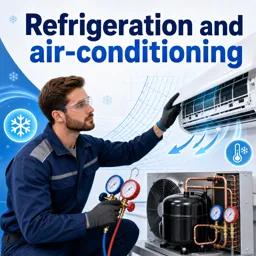
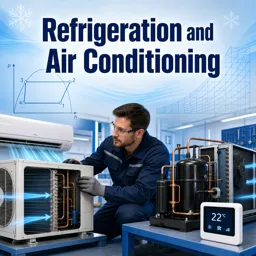
Free Course Image Refrigeration and air-conditioning

Free online courseRefrigeration and air-conditioning

Duration of the online course: 17 hours and 58 minutes

New course

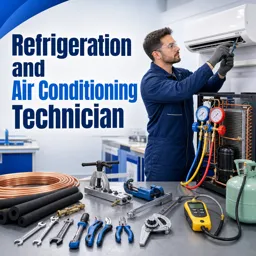
Enroll in this free online course on Refrigeration and Air-conditioning to master thermodynamics, cooling loads, vapour cycles, air distribution systems, and more.

In this free course, learn about

  • Thermodynamics Foundations and Refrigeration Basics
  • Aircraft and Air Refrigeration Cycles
  • Vapour Compression Refrigeration Cycles
  • Advanced Compression and Multi-Evaporator Systems
  • Refrigerants and Vapour Absorption Systems
  • Introduction to Air-Conditioning and Moist Air Properties
  • Infiltration, Design Conditions, and Cooling Load
  • Air Distribution and Air-Conditioning Systems
  • Human Physiology, Thermal Comfort, and Indoor Environmental Health

Course Description

The course titled "Refrigeration and Air-Conditioning" offers a comprehensive exploration into the realm of thermal management systems. With a duration of 17 hours and 58 minutes, this professional course encapsulates a detailed study categorized under refrigeration and air conditioning, focusing on crucial principles and advanced applications pertinent to this field.

This in-depth course begins with a thorough Recapitulation of Thermodynamics, ensuring that students are grounded in the essential concepts that form the backbone of refrigeration systems. Moving forward, the Introduction to Refrigeration sets the stage for more complex topics, providing a clear understanding of the basics and laying the groundwork for intricate cycles and systems discussed later.

The curriculum advances into specific cycles starting with the Air Refrigeration Cycle and its various applications, including a detailed examination of Aircraft Refrigeration Cycles across three segments. These segments dissect the unique requirements and engineering solutions pertinent to aircraft, highlighting the differences and challenges associated with high-altitude and high-speed conditions.

Next, the course delves into the Vapour Compression Cycle, presented in a two-part series. This section is crucial as it discusses the most widely used refrigeration cycle, including the use and interpretation of P-h Charts. The discussion extends to the Actual Vapour Compression Cycles, accounting for real-world deviations from ideal cycles over two sessions.

The exploration continues with Compound Compression with Intercooling and Multiple Evaporator and Cascade Systems, elaborating on more complex refrigeration architectures aimed at improving efficiency and performance. Throughout the course, various techniques and strategies are explained through Problem Solving modules, ensuring practical understanding and application of theoretical knowledge.

The segment on Refrigerants introduces and analyzes different types of refrigerants, emphasizing their properties, applications, and environmental impact across two parts. Following this, three sessions are dedicated to Vapour Absorption Systems, an alternative refrigeration technique significant in both historical context and modern sustainable applications.

In transitioning to the second major part of the course, Introduction to Air-conditioning, the course addresses the fundamental principles and the nuances of air-conditioning systems. Concepts such as the Properties of Moist Air are covered in detail, with practical learning facilitated through the utilization of the Psychrometric Chart.

The Psychrometric Processes are dissected across three sessions, providing a step-by-step understanding of how air properties change under various cooling and heating conditions. Additional elements like Infiltration and Design Conditions highlight practical considerations in creating effective air-conditioning systems.

The course meticulously covers the Cooling Load calculations in a three-part series, examining how to accurately determine the amount of cooling required to maintain desired indoor conditions. This is complemented by sections on the Air Distribution System, ensuring participants understand the dynamics of airflow and distribution within conditioned spaces.

To provide a holistic understanding, the course also integrates aspects of Human Physiology, Thermal Comfort, and Indoor Environmental Health. These topics emphasize the import.

Course content

  • Video class: Recapitulation of Thermodynamics 32m
  • Exercise: Which of the following processes describes a transformation where the volume remains constant?
  • Video class: Introduction to Refrigeration 27m
  • Exercise: What does one ton of refrigeration mean in terms of ice production?
  • Video class: Air Refrigeration Cycle 25m
  • Exercise: Which cycle is referred to as the 'reverse Joules Brayton cycle' in air refrigeration systems?
  • Video class: Aircraft Refrigeration Cycles-1 24m
  • Exercise: Why is cooling required in airplanes despite low external temperatures?
  • Video class: Aircraft Refrigeration Cycles-2 23m
  • Exercise: Which refrigeration cycle introduces an evaporative cooler just before the expansion turbine to further decrease the air temperature?
  • Video class: Aircraft Refrigeration Cycles-3 23m
  • Exercise: What is the coefficient of performance (COP) of the aircraft refrigeration system described in the lecture?
  • Video class: Vapour Compression Cycle1 25m
  • Exercise: What is the impact of increasing the clearance ratio in a vapor compression refrigeration system's reciprocating compressor?
  • Video class: Vapour Compression Cycle2 25m
  • Exercise: What does the vapour compression refrigeration cycle replace in the conventional Carnot cycle?
  • Video class: P-h Charts 23m
  • Exercise: What does the P-H chart stand for in refrigeration and air conditioning?
  • Video class: Actual Vapour Compression Cycle-1 25m
  • Exercise: What is the primary reason for avoiding wet vapor entering the compressor in a vapor compression cycle?
  • Video class: Actual Vapour Compression Cycle-2 29m
  • Exercise: What is the result of increasing evaporator pressure in a vapor compression cycle?
  • Video class: Compound Compression with Intercooling-1 25m
  • Exercise: What is the primary purpose of using compound compression with intercooling in a refrigeration system?
  • Video class: Compound Compression with Intercooling-2 23m
  • Exercise: What is the main purpose of intercooling in a refrigeration system?
  • Video class: Multiple Evaporator and Cascade System 29m
  • Exercise: What is a key advantage of a multi-evaporator system?
  • Video class: Problem Solving 26m
  • Exercise: What is the effect on the room temperature if the door of a refrigerator is left open?
  • Video class: Refrigerants-1 27m
  • Exercise: What is the primary function of a refrigerant in a refrigeration system?
  • Video class: Refrigerants-2 22m
  • Exercise: Which of the following statements is TRUE about an ideal refrigerant in terms of environmental impact?
  • Video class: Vapour Absorption Systems-1 27m
  • Exercise: What principle was demonstrated by Faraday's experiment with silver chloride?
  • Video class: Vapour Absorption Systems-2 26m
  • Exercise: Which component in a vapor absorption refrigeration system is responsible for raising the pressure of the refrigerant-absorbent mixture?
  • Video class: Vapour Absorption Systems-3 25m
  • Exercise: What is a key advantage of the three fluid refrigeration system compared to two fluid systems?
  • Video class: Introduction to Air-conditioning 24m
  • Exercise: Which of the following statements correctly describes the features of an air conditioning system?
  • Video class: Properties of Moist Air 31m
  • Video class: Psychrometric Chart 24m
  • Exercise: What is the typical value of dry bulb temperature considered ideal for most people's comfort according to the text?
  • Video class: Psychrometric Processes-1 27m
  • Video class: Psychrometric Processes-2 26m
  • Exercise: In the context of psychrometric processes in air conditioning, what is the purpose of mixing return air with fresh air?
  • Video class: Psychrometric Processes-3 26m
  • Video class: Infiltration 31m
  • Exercise: What is the primary reason that infiltration and exfiltration in buildings can impact the performance of an air conditioning system?
  • Video class: Design Conditions 27m
  • Video class: Cooling Load -1 22m
  • Exercise: What is the primary function of the coil dew temperature in a split AC system?
  • Video class: Cooling Load -2 30m
  • Video class: Cooling Load -3 34m
  • Exercise: In the given scenario, if the restaurant is entirely occupied and each person adds 100 watts as sensible heat while seated, what would be the total sensible heat contribution from the occupants alone?
  • Video class: Air Distribution System-1 26m
  • Video class: Air Distribution System-2 25m
  • Exercise: What is the effect on velocity and noise level in air ducts when the duct diameter is reduced for a constant discharge?
  • Video class: Problem Solving 26m
  • Video class: Air-Conditioning Systems 30m
  • Exercise: What is the primary benefit of using chilled water systems in large air conditioning applications?
  • Video class: Human Physiology 31m
  • Video class: Thermal Comfort 29m
  • Exercise: What is the ideal temperature and relative humidity for achieving thermal comfort in artificially controlled environments, as suggested in the provided text?
  • Video class: Indoor Environmental Health-1 23m
  • Video class: Indoor Environmental Health-2 25m
  • Exercise: What is the primary benefit of displacement ventilation over traditional mixing ventilation?
  • Video class: Problem Solving 28m

This free course includes:

17 hours and 58 minutes of online video course

Digital certificate of course completion (Free)

Exercises to train your knowledge

100% free, from content to certificate

Ready to get started?Download the app and get started today.

Install the app now

to access the course
Icon representing technology and business courses

Over 5,000 free courses

Programming, English, Digital Marketing and much more! Learn whatever you want, for free.

Calendar icon with target representing study planning

Study plan with AI

Our app's Artificial Intelligence can create a study schedule for the course you choose.

Professional icon representing career and business

From zero to professional success

Improve your resume with our free Certificate and then use our Artificial Intelligence to find your dream job.

You can also use the QR Code or the links below.

QR Code - Download Cursa - Online Courses

More free courses at Refrigeration and air conditioning

Free Ebook + Audiobooks! Learn by listening or reading!

Download the App now to have access to + 3300 free courses, exercises, certificates and lots of content without paying anything!

  • 100% free online courses from start to finish

    Thousands of online courses in video, ebooks and audiobooks.

  • More than 48 thousand free exercises

    To test your knowledge during online courses

  • Valid free Digital Certificate with QR Code

    Generated directly from your cell phone's photo gallery and sent to your email

Cursa app on the ebook screen, the video course screen and the course exercises screen, plus the course completion certificate

+ 9 million
students

Free and Valid
Certificate

60 thousand free
exercises

4.8/5 rating in
app stores

Free courses in
video and ebooks