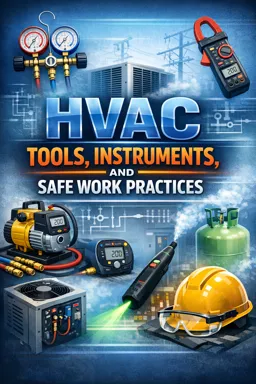

Free ebook on HVAC tools, measurement instruments, refrigerant recovery, leak testing, evacuation, and safe service practices.
Free ebook content
-

HVAC Service Tools and Safe Work Practices: Scope, Responsibilities, and Work Readiness
+ Exercise: During evacuation, why should the micron gauge be placed at the system (far from the vacuum pump) instead of only at the pump?
-
Manifold Gauges and Hoses for HVAC Systems: Correct Setup, Measurement, and Charging Control
+ Exercise: When connecting a center (yellow) hose to a refrigerant cylinder, what is the main purpose of briefly pressurizing and purging the hose before charging?


-
Vacuum Pumps in HVAC: Deep Evacuation Techniques and Moisture Removal
+ Exercise: During HVAC evacuation, what setup best verifies the true depth and stability of vacuum in the system?
-
Micron Gauges for HVAC: Measuring Vacuum Accurately and Proving System Dryness
+ Exercise: During an isolation/decay test, which pressure-rise pattern most strongly indicates a leak rather than moisture or normal outgassing?
-
Refrigerant Recovery Machines and Cylinders: Legal, Safe, and Effective Recovery Operations
+ Exercise: Which practice best prevents overfilling a refrigerant recovery cylinder during recovery operations?
-
HVAC Leak Detection Tools: Electronic Detectors, Nitrogen Pressure Testing, and Verification Methods
+ Exercise: Which workflow best reduces false positives and ensures a verified HVAC refrigerant leak repair?
-
Thermometers and Temperature Measurement in HVAC: Superheat, Subcooling, and Air-Side Readings
+ Exercise: When using an infrared (IR) thermometer on a shiny copper refrigerant line, what is the best way to improve reading accuracy?
-
Clamp Meters and Electrical Instruments for HVAC: Safe Testing, Diagnosis, and Meter Selection
+ Exercise: When troubleshooting a "unit not starting" complaint, what is the most appropriate next step if correct line voltage is present at the contactor line side but the contactor is not pulling in?
-
Core Safety Practices for HVAC Service: Electrical Safety, Refrigerant Handling, PPE, and Jobsite Procedures
+ Exercise: When verifying that an HVAC unit is de-energized before touching conductors, what is the correct “test before touch” sequence for using a meter?
-
Putting HVAC Tools Together: End-to-End Service Workflows and Common Failure Patterns
+ Exercise: During a sealed-system repair, the micron level reaches the target but rises quickly after isolating the vacuum. What is the correct next action before charging refrigerant?
About the free ebook
HVAC Tools, Instruments, and Safe Work Practices
This free ebook provides a practical guide to the tools, measurements, and safety habits used in refrigeration and air-conditioning service. It helps technicians connect instruments correctly, interpret readings, protect equipment, and perform work with greater control.
Build reliable HVAC service habits
Learn how manifold gauges, hoses, vacuum pumps, micron gauges, recovery machines, leak detectors, thermometers, and clamp meters support accurate diagnosis and service. The material explains how these tools fit into real tasks, from initial inspection through evacuation, charging, testing, and verification.
Focus on measurements that matter
- Set up manifold gauges and hoses to control pressure measurement and refrigerant charging.
- Use vacuum pumps and micron gauges to evacuate systems and confirm dryness.
- Recover refrigerant safely using appropriate machines and cylinders.
- Locate and verify leaks with electronic detection and nitrogen pressure testing.
- Measure superheat, subcooling, air-side temperatures, and electrical values.
Safety integrated into every task
Effective HVAC work depends on more than selecting the right instrument. This ebook emphasizes electrical safety, refrigerant handling, personal protective equipment, cylinder practices, jobsite preparation, and disciplined procedures. It also addresses common failure patterns, helping readers recognize errors such as poor hose setup, incomplete evacuation, misleading measurements, and unsafe testing conditions.
HVAC Tools, Instruments, and Safe Work Practices connects individual tools to complete service workflows, so technicians can make sound decisions before, during, and after work on HVAC equipment.
How does a micron gauge confirm an HVAC system is dry?
It measures deep vacuum levels and helps verify that moisture and non-condensables have been removed.
Why is nitrogen used for HVAC leak pressure testing?
Dry nitrogen provides a controlled, non-flammable pressure source for finding and verifying leaks.
What HVAC readings are used to calculate superheat and subcooling?
Technicians combine pressure-based saturation temperatures with measured line temperatures.
This ebook includes:

10 content chapters

Digital certificate of course completion (Free)

Exercises to train your knowledge

100% free, from content to certificate
Ready to get started?

 recommended
In the app you will also find...

Over 5,000 free courses
Programming, English, Digital Marketing and much more! Learn whatever you want, for free.

Study plan with AI
Our app's Artificial Intelligence can create a study schedule for the course you choose.

From zero to professional success
Improve your resume with our free Certificate and then use our Artificial Intelligence to find your dream job.
You can also use the QR Code or the links below.