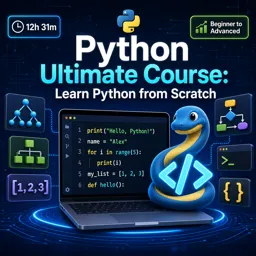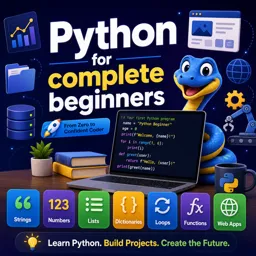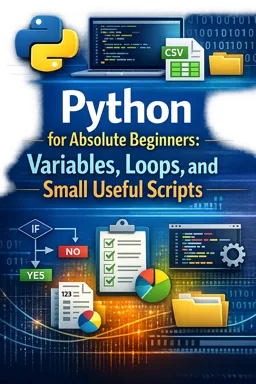

Free ebook for absolute beginners learning Python variables, loops, functions, files, error handling, and useful starter scripts.
Free ebook content
-

Setting Up a Beginner-Friendly Python Workspace
+ Exercise: Why is using a virtual environment recommended when setting up a beginner-friendly Python workspace?
-
Understanding Values, Variables, and Core Data Types
+ Exercise: In Python, what is the key reason changing a list through one variable can also change what another variable shows?
-
Working with Strings and User Input for Simple Programs
+ Exercise: When asking the user for their age and using it in math, which approach is most beginner-friendly and least fragile?


-
Controlling Program Flow with Conditions and Comparisons
+ Exercise: Why is the condition written as if text and text[0] == A instead of just checking text[0] == A?
-
Repeating Actions with Loops and Iteration Patterns
+ Exercise: When should you choose a while loop instead of a for loop in Python?
-
Organizing Code with Functions and Reusable Logic
+ Exercise: Why is returning a value often better than printing inside a function when you want reusable logic?
-
Storing and Updating Data with Lists and Dictionaries
+ Exercise: You want to add all items from one list into another list so they become separate elements, not a nested list. Which operation should you use?
-
Reading and Writing Files for Practical Automation
+ Exercise: You need to extract only lines containing WARNING or ERROR from a very large log file and save them into a new file. Which approach best matches a memory-friendly and safe solution?
-
Handling Errors with Try/Except and Defensive Checks
+ Exercise: In a loop that asks the user to choose an option from 1 to 5, which approach correctly handles both non-numeric input and an out-of-range number?
-
Building a Personal Budget Tracker Script
+ Exercise: Why does the budget tracker store amount as a positive number and also store a kind field (income or expense)?
-
Creating a Text Cleaner for Formatting and Filtering
+ Exercise: Why is designing a text cleaner as a pipeline of stages useful?
-
Parsing and Summarizing Data with a Simple CSV Reader
+ Exercise: Why is using Python’s csv module (such as csv.DictReader) more reliable than splitting each line with line.split(,) when reading CSV files?
-
Practice Exercises with Expected Outputs and Self-Checks
+ Exercise: In the Guess the Number game with 5 attempts, what should happen when the user enters a non-integer such as abc?
-
Troubleshooting Strategies and Next Steps for Continued Learning
+ Exercise: When a script produces the wrong final output but does not crash, what is an effective way to locate where the mistake begins?
About the free ebook
Python for Absolute Beginners: Variables, Loops, and Small Useful Scripts
This free ebook provides a practical first step into Python programming for people who want to write clear, useful code from day one. Start by creating a beginner-friendly workspace, then learn how Python represents values through numbers, text, booleans, variables, and core data types.
Build confidence with essential Python logic
Learn how to accept user input, work with strings, compare values, and make decisions with conditional statements. You will also practice repeating tasks with loops, organizing repeated actions into functions, and managing collections of information with lists and dictionaries.
The explanations focus on the reasoning behind each concept, helping you understand not only what code does but also when to use it. Small examples encourage you to test ideas, inspect results, and turn everyday tasks into simple programs.
Create scripts for real-world tasks
Move beyond isolated exercises by working with files, handling common errors using try/except, and adding defensive checks to make scripts more reliable. Practical projects include a personal budget tracker, a text-cleaning tool, and a simple CSV data reader that can summarize information.
Practice, troubleshoot, and continue learning
Guided exercises with expected outputs and self-checks reinforce the fundamentals. The ebook also introduces troubleshooting habits that make errors less frustrating and helps you identify sensible next steps for continued Python learning.
- Write and run simple Python programs
- Use variables, conditions, loops, functions, and collections
- Read and write text files for lightweight automation
- Create small scripts that solve useful personal tasks
What Python concepts are covered before the practical scripts?
It covers variables, data types, strings, input, conditions, loops, functions, lists, dictionaries, files, and error handling.
What kind of Python projects does the ebook include?
You build a personal budget tracker, a text cleaner, and a simple CSV reader and summarizer.
Does the ebook explain how to handle Python errors?
Yes. It introduces try/except, defensive checks, and practical troubleshooting strategies.
This ebook includes:

14 content chapters

Digital certificate of course completion (Free)

Exercises to train your knowledge

100% free, from content to certificate
Ready to get started?

 recommended
In the app you will also find...

Over 5,000 free courses
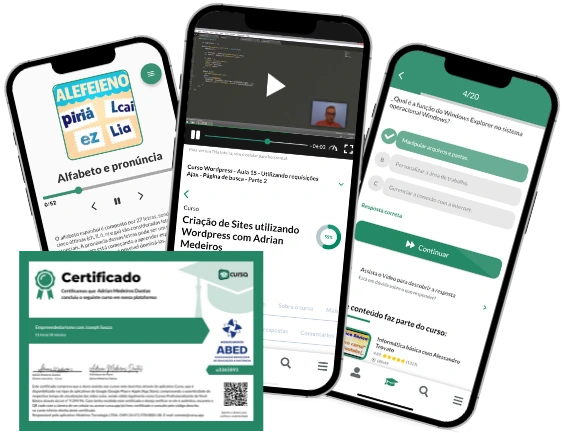
Programming, English, Digital Marketing and much more! Learn whatever you want, for free.

Study plan with AI
Our app's Artificial Intelligence can create a study schedule for the course you choose.

From zero to professional success
Improve your resume with our free Certificate and then use our Artificial Intelligence to find your dream job.
You can also use the QR Code or the links below.