
Free ebook on practical Python data modeling with dataclasses, Pydantic, type hints, validation, serialization, and model evolution.
Free ebook content
-

Domain Data Modeling Goals and Boundaries
+ Exercise: Which approach best preserves clear boundaries in a Python domain model while still enforcing business invariants?
-
Type Hints as an Executable Design Tool
+ Exercise: When treating type hints as an executable design tool, where should runtime validation be applied to best protect the core of the system?
-
Dataclasses for Clean Domain Objects
+ Exercise: When designing a dataclass-based domain object, which approach best helps keep the object valid and hard to misuse?
-
Enforcing Invariants with Post-Initialization and Validators
+ Exercise: Why is it recommended to enforce invariants during object creation using dataclass __post_init__ or Pydantic validators?


-
Value Objects, Entities, and Identity Semantics
+ Exercise: Which approach best avoids collection bugs when tracking a group of mutable entities like customers?
-
Immutability, Freezing, and Controlled Mutation
+ Exercise: In a frozen dataclass, why can a list field still be modified, and what approach best achieves deep immutability?
-
Protocols and Structural Typing for Layer Decoupling
+ Exercise: How do Protocols support layer decoupling in a Python application?
-
Modeling Collections, Nested Structures, and Optionality
+ Exercise: In a Pydantic patch/update workflow, how can you avoid accidentally overwriting fields that were not provided in the input payload?
-
Serialization and Deserialization Strategies
+ Exercise: When accepting a partial update payload, which approach best preserves correct patch semantics by distinguishing between fields not provided and fields explicitly set to null?
-
Pydantic-Style Validation for Robust Input Boundaries
+ Exercise: What is the main purpose of using a boundary validation pipeline that parses, validates, normalizes, and then hands off input data?
-
Error Modeling and Validation Feedback Design
+ Exercise: When designing validation feedback for APIs or CLIs, which approach best makes errors machine-readable and actionable?
-
Testing Data Models: Invariants, Edge Cases, and Contracts
+ Exercise: Which test best captures a model contract about a boundary rule rather than just validating input types?
-
Maintaining Model Evolution: Versioning and Backward Compatibility
+ Exercise: Which approach best keeps your internal Python model stable by transforming older payloads into the newest representation before the rest of the code processes them?
-
Integrating Domain Models with Application and Persistence Layers
+ Exercise: Which approach best prevents persistence concerns from leaking into domain logic when integrating layers?
About the free ebook
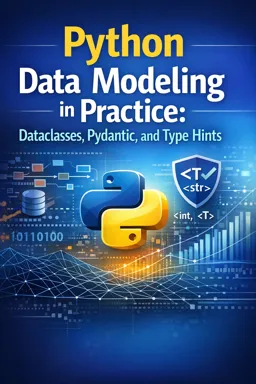
Python Data Modeling in Practice: Dataclasses, Pydantic, and Type Hints
Build Python applications around data models that are clear, dependable, and ready to evolve. This free ebook explores practical techniques for representing business concepts with type hints, dataclasses, validation, and Pydantic-style boundary models.
Design models that express real rules
Learn how to distinguish entities from value objects, define identity semantics, model optional and nested data, and enforce invariants where they belong. The material emphasizes domain-focused design: models should communicate intent, prevent invalid states, and remain understandable as requirements change.
Use Python’s type system with purpose
Discover how type hints can act as an executable design tool and how protocols support decoupled components through structural typing. Practical guidance covers frozen models, controlled mutation, collection modeling, and choosing appropriate defaults without hiding important business decisions.
Validate and move data safely
Explore serialization and deserialization strategies for APIs, files, and persistence layers. You will see how Pydantic-style validation creates robust input boundaries, how useful validation feedback can be modeled, and how domain models can stay separate from transport and storage concerns.
Keep models reliable over time
Strong data models need tests and an evolution strategy. This ebook addresses testing invariants, edge cases, and contracts, along with versioning and backward compatibility. It also explains practical integration patterns between domain, application, and persistence layers.
What you will gain
- Patterns for expressive dataclasses and validated input models
- Methods for protecting invariants and handling errors clearly
- Approaches for maintainable model changes in production code
When should I use a dataclass instead of a Pydantic model in Python?
Use dataclasses for core domain objects and Pydantic-style models at input, API, or configuration boundaries requiring parsing and validation.
How can Python dataclasses enforce business rules?
Validate fields in post-initialization logic, reject invalid combinations, and use frozen objects or controlled methods to protect invariants.
What is structural typing with Python Protocols?
Protocols define required behavior rather than inheritance, letting components depend on compatible interfaces and reducing coupling.
This ebook includes:

14 content chapters

Digital certificate of course completion (Free)

Exercises to train your knowledge

100% free, from content to certificate
Ready to get started?

 recommended
In the app you will also find...

Over 5,000 free courses
Programming, English, Digital Marketing and much more! Learn whatever you want, for free.

Study plan with AI
Our app's Artificial Intelligence can create a study schedule for the course you choose.

From zero to professional success
Improve your resume with our free Certificate and then use our Artificial Intelligence to find your dream job.
You can also use the QR Code or the links below.