
Free ebook explaining liberalism, conservatism, socialism, and other political ideologies in clear, neutral plain language.
Free ebook content
-

Political Ideologies in Plain Language: Core Questions and Vocabulary
+ Exercise: In the framework for mapping a policy disagreement, what is the main purpose of surfacing hidden assumptions using “if…then…” statements?
-
Liberalism: Individual Rights, Rule of Law, and Competing Ideas of Freedom
+ Exercise: Which policy approach best reflects a liberal rule-of-law way to evaluate expanded government surveillance after attacks?
-
Conservatism: Tradition, Social Order, and Skepticism About Rapid Change
+ Exercise: Why do conservatives often prefer incremental, testable reforms instead of rapid, sweeping changes?
-
Socialism: Equality, Collective Provision, and Critiques of Capitalism
+ Exercise: Which description best matches a socialist approach to reducing inequality, as presented here?
-
Libertarianism: Minimal State, Property Rights, and Market Solutions
+ Exercise: Which policy approach best matches libertarian reasoning when evaluating government action?
-
Anarchism: Authority Skepticism and Visions of Stateless Coordination
+ Exercise: Which approach best reflects how anarchism aims to coordinate society while opposing coercive hierarchy?


-
Feminism as Political Ideology: Power, Equality, and the Public–Private Boundary
+ Exercise: A policy team wants to evaluate a new parental leave program through a feminist lens. Which approach best matches the toolkit described for analyzing any policy?
-
Environmentalism and Green Ideologies: Sustainability, Growth, and Responsibility
+ Exercise: Which policy approach best matches the idea of reducing emissions by making pollution more expensive while letting households and firms choose how to adjust?
-
Nationalism, Globalism, and Populism: Belonging, Sovereignty, and ‘The People’
+ Exercise: A politician argues that major decisions should be made through national referenda because unelected bureaucrats and courts are blocking what “ordinary people” want. Which lens best describes the core framing of this argument?
-
Authoritarianism and Totalitarian Tendencies: State Power, Control, and Compliance
+ Exercise: Which scenario best illustrates an authoritarian risk in an “anti-disinformation” policy?
-
How Ideologies Show Up in Policy Debates: A Neutral Comparison Toolkit
+ Exercise: In the “Policy Lab” method, what is the main purpose of tagging claims as [VALUE] or [EMPIRICAL]?
-
Hybrid and Modern Variations: Centrism, Third Way, Neoliberalism, and Post-Liberal Currents
+ Exercise: A policy proposal keeps public funding for a service, allows a mix of public and private providers, and uses performance rules plus audits and transparency metrics. Based on the diagnostic focus on institutional design, how should this arrangement be classified?
-
Building Your Own Ideology Map: Values, Evidence, Trade-offs, and Consistency Checks
+ Exercise: Which statement best describes the purpose of an ideology map?
About the free ebook
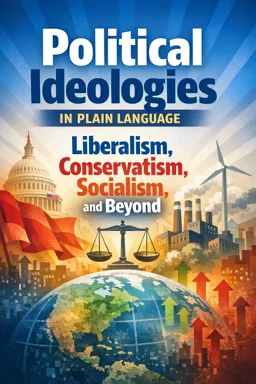
Political Ideologies in Plain Language: Liberalism, Conservatism, Socialism, and Beyond
This free ebook offers a clear, neutral guide to the ideas that shape political debate, public policy, and business environments. It explains how major ideologies answer enduring questions about freedom, equality, authority, property, community, markets, and the role of government.
Understand ideas without political jargon
Explore liberalism, conservatism, socialism, libertarianism, anarchism, feminism, environmentalism, nationalism, globalism, populism, authoritarianism, and totalitarian tendencies. Each perspective is presented through its central values, common arguments, internal differences, and practical policy implications.
Compare competing views fairly
Political labels can simplify complex beliefs. This ebook provides a neutral comparison toolkit for examining policy debates, including the trade-offs between individual rights and collective provision, economic growth and sustainability, stability and reform, or national sovereignty and international cooperation.
What you will gain
- Plain-language definitions of essential political vocabulary
- Clear distinctions between related ideologies and movements
- Context for debates about markets, welfare, regulation, identity, and state power
- A practical framework for mapping your own values and testing them for consistency
Rather than telling you what to believe, this ebook helps you recognize assumptions, assess evidence, and understand why reasonable people can reach different conclusions. It is a useful resource for readers interested in politics, public policy, leadership, marketing audiences, and the social forces that influence institutions and decisions.
What is the difference between liberalism and libertarianism?
Both value individual liberty, but libertarianism generally favors a much smaller state and stronger limits on regulation and taxation.
How does socialism differ from social democracy?
Socialism commonly seeks broader social or public ownership, while social democracy usually retains markets alongside extensive welfare and regulation.
What is a neutral way to compare political ideologies?
Compare their views on rights, equality, authority, property, markets, community, evidence, and policy trade-offs.
This ebook includes:

13 content chapters

Digital certificate of course completion (Free)

Exercises to train your knowledge

100% free, from content to certificate
Ready to get started?

 recommended
In the app you will also find...

Over 5,000 free courses
Programming, English, Digital Marketing and much more! Learn whatever you want, for free.

Study plan with AI
Our app's Artificial Intelligence can create a study schedule for the course you choose.

From zero to professional success
Improve your resume with our free Certificate and then use our Artificial Intelligence to find your dream job.
You can also use the QR Code or the links below.