
SMART objectives are specific, measurable, achievable, relevant, and time-bound goals that guide PR activities and make results easier to evaluate.

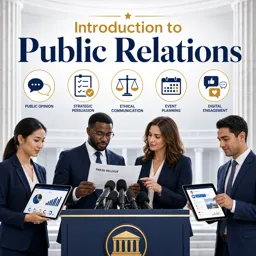
Duration of the online course: 7 hours and 51 minutes
5

(8)
Build PR skills to shape reputation and influence public opinion in this free online course—cover ethics, planning, media tools, and evaluation.
Public relations is more than publicity. It is the disciplined work of building trust, protecting credibility, and creating communication that serves both an organization and the public. In this course, you will develop a clear understanding of what PR is, what it is not, and why it matters in business, marketing, and the public policy arena—especially when messages can quickly shape opinion, behavior, and community outcomes.
You will explore the purpose of public relations from an academic perspective and connect it to real-world practice: defining the problem, learning how research guides decisions, and translating insights into a program plan with objectives that are specific and measurable. This foundation helps you move beyond vague awareness goals and toward outcomes you can justify to stakeholders, whether you are supporting a campaign, advising leadership, or communicating on behalf of a public-facing institution.
Ethics is treated as a core competency rather than an afterthought. You will examine how PR professionals evaluate choices, balance competing responsibilities, and make decisions that stand up to scrutiny. Along the way, you will consider persuasion and its boundaries, including the ethical issues that arise when messages are designed to influence others.
To connect strategy with action, the course addresses implementation, the role of communication tools, and why evaluation is essential. You will also learn how PR adapts for diverse audiences, with attention to the difference between diversity-focused communication and international or global approaches. As you work with media-oriented writing and digital communication practices, you will strengthen your ability to craft clear messages while recognizing legal risks such as defamation and the practical distinction between libel and slander.
Finally, you will look at the day-to-day life of PR and the planning of events, including why defining the exact type of event is crucial before decisions about format, messaging, and success metrics can be made. By the end, you will have a cohesive view of the PR process—from situation analysis to evaluation—ready to apply to organizational communication, campaigns, and public-interest initiatives.

7 hours and 51 minutes of online video course

Digital certificate of course completion (Free)

Exercises to train your knowledge

100% free, from content to certificate
What are SMART objectives in a public relations program plan?
SMART objectives are specific, measurable, achievable, relevant, and time-bound goals that guide PR activities and make results easier to evaluate.
What is the difference between libel and slander in public relations?
Libel is defamatory communication in a fixed form, such as writing or online content, while slander is spoken defamation.
Why is a situation statement included in the PR planning process?
It defines the problem or opportunity the campaign will address, providing the research-based context for goals, strategies, and tactics.
Ready to get started?Download the app and get started today.
Install the app now
to access the course
Over 5,000 free courses
Programming, English, Digital Marketing and much more! Learn whatever you want, for free.

Study plan with AI
Our app's Artificial Intelligence can create a study schedule for the course you choose.

From zero to professional success
Improve your resume with our free Certificate and then use our Artificial Intelligence to find your dream job.
You can also use the QR Code or the links below.




Free CourseEssentials of Global Health
5
(3)

11h16m

27 exercises
Free CoursePolitical Complexity
5
(52)
6h54m
19 exercises
Free CourseIntroduction to Enviromental Policy and Planning
4.7

(3)
1h52m
17 exercises
Free CourseInternational Relations
4.4
(8)
12h00m
54 exercises
Free CoursePower and politics
4.4
(20)
31h33m
22 exercises
Free CourseIntro to Political Science
4
(4)
1h51m
11 exercises
Free CoursePolitical Science
3.5
(4)
21h28m
18 exercises
Free CourseIntroduction to Political Philosophy
New
17h35m
24 exercises
Free CoursePublic Economics: Taxation, Social Insurance, Public Goods and Corporate Tax Policy
New
32h04m
28 exercises
Carry knowledge in your pocket.
Download the Cursa app.
There are hundreds of free courses available, with a free certificate of completion that is saved in your mobile image gallery.
Download the app to access the Course Completion Certificate for Free.


+ 10 million
students

Free and Valid
Certificate

60 thousand free
exercises

4.8/5 rating in
app stores

Free courses in
video and ebooks
Course comments: Introduction to Public Relations
Matthew Ogwuche
Fantastic lecture
Muruhuka Augustin
This is my first day and my first experience with this amazing course. I'm incredibly happy and annoying the learning our able trainer.
Felicia
she’s an excellent teacher and is the best way to get grounded in the foundations of Public Relations