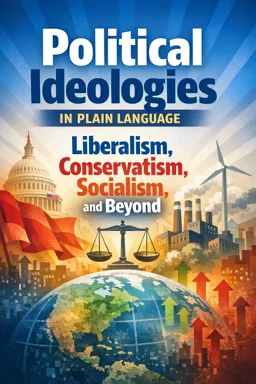
What an ideology is (and what it isn’t)
An ideology is a structured set of values and assumptions that helps people decide what political goals matter and which policy choices seem acceptable. It works like a mental map: it highlights certain problems, suggests causes, and ranks solutions.
Ideology vs. party labels
A party label (for example, “liberal,” “conservative,” “social democratic”) is often a shortcut used in campaigns and media. Parties can change positions, combine ideas, or adopt policies for strategic reasons. An ideology is more stable: it is the underlying logic that explains why certain policies feel right or wrong.
Ideology vs. personalities
Charismatic leaders can attract support even when their policy views are unclear or inconsistent. Personality politics answers “Who do I trust?” Ideology answers “What should be done, and on what principles?”
Ideology vs. single issues
Single-issue politics focuses on one outcome (for example, taxes, immigration, climate policy). Ideology connects issues by using a broader value system. Two people can agree on a single issue for different ideological reasons, or disagree even if they share some goals.
| What you’re looking at | Main focus | Typical clue |
|---|---|---|
| Ideology | Values + assumptions + priorities | Explains positions across many issues |
| Party label | Coalition + branding + platform | May shift with elections or leadership |
| Personality | Trust, style, identity | Support persists despite policy inconsistency |
| Single issue | One policy outcome | Agreement/disagreement doesn’t generalize |
The recurring questions ideologies answer
Most political ideologies can be understood as different answers to a small set of recurring questions. When you hear a policy argument, try to identify which question it is really about.
- Listen to the audio with the screen off.
- Earn a certificate upon completion.
- Over 5000 courses for you to explore!

Download the app
1) What counts as freedom?
Freedom is not a single idea. Two common meanings show up in debates:
Negative freedom (freedom from interference)
Negative freedom means you are free when others (especially the state) do not stop you. The focus is on limits: fewer restrictions, fewer prohibitions, fewer mandates.
- Policy example: “The government should not tell adults what to do with their own money.”
- Typical concern: Rules can become coercive or paternalistic.
Positive freedom (freedom to actually act)
Positive freedom means you are free when you have the real capacity to pursue goals. The focus is on enabling conditions: education, health, safety, and resources that make choices meaningful.
- Policy example: “People aren’t truly free to choose work if they can’t access basic healthcare or schooling.”
- Typical concern: Formal rights can be hollow without practical ability.
How the same debate can be two different freedom claims
Consider a proposal for mandatory paid leave:
- Negative freedom framing: It restricts employers’ and employees’ freedom to contract on their own terms.
- Positive freedom framing: It enables workers to care for family without losing income, expanding real options.
2) What kind of equality matters?
“Equality” can mean different targets. Ideologies often prioritize one type over others.
Equality before the law (legal equality)
Everyone is subject to the same laws and has equal legal standing. The emphasis is on impartial rules and equal treatment by institutions.
- Policy example: Anti-discrimination enforcement in hiring or housing.
Equality of opportunity
People should have a fair chance to compete. Inequalities are more acceptable if the “starting line” is not rigged by background, discrimination, or lack of access to basics.
- Policy example: Public education funding, early-childhood programs, or removing barriers to entry in professions.
Equality of outcome
Large gaps in results (income, wealth, health, life expectancy) are seen as a problem in themselves, not just as a byproduct of unfair starting conditions.
- Policy example: Progressive taxation, wealth taxes, or strong income supports.
Trade-offs to listen for
- Opportunity vs outcome: A policy can improve opportunity without equalizing outcomes, or equalize outcomes while limiting certain opportunities.
- Equality vs liberty: Some policies that reduce inequality require more rules or higher taxes, which some see as reducing negative freedom.
3) What is the market for, and when should it be limited?
Markets are tools for coordinating production and exchange through prices and voluntary transactions. Ideologies differ on what markets do well, what they do poorly, and what should never be treated as a commodity.
Common pro-market claims
- Efficiency: Competition can lower costs and improve quality.
- Innovation: Profit incentives can drive new products and services.
- Choice: Consumers can select what fits their preferences.
Common limits-to-market claims
- Market failures: Pollution, monopolies, information asymmetry, and under-provision of public goods.
- Power imbalances: “Voluntary” deals can be shaped by desperation or lack of alternatives.
- Moral boundaries: Some goods (votes, basic justice, certain human services) may be seen as inappropriate to buy and sell.
Practical diagnostic questions
- Is competition real, or is the market dominated by a few players?
- Do buyers understand what they’re buying (for example, complex financial products)?
- Are there spillovers (for example, pollution) that affect non-consenting third parties?
- Is the good essential for basic participation in society (for example, primary education)?
4) What role do tradition and social norms play?
Traditions and norms are informal rules about how people should behave. Ideologies differ on whether these are valuable stabilizers, unjust constraints, or both depending on context.
Tradition as a stabilizer
- Claim: Long-standing practices often contain “tested” wisdom and help maintain social trust.
- Policy implication: Change should be cautious, incremental, and attentive to unintended consequences.
Tradition as a constraint
- Claim: Norms can preserve hierarchy, exclusion, or discrimination.
- Policy implication: Reform may be needed to expand rights and recognition.
How to spot the underlying disagreement
Listen for whether the argument treats social order as fragile (needing protection) or treats existing norms as a source of hidden coercion (needing challenge). The same policy—say, changing school curricula—can be framed as protecting shared values or as correcting systemic bias.
5) What should the state do, and what should it not do?
Ideologies differ on the legitimate scope of state action. Many disputes are not about the goal (safety, prosperity, dignity) but about which institution should achieve it and how much coercion is acceptable.
Common roles assigned to the state
- Security and rule enforcement: policing, courts, national defense.
- Public goods: infrastructure, basic research, epidemic control.
- Correcting market failures: environmental rules, anti-monopoly policy.
- Social protection: unemployment insurance, pensions, healthcare support.
Common limits placed on the state
- Rights constraints: even popular policies may be illegitimate if they violate basic rights.
- Competence constraints: the state may be seen as too slow, too blunt, or prone to capture by interest groups.
- Pluralism constraints: the state should not impose a single “good life” on diverse citizens.
Institution choice: state, market, civil society
Many policy disagreements are really about which tool to use:
- State tool: laws, taxes, public programs.
- Market tool: competition, prices, private provision.
- Civil society tool: charities, unions, religious groups, community associations, mutual aid.
Shared glossary (plain-language definitions)
| Term | Plain-language meaning | Quick example |
|---|---|---|
| State | The set of institutions with ultimate authority to make and enforce rules in a territory (courts, police, agencies). | Tax authority enforcing payment. |
| Government | The people currently running the state (elected leaders and appointed officials). | A cabinet proposing a budget. |
| Civil society | Organizations and networks outside the state and for-profit market that shape social life. | Unions, neighborhood groups, charities. |
| Rights | Claims people can make that others (including the state) must respect. | Right to due process in court. |
| Duties | Responsibilities people owe to others or to the political community. | Jury duty; paying taxes. |
| Legitimacy | Whether power is seen as rightfully exercised and worthy of obedience. | Accepting election results as valid. |
| Sovereignty | Final authority over a territory—no higher power can overrule it within that domain. | A state controlling its border policy. |
| Democracy | A system where political power is accountable to the people, typically through elections and rights protections. | Regular competitive elections with free speech. |
| Capitalism | An economic system where most production is privately owned and coordinated largely through markets. | Private firms competing to sell goods. |
| Welfare state | Public programs that reduce risk and hardship (health, income support, pensions). | Unemployment insurance during job loss. |
| Redistribution | Shifting resources across people or groups, usually via taxes and transfers. | Progressive taxes funding cash benefits. |
| Regulation | Rules that shape how individuals and firms can act in markets and society. | Food safety standards; emissions limits. |
A practical framework: mapping a policy disagreement
Use the steps below to translate a heated policy argument into a clearer map of values, trade-offs, and assumptions. This helps you understand what is really being contested—and what evidence could actually change minds.
Step 1: Write the policy in one sentence
Be concrete and testable. Avoid slogans.
- Example: “Increase the minimum wage to $X over Y years, with small-business tax credits.”
Step 2: Identify the stated goal(s)
Most sides share some goals but rank them differently.
- Examples of goals: reduce poverty, protect jobs, reward work, keep prices low, preserve small businesses.
Step 3: Translate arguments into the five core questions
- Freedom: Is the policy expanding real options (positive) or restricting voluntary choice (negative)?
- Equality: Is the aim equal legal treatment, fair opportunity, or narrower outcome gaps?
- Markets: Is the market producing acceptable results here, or failing due to power imbalance/monopoly/externalities?
- Tradition/norms: Does the policy reinforce or disrupt valued social expectations (work norms, family roles, community stability)?
- State role: Should the state set rules, provide services, or leave it to bargaining/associations?
Step 4: List the trade-offs explicitly
Turn vague worries into paired tensions.
- Examples: higher wages vs fewer entry-level jobs; simpler rules vs tailored exemptions; national standards vs local flexibility; short-term costs vs long-term gains.
Step 5: Surface hidden assumptions (the “if…then…” statements)
Most disagreements persist because people assume different facts about how the world works.
If employers have strong market power, then wage floors may raise incomes with limited job loss. If labor markets are highly competitive, then wage floors may reduce hiring or hours. If price increases are passed on to consumers, then the policy may affect inflation and purchasing power.Step 6: Decide what evidence would matter
Separate value conflict from factual dispute.
- Factual checks: local labor market concentration, wage distribution, employment trends, price changes.
- Design checks: phase-in speed, regional variation, enforcement capacity, complementary policies (tax credits, training).
Step 7: Reframe the disagreement as a choice among principles
Write two or three “principle summaries” that fairly represent each side’s priority ordering.
- Example A: “Protect voluntary contracting and job creation; use targeted aid rather than broad mandates.”
- Example B: “Guarantee a decent wage floor to expand real freedom and reduce outcome inequality; accept some market constraints.”
Step 8: Map possible compromises (without pretending values disappear)
Compromises usually adjust scope, timing, targeting, or institution choice.
- Scope: exemptions for very small firms.
- Timing: slower phase-in tied to economic indicators.
- Targeting: combine wage policy with earned-income tax credits.
- Institution choice: strengthen collective bargaining rather than set a single national rate.