Duration of the online course: 11 hours and 16 minutes
5
(2)
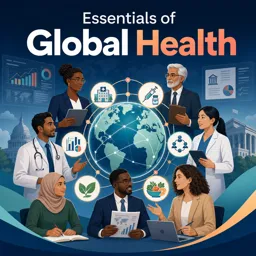
Build global health expertise with a free online course on policy, systems, and diseases—learn to evaluate interventions and improve population outcomes.
In this free course, learn about
Core concepts, history, and key perspectives that define the field of global health
How social determinants and inequities drive health disparities within and between countries
Global health actors, governance, and SDGs as a framework for priorities and accountability
Trends in global health status: life expectancy gains and remaining gaps across regions
Demographic transition, population change, and their effects on disease patterns and health needs
How to measure burden of disease using DALYs and interpret causes of death/disability
Major risk factors for mortality/DALYs and high-impact prevention strategies (e.g., WASH, nutrition)
Economic evaluation: cost-effectiveness and value-for-money principles in global health choices
Health systems goals (WHO), organization, and Universal Health Coverage (UHC) fundamentals
Priority topics in women, child, and adolescent health, including vaccines and key interventions
Humanitarian emergencies: key definitions (e.g., refugee vs internally displaced) and implications
Major infectious diseases and control strategies: HIV, TB, malaria, NTDs, emerging infections
Noncommunicable diseases, mental health, injuries, and leading behavioral risks (tobacco, alcohol)
Public health futures: technology, intersectoral approaches, and COVID as a systems challenge
About the free online course
Understanding global health is now a core professional skill for anyone working in business, marketing, policy, or public service. This free online course helps you make sense of why health outcomes differ so widely across countries and communities, and how decisions made in governments, organizations, and markets translate into real impacts on people’s lives.
You will develop a clear framework for thinking about the global health landscape, from the big picture of demographic change and rising life expectancy to the persistent challenges of infectious disease, maternal and child health, nutrition, and environmental risks. The course emphasizes practical ways to interpret evidence, including how to compare health problems across settings and how to reason about trade-offs when budgets are limited. You will also learn to connect health to broader development goals and understand how actors such as national governments, international institutions, and local systems shape priorities and results.
A major focus is how health systems work and why they sometimes fail: what they are designed to achieve, what universal health coverage means in practice, and how quality, access, and fairness influence outcomes. The course also explores inequality and health disparities, showing how social and economic conditions can be as decisive as medical care. By linking topics like humanitarian emergencies, emerging infections, HIV, tuberculosis, malaria, noncommunicable diseases, mental health, injuries, and COVID-era lessons, you will gain the ability to see patterns across crises rather than treating each issue in isolation.
By the end, you will be better equipped to speak the language of modern public health, evaluate interventions through a value-for-money lens, and contribute to smarter strategies across policy and program design. Whether you are preparing for work in public policy, consulting, impact-focused business, or international development, this course strengthens your ability to make decisions grounded in evidence and ethics, with a sharper view of the global forces shaping health.
Course content
Video class: Course Introduction | Essentials of Global Health with Richard Skolnik13m
Exercise: What important progress did the utilization of long-lasting insecticide-treated bed nets contribute to?
Video class: Key Perspectives on Global Health15m
Exercise: What are social determinants of health?
Video class: The Global Health Context and Who Plays | Essentials of Global Health with Richard Skolnik18m
Exercise: Which of the following statements is accurate about the Sustainable Development Goals (SDGs) as discussed in the 'Essentials of Global Health by Yale Courses'?
Video class: The State of the World's Health | Essentials of Global Health with Richard Skolnik18m
Exercise: What was the main increase in global life expectancy from 1960 to 2013?
Video class: Demography and Health | Essentials of Global Health with Richard Skolnik23m
Exercise: What demographic phenomenon has the most significant impact on health according to the text?
Video class: Measuring the Burden of Disease - the DALY | Essentials of Global Health with Richard Skolnik16m
Exercise: What is DALLY and its significance in measuring health status?
Video class: What Do People Get Sick, Disabled, and Die From? | Essentials of Global Health with Richard Skolnik28m
Exercise: Which major demographic shift regarding health is observed in countries as they develop and improve in aspects such as education and nutrition?
Video class: Key Risk Factors for Illness, Death, and DALY | Essentials of Global Health with Richard Skolnik14m
Exercise: What is a major risk factor for child mortality in sub-Saharan Africa?
Video class: Value for Money in Global Health | Essentials of Global Health with Richard Skolnik14m
Exercise: What is a fundamental principle of cost-effectiveness analysis in global health?
Video class: The Aims and Organization of Health Systems | Essentials of Global Health with Richard Skolnik17m
Exercise: What are the primary goals of a health system according to the World Health Organization?
Video class: Key Health Systems Issues | Essentials of Global Health with Richard Skolnik35m
Exercise: Which of the following correctly defines the concept of 'Universal Health Coverage' (UHC)?
Video class: Health Disparities | Essentials of Global Health with Richard Skolnik21m
Exercise: What is a key concept of health disparities?
Video class: The Environment and Health | Essentials of Global Health with Richard Skolnik24m
Exercise: Which of these interventions is considered a cost-effective way to reduce the environmental health burden related to poor sanitation practices?
Video class: Nutrition and Global Health | Essentials of Global Health with Richard Skolnik40m
Exercise: What is a key factor that could have contributed to Shireen's failure to thrive?
Video class: Women's Health | Essentials of Global Health with Richard Skolnik17m
Exercise: Which of the following is the leading infectious cause of death for women worldwide?
Video class: Child Health | Essentials of Global Health with Richard Skolnik24m
Exercise: What is a highly effective intervention to prevent childhood diseases in low-income countries?
Video class: Childhood Immunizations | Essentials of Global Health with Richard Skolnik10m
Exercise: Which vaccine is NOT part of the pentavalent vaccine mentioned in the text regarding childhood immunization?
Video class: Adolescent Health | Essentials of Global Health with Richard Skolnik19m
Exercise: What is the age range defined for adolescence?
Video class: Complex Humanitarian Emergencies | Essentials of Global Health with Richard Skolnik14m
Exercise: Which two key terms are particularly important to understand due to their differing international and legal status in the context of complex humanitarian emergencies?
Video class: Emerging20m
Exercise: What is a primary factor contributing to the emergence of new infectious diseases?
Video class: HIV | Essentials of Global Health with Richard Skolnik21m
Exercise: Which of the following statements is true regarding the global HIV/AIDS epidemic?
Video class: Tuberculosis | Essentials of Global Health with Richard Skolnik21m
Video class: Malaria | Essentials of Global Health with Richard Skolnik14m
Exercise: Which intervention method is NOT widely recognized as a key effort to reduce the burden of malaria?
Video class: Neglected Tropical Diseases | Essentials of Global Health with Richard Skolnik13m
Video class: Noncommunicable Diseases | Essentials of Global Health with Richard Skolnik21m
Exercise: Which of the following is NOT listed as a leading risk factor for deaths globally in the provided text?
Video class: Cancer and Diabetes | Essentials of Global Health with Richard Skolnik11m
Video class: Tobacco and Alcohol | Essentials of Global Health with Richard Skolnik20m
Exercise: Which risk factor is particularly significant for cardiovascular diseases, cancer, and diabetes, and also contributes to a large number of deaths in low-income countries?
Video class: Mental Health | Essentials of Global Health with Richard Skolnik21m
Video class: Unintentional Injuries | Essentials of Global Health with Richard Skolnik16m
Exercise: What percentage of total deaths worldwide are attributed to unintentional injuries?
Video class: Science and Technology for Global Health | Essentials of Global Health with Richard Skolnik23m
Video class: Key Challenges for the Future of Public Health | Essentials of Global Health with Richard Skolnik19m
Exercise: Which of the following is NOT one of the five main challenges in global health as presented in the lecture?
Video class: COVID: the Quintessential Public Health Problem | Essentials of Global Health with Richard Skolnik33m
Video class: Intersectoral Approaches for Better Health | Essentials of Global Health with Richard Skolnik26m
Exercise: Which of the following is an essential approach for addressing broader determinants of health and ensuring better health outcomes across populations?
What does DALY mean in global health, and why is it used?
DALY means disability-adjusted life year. It measures healthy years lost because of illness, disability, or early death, helping compare disease burdens across populations.
How do long-lasting insecticide-treated bed nets reduce malaria?
They create a protective barrier and kill or repel mosquitoes that transmit malaria, reducing malaria cases and deaths, especially among young children and pregnant women.
What is universal health coverage (UHC) in global health policy?
UHC means everyone can obtain needed quality health services without suffering financial hardship from paying for care.
Ready to get started?Download the app and get started today.