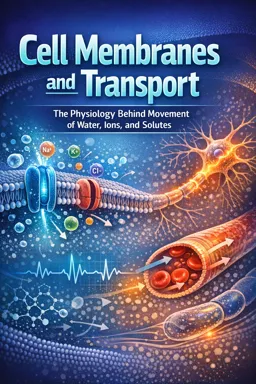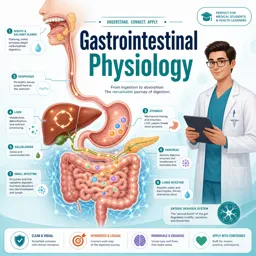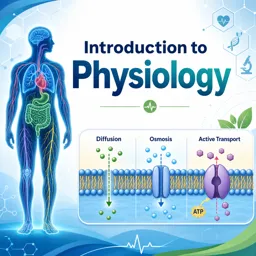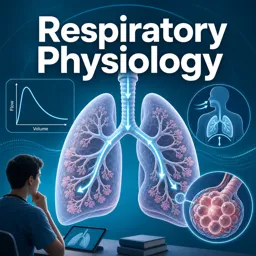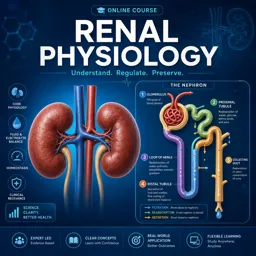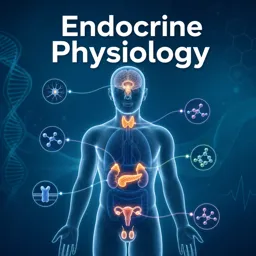

Free ebook on homeostasis, feedback loops, thermoregulation, blood glucose control, and physiological control systems.
Free ebook content
-

Physiology Foundations: Homeostasis and Internal Stability
+ Exercise: In a homeostasis control system, what do sensors primarily detect when a disturbance occurs?
-
Physiology Foundations: Control System Components and Information Flow
+ Exercise: In a physiological control loop, which statement best describes how information and effects flow through the system?
-
Physiology Foundations: Set Points, Error Signals, and Normal Ranges
+ Exercise: A physiological variable rises gradually to a higher level over several hours, then remains stable at that higher plateau, with body responses appearing to maintain it there. Which interpretation best fits this pattern?


-
Physiology Foundations: Negative Feedback as the Primary Stabilizing Mechanism
+ Exercise: Which statement best describes how to identify negative feedback in a physiological control system?
-
Physiology Foundations: Thermoregulation as a Negative Feedback Case Study
+ Exercise: During overheating while exercising on a humid day, why can core temperature keep rising even when sweating and skin vasodilation are strongly activated?
-
Physiology Foundations: Blood Glucose Regulation and Counterregulation
+ Exercise: During early fasting (about 3–12 hours after a meal), which pattern best explains how blood glucose is stabilized?
-
Physiology Foundations: Positive Feedback and Self-Amplifying Loops
+ Exercise: Which statement best describes why positive feedback loops in physiology usually require a separate stop condition?
-
Physiology Foundations: Feedforward Control and Anticipatory Regulation
+ Exercise: Which description best matches how feedforward and feedback commonly work together during a meal?
-
Physiology Foundations: Gain, Sensitivity, and Response Speed in Control Systems
+ Exercise: A control system shows repeated crossings of the set point after a disturbance. Which change best explains this pattern without directly changing gain?
-
Physiology Foundations: Clinical Reasoning with Homeostasis—From Symptom to Loop Failure
+ Exercise: A patient has a core temperature of 39.2°C and is shivering, wrapped in blankets, and says they feel cold. Which control-system issue best explains this mismatched response?
-
Physiology Foundations: Core Vocabulary and Cause-and-Effect Communication
+ Exercise: In a control-loop explanation, which statement correctly separates sensing, deciding, and doing when arterial pressure decreases upon standing?
About the free ebook
Physiology Foundations: Homeostasis, Feedback Loops, and Control Systems
This free ebook introduces the control processes that help the human body maintain a stable internal environment despite changing external and internal conditions. Learn how physiological variables are monitored, compared with functional targets, and adjusted through coordinated responses.
Understand how homeostasis works
Explore the relationship between receptors, control centers, effectors, signals, and responses. The ebook explains how these components exchange information to regulate temperature, blood glucose, fluid balance, and other essential variables.
Study feedback and anticipatory control
Learn why negative feedback is the primary mechanism for stability, how positive feedback amplifies specific events, and how feedforward control prepares the body for expected changes. Clear examples connect control-system concepts to everyday physiology.
Build clinical reasoning skills
Use concepts such as set point, normal range, error signal, gain, sensitivity, and response speed to interpret physiological disturbances. The material supports cause-and-effect thinking when considering how symptoms may arise from a disrupted regulatory loop.
Key learning focus
- Internal stability and regulated variables
- Control-system components and information flow
- Thermoregulation and glucose counterregulation
- Negative, positive, and feedforward mechanisms
- Clinical communication using core physiology vocabulary
Designed for health and physiology learners, this ebook provides a structured foundation for understanding how the body detects change, responds to disruption, and restores functional balance.
What are the main components of a physiological control system?
A control system includes receptors, an integrating or control center, effectors, and communication signals.
How does negative feedback maintain homeostasis?
It detects deviation from a functional range and activates responses that reduce the deviation.
What is the difference between positive feedback and feedforward control?
Positive feedback amplifies a change, while feedforward control anticipates a change before it disrupts a variable.
This ebook includes:

11 content chapters

Digital certificate of course completion (Free)

Exercises to train your knowledge

100% free, from content to certificate
Ready to get started?

 recommended
In the app you will also find...

Over 5,000 free courses
Programming, English, Digital Marketing and much more! Learn whatever you want, for free.

Study plan with AI
Our app's Artificial Intelligence can create a study schedule for the course you choose.

From zero to professional success
Improve your resume with our free Certificate and then use our Artificial Intelligence to find your dream job.
You can also use the QR Code or the links below.