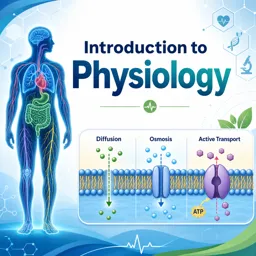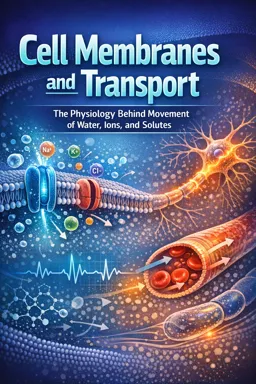

Free ebook on cell membranes and transport, covering diffusion, osmosis, active transport, ion gradients, and membrane potential.
Free ebook content
-

Cell Membranes and Transport: Building the Selective Barrier
+ Exercise: A molecule is neutral but has multiple polar groups (for example, several –OH or –NH groups). What is the best prediction about its ability to cross a phospholipid bilayer unaided?
-
Membrane Permeability and Driving Forces: Why Molecules Move
+ Exercise: Why can Na+ show very little net movement across a cell membrane even when its electrochemical gradient strongly favors entry?
-
Simple Diffusion Across Membranes: From Random Motion to Net Flux
+ Exercise: During simple diffusion across a membrane, why does net flux slow as time passes and the two sides approach equal concentration?
-
Osmosis and Tonicity: Predicting Water Movement in Cells and Tissues
+ Exercise: A cell has an effective intracellular osmolarity of 300 mOsm from non-penetrating solutes. It is placed in an extracellular solution containing 150 mOsm non-penetrating solute plus 150 mOsm fully penetrating solute. What happens to water movement and cell volume over time?
-
Facilitated Diffusion: Channels and Carriers Without Energy Input
+ Exercise: A solute is moved across a membrane by a carrier protein using facilitated diffusion. As solute concentration increases, transport rate rises at first but then plateaus. What best explains the plateau?


-
Active Transport: Using Cellular Energy to Move Solutes Uphill
+ Exercise: Why does blocking the Na+/K+ ATPase reduce glucose absorption from the intestinal lumen?
-
Electrochemical Gradients and Membrane Potential: The Logic of Ions
+ Exercise: If a cell membrane suddenly becomes much more permeable to Na+ at rest, which outcome is most likely for the membrane potential?
-
Transport Integration in Tissues: Fluid Balance and Capillary Exchange
+ Exercise: After prolonged standing, what most directly drives fluid to leave leg capillaries and where does that fluid primarily accumulate?
-
Membrane Transport in Nerves and Muscles: From Ion Flow to Electrical Signals
+ Exercise: Which sequence best explains how an action potential transitions from its rapid upstroke to repolarization in terms of ion transport?
-
Applying Transport Concepts: Predicting Outcomes in Real Physiology Scenarios
+ Exercise: A child with acute watery diarrhea is given either plain water or an oral rehydration solution (ORS) containing Na+ and glucose. Which choice more effectively increases net water absorption into the body, and why?
About the free ebook
Cell Membranes and Transport: The Physiology Behind Movement of Water, Ions, and Solutes
This free ebook explains how cell membranes create a selective barrier and how substances move between cells and their surroundings. Learn the physiological principles that govern water, ion, and solute movement in healthy tissues.
Understand the forces behind membrane movement
Explore membrane permeability, concentration gradients, electrical forces, and pressure differences. The ebook connects random molecular motion to net diffusion and shows why some substances cross lipid bilayers easily while others require transport proteins.
- Simple diffusion and facilitated diffusion
- Osmosis, tonicity, and cell-volume changes
- Channels, carriers, pumps, and active transport
- Electrochemical gradients and membrane potential
Connect transport mechanisms to real physiology
See how membrane transport supports fluid balance, capillary exchange, nerve signaling, and muscle activity. Clear physiological scenarios help you predict the effects of changing solute concentration, permeability, or ion gradients.
Key concepts for health and physiology study
Build a practical foundation for interpreting how cells regulate their internal environment, maintain electrical activity, and coordinate exchange across tissues. Cell membranes are dynamic systems that control both chemical balance and physiological function.
What is the difference between simple diffusion and facilitated diffusion?
Simple diffusion occurs through the lipid bilayer, while facilitated diffusion uses channels or carrier proteins without direct energy input.
How does tonicity predict whether a cell swells or shrinks?
Water moves toward the side with higher effective solute concentration; hypotonic solutions can swell cells, while hypertonic solutions can shrink them.
Why is the sodium-potassium pump important for membrane potential?
It uses ATP to move sodium out and potassium in, helping maintain the ion gradients required for resting membrane potential and excitability.
This ebook includes:

10 content chapters

Digital certificate of course completion (Free)

Exercises to train your knowledge

100% free, from content to certificate
Ready to get started?

 recommended
In the app you will also find...

Over 5,000 free courses
Programming, English, Digital Marketing and much more! Learn whatever you want, for free.

Study plan with AI
Our app's Artificial Intelligence can create a study schedule for the course you choose.

From zero to professional success
Improve your resume with our free Certificate and then use our Artificial Intelligence to find your dream job.
You can also use the QR Code or the links below.