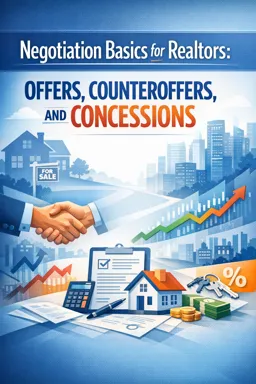

A free ebook for realtors on evaluating offers, using counteroffers, managing contingencies, and negotiating concessions confidently.
Free ebook content
-

Negotiation Basics for Realtors: Mindset, Roles, and Boundaries
+ Exercise: A client asks, “Can I cancel this contract without being in breach?” What is the most appropriate agent response based on role boundaries?
-
Anatomy of an Offer: Price, Terms, and the Full Package
+ Exercise: When comparing two offers with similar prices, which approach best reflects how a seller typically evaluates overall offer strength?
-
Client Preparation: Setting Expectations Before Offers Begin
+ Exercise: What is the main purpose of creating a documented negotiation plan with a client before offers or counteroffers begin?
-
Leverage Points in Residential Deals: Where Negotiation Power Comes From
+ Exercise: In a situation where a listing agent says “We have another offer coming” but provides no details, what is the most appropriate negotiation approach for a buyer’s agent?


-
Counteroffers and Offer Strategy: Concede, Hold, or Trade
+ Exercise: When using a multiple-counter strategy (Option A and Option B), what is the best way to reduce confusion and prevent the other side from mixing terms?
-
Contingencies and Risk Management: Inspection, Financing, Appraisal, Sale-of-Home
+ Exercise: A buyer wants to make an offer more attractive to a seller while still keeping a safety valve for major inspection issues. Which inspection-contingency approach best fits this goal?
-
Concessions and Credits: Repairs, Closing Costs, and Creative Solutions
+ Exercise: When a buyer’s main problem is having too little cash-to-close, which concession type is typically the best first choice (assuming loan limits allow it)?
-
Escalation Clauses and Multiple-Offer Dynamics: Competing Without Chaos
+ Exercise: In a multiple-offer situation, what is the main purpose of including proof language in an escalation clause?
-
Keeping Emotions Out of Negotiation: Communication That De-escalates
+ Exercise: When a client becomes emotional and wants to send an angry response, which sequence best helps prevent a reactive decision and keep the negotiation solvable?
-
Negotiation Workflows, Documentation, and Smooth Closings
+ Exercise: During negotiations, a seller agrees on a phone call to provide a $5,000 credit if closing occurs by a specific date. What is the best next step to prevent this term from becoming an "orphaned" promise and to keep the deal on track?
About the free ebook
Negotiation Basics for Realtors: Offers, Counteroffers, and Concessions
Effective real estate negotiation is more than reaching a price. It is the ability to evaluate the full offer, protect a client’s priorities, manage risk, and communicate clearly from the first conversation through closing.
Build a practical negotiation framework
This free ebook helps realtors approach residential negotiations with a structured, client-focused mindset. Learn how buyer and seller goals, market conditions, timing, financing, contingencies, and property condition can influence bargaining power. Rather than treating every request as a win-or-lose issue, you will learn to identify options that create value for both sides.
Handle offers with clarity
Explore how to assess price alongside important terms such as earnest money, closing dates, inspection provisions, appraisal exposure, financing requirements, and sale-of-home contingencies. The ebook explains how to prepare clients before an offer arrives, set decision boundaries, and avoid surprises when negotiations become fast-moving or emotional.
Use counteroffers and concessions strategically
Learn when to hold firm, when to concede, and when to trade one term for another. Practical guidance covers repair requests, seller credits, closing-cost assistance, escalation clauses, and multiple-offer situations. You will also examine ways to communicate proposals without escalating conflict or weakening your client’s position.
Support smoother transactions
Strong negotiation continues after acceptance. This ebook highlights documentation habits, workflow discipline, and risk-aware communication that can reduce misunderstandings and help keep a transaction on track. Use these principles to guide clients with confidence while staying within your role, local practices, brokerage policies, and applicable laws.
What you will gain
- A method for comparing the complete strength of competing offers
- Client-preparation techniques for clearer decisions
- Approaches for counteroffers, credits, contingencies, and repair negotiations
- Communication practices that keep discussions professional and productive
Note: This educational resource is not legal, financial, or brokerage compliance advice. Consult appropriate professionals and follow local regulations.
How should a realtor compare two offers with different prices and contingencies?
Compare net proceeds or total cost, financing strength, contingency risk, timing, deposits, and requested concessions—not price alone.
What can a realtor negotiate instead of reducing the purchase price?
Possible trade items include closing dates, repair scope, seller credits, personal property, earnest money, and contingency deadlines.
How do escalation clauses affect multiple-offer negotiations?
They can raise an offer automatically to a stated cap, but should be reviewed carefully for proof requirements, increments, and client risk.
This ebook includes:

10 content chapters

Digital certificate of course completion (Free)

Exercises to train your knowledge

100% free, from content to certificate
Ready to get started?

 recommended
In the app you will also find...

Over 5,000 free courses
Programming, English, Digital Marketing and much more! Learn whatever you want, for free.

Study plan with AI
Our app's Artificial Intelligence can create a study schedule for the course you choose.

From zero to professional success
Improve your resume with our free Certificate and then use our Artificial Intelligence to find your dream job.
You can also use the QR Code or the links below.