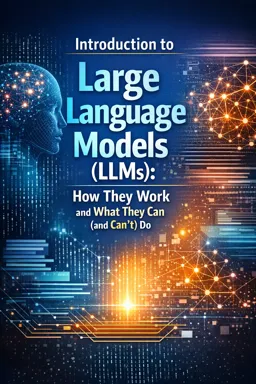

Free ebook introducing large language models, tokens, hallucinations, prompting, grounded workflows, and responsible AI use.
Free ebook content
-

What an LLM Is and What It Produces
+ Exercise: When you need an LLM to produce machine-readable output for automation, which prompting approach best improves reliability?
-
Tokens and Why Text Is Chunked
+ Exercise: Why is chunking by tokens often more reliable than chunking by a fixed number of characters when working with LLM context limits?
-
Context Windows and In-Session Memory
+ Exercise: What is the most accurate explanation for why a model may seem to forget earlier details in a long chat?
-
Embeddings and Semantic Similarity
+ Exercise: In a semantic search system using embeddings, why is it important to chunk long documents into smaller passages before indexing?
-
Pretraining Versus Fine-Tuning
+ Exercise: Which scenario best matches when fine-tuning is the appropriate lever rather than relying on a pretrained model with prompting alone?


-
Why Hallucinations Happen
+ Exercise: Which prompt approach best reduces the risk of an LLM inventing unsupported details when information is missing?
-
Evaluating Quality, Reliability, and Risk
+ Exercise: In an evaluation plan for an LLM feature, which approach best tests reliability rather than just quality?
-
When LLMs Are the Right Tool
+ Exercise: In which situation is an LLM most appropriate as the main tool rather than only a helper inside a stricter system?
-
When to Avoid or Constrain LLM Use
+ Exercise: Which workflow best applies the pattern of separating language from decision when using an LLM?
-
Practical Prompting for Better Outcomes
+ Exercise: Which prompt is most likely to produce predictable, verifiable results using the practical prompting approach?
-
Designing Grounded Workflows
+ Exercise: Which design choice best reflects a grounded LLM workflow?
-
Course Wrap-Up: Building Sound Expectations and Habits
+ Exercise: Which workflow best reflects the habit of separating Generate from Decide when using an LLM?
About the free ebook
Introduction to Large Language Models (LLMs): How They Work and What They Can (and Can’t) Do
This free ebook explains the essential ideas behind large language models without treating them as magical answer engines. Learn how LLMs generate text, why they work with tokens rather than whole words, and how context windows shape what a model can consider during a conversation.
Build a practical mental model of LLMs
Explore embeddings, semantic similarity, pretraining, and fine-tuning to understand how models represent language and adapt to tasks. The ebook also examines why plausible-sounding hallucinations occur and why confident wording is not proof that an answer is correct.
Use AI with sound judgment
Learn ways to assess output quality, reliability, and risk before using an LLM in real work. You will identify situations where LLMs are useful, recognize cases that require constraints or alternative tools, and apply practical prompting techniques for clearer results.
Create more dependable workflows
Discover how grounded workflows can connect model responses to trusted information, review steps, and defined goals. By the end, you will have stronger expectations about what LLMs can do, where they can fail, and how to use them responsibly in technology, programming, and everyday knowledge tasks.
Key takeaways
- Understand tokens, context windows, embeddings, and model training.
- Recognize hallucinations and evaluate AI-generated claims.
- Choose appropriate use cases and constrain high-risk ones.
- Write prompts and workflows that support more useful outcomes.
Why do large language models hallucinate?
LLMs predict likely text patterns, so they can produce believable but incorrect details when context, data, or verification is missing.
What is a context window in an LLM?
A context window is the limited amount of tokenized information a model can consider at one time during a prompt or session.
What is a grounded LLM workflow?
It is a workflow that anchors model output to trusted sources, structured data, tools, and review steps.
This ebook includes:

12 content chapters

Digital certificate of course completion (Free)

Exercises to train your knowledge

100% free, from content to certificate
Ready to get started?

 recommended
In the app you will also find...

Over 5,000 free courses
Programming, English, Digital Marketing and much more! Learn whatever you want, for free.

Study plan with AI
Our app's Artificial Intelligence can create a study schedule for the course you choose.

From zero to professional success
Improve your resume with our free Certificate and then use our Artificial Intelligence to find your dream job.
You can also use the QR Code or the links below.