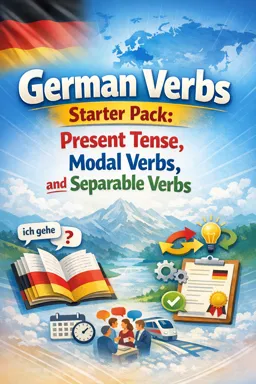

Free ebook on German present tense, modal verbs, separable verbs, and everyday sentence structure for clear communication.
Free ebook content
-

How German Verbs Build Meaning in Everyday Sentences
+ Exercise: When decoding a German main clause with a separable verb, what is the most effective strategy to reconstruct the core meaning?
-
Present Tense Foundations: Infinitives, Verb Stems, and Personal Endings
+ Exercise: Which rule correctly forms the du present tense for verbs whose stem ends in an s-sound like -s, -ss, -ß, -z, or -x?
-
Core Sentence Structure: Verb Position in Statements and Questions
+ Exercise: Which sentence shows the standard word order for a yes/no question with a separable verb?
-
Spelling and Sound Adjustments in Present Tense Conjugation
+ Exercise: Which pair correctly applies present tense adjustments for du and er/sie/es with the verb fahren?
-
High-Frequency Irregular Verbs in the Present Tense
+ Exercise: In the present tense, where do stem-vowel changes usually appear in high-frequency irregular German verbs?


-
Using Modal Verbs to Express Ability, Permission, Obligation, and Intention
+ Exercise: Which sentence correctly asks for permission to open the window, focusing on what is allowed?
-
Modal Verb Sentence Patterns: Two-Verb Constructions and Infinitive Placement
+ Exercise: Which sentence correctly follows the word order rule for a main clause with a modal verb and an infinitive?
-
Choosing the Right Modal: Nuance and Politeness in Daily Contexts
+ Exercise: You want to ask a colleague for help in a neutral, polite way without questioning their willingness. Which modal choice best matches this tone?
-
Separable-Prefix Verbs: Recognizing Prefixes and Core Meanings
+ Exercise: In the sentence Ich mache die Tür zu., what is the best way to reconstruct the infinitive and meaning of the verb?
-
Separable Verbs in Main Clauses: Prefix Placement and Word Order
+ Exercise: Which main-clause sentence correctly applies separable-verb word order with anrufen and negation?
-
Separable Verbs with Modals and Questions: Keeping Meaning Clear
+ Exercise: Which sentence follows the correct pattern for a modal verb plus a separable verb in a yes/no question?
-
Practical Communication Set: Routines, Plans, Requests, and Short Dialogues
+ Exercise: Which sequence best follows the recommended steps for making and confirming a plan?
-
Error-Proofing: Common Learner Mistakes and Fast Self-Correction Checks
+ Exercise: In a sentence with a modal verb plus another verb, what should you check to avoid verb form mistakes?
About the free ebook
German Verbs Starter Pack: Present Tense, Modal Verbs, and Separable Verbs
Build a practical foundation for making clear German sentences with this free ebook. Learn how verbs shape meaning in everyday communication, from describing routines to making requests and discussing plans.
Make present-tense sentences with confidence
Understand infinitives, verb stems, and personal endings, then apply German verb-position rules in statements and questions. Clear explanations help you notice spelling changes, pronunciation-related adjustments, and common patterns in frequently used irregular verbs.
Use modal verbs naturally
Explore how können, müssen, dürfen, wollen, sollen, and mögen express ability, obligation, permission, intention, advice, and polite requests. Practice the two-verb sentence pattern and the placement of the infinitive.
Handle separable verbs and word order
Learn to recognize separable prefixes and see how they move in main clauses. The ebook also clarifies what happens when separable verbs appear with modal verbs or in questions, so you can preserve meaning while using correct word order.
Practical, communication-focused learning
Short examples and dialogue-based situations connect grammar to daily life. Use routines, plans, requests, and fast self-correction checks to identify errors before they become habits.
- Form regular and key irregular present-tense verbs
- Place conjugated verbs correctly in statements and questions
- Choose modal verbs for accurate meaning and appropriate politeness
- Use separable-prefix verbs in common real-world sentences
This starter pack is designed as a focused reference for learners who want to understand the patterns behind usable German.
Where does the verb go in a German present-tense statement?
In a main statement, the conjugated verb usually takes the second position.
Why does the infinitive go to the end with German modal verbs?
A modal verb is conjugated in the main clause, while the second verb remains in the infinitive at the end.
How do separable verbs work in German main clauses?
The verb stem is conjugated in second position, and the separable prefix moves to the end of the clause.
This ebook includes:

13 content chapters

Digital certificate of course completion (Free)

Exercises to train your knowledge

100% free, from content to certificate
Ready to get started?

 recommended
In the app you will also find...

Over 5,000 free courses
Programming, English, Digital Marketing and much more! Learn whatever you want, for free.

Study plan with AI
Our app's Artificial Intelligence can create a study schedule for the course you choose.

From zero to professional success
Improve your resume with our free Certificate and then use our Artificial Intelligence to find your dream job.
You can also use the QR Code or the links below.