
Free ebook on essential German B1 grammar, including subordinate clauses, relative clauses, passive voice, and Konjunktiv II.
Free ebook content
-

German B1 Bridge: Building Longer Sentences with Subordinate Clauses (weil, dass, wenn)
+ Exercise: Welche Version zeigt die korrekte Wortstellung und Zeichensetzung, wenn der weil-Nebensatz zuerst steht?
-
German B1 Bridge: Relative Clauses to Add Precise Information
+ Exercise: Welche Aussage beschreibt korrekt, wie man das richtige Relativpronomen auswählt?
-
German B1 Bridge: Reflexive Verbs and Reflexive Pronouns (mich, dich, sich, uns, euch)
+ Exercise: Wann steht das Reflexivpronomen in der Regel im Dativ statt im Akkusativ?


-
German B1 Bridge: Comparatives and Superlatives for Clear Opinions and Descriptions
+ Exercise: Welche Satzoption zeigt einen direkten Vergleich mit dem Komparativ korrekt (Ungleichheit)?
-
German B1 Bridge: Passive Voice Basics (Präsens and Präteritum) for Processes and Formal Contexts
+ Exercise: Welche Satzvariante ist korrekt, wenn du im Passiv Präsens Zeit und Ort einfügst und das Partizip II am Ende stehen soll?
-
German B1 Bridge: Konjunktiv II for Polite Requests, Suggestions, and Softening Statements
+ Exercise: Welche Formulierung nutzt Konjunktiv II, um eine direkte Bitte höflicher zu machen?
About the free ebook
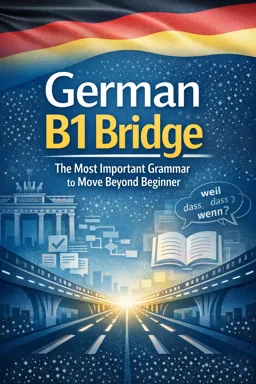
German B1 Bridge: The Most Important Grammar to Move Beyond Beginner
This free online ebook helps German learners strengthen the grammar skills needed to move from basic communication toward confident B1-level expression. It focuses on structures that make speech and writing clearer, more connected, and more natural in everyday, academic, and workplace situations.
Build more complete German sentences
Learn how to link ideas with subordinate clauses using weil, dass, and wenn, while placing verbs correctly at the end of the clause. The ebook also explains relative clauses, helping you add exact details about people, things, places, and situations without relying on several short sentences.
Express yourself with greater precision
Practice reflexive verbs and pronouns, comparisons, and superlatives to describe routines, preferences, opinions, and differences accurately. Clear examples show how grammar choices change meaning and make descriptions more informative.
Use grammar for real-life communication
Discover the foundations of passive voice in the present and simple past, useful for describing processes and formal contexts. You will also work with Konjunktiv II for polite requests, suggestions, wishes, and softer statements.
Connect the structures in context
The final practice section brings key grammar together so you can create longer, better-organized messages. Use this ebook to review important B1 grammar, notice common sentence patterns, and develop more flexible German for conversations and writing.
- Clear explanations of essential B1 grammar
- Useful examples for everyday German
- Practice-oriented guidance for combining structures
How do weil, dass, and wenn change German word order?
They introduce subordinate clauses, where the conjugated verb usually moves to the end.
When is Konjunktiv II used in German?
It is used for polite requests, suggestions, wishes, and hypothetical situations.
What is the difference between active and passive voice in German?
Active voice emphasizes who performs an action; passive voice emphasizes the action or process.
This ebook includes:

7 content chapters

Digital certificate of course completion (Free)

Exercises to train your knowledge

100% free, from content to certificate
Ready to get started?

 recommended
In the app you will also find...

Over 5,000 free courses
Programming, English, Digital Marketing and much more! Learn whatever you want, for free.

Study plan with AI
Our app's Artificial Intelligence can create a study schedule for the course you choose.

From zero to professional success
Improve your resume with our free Certificate and then use our Artificial Intelligence to find your dream job.
You can also use the QR Code or the links below.