Free online course A1 | Learn German for beginners
Duration of the online course: 11 hours and 7 minutes
4.7
(51)
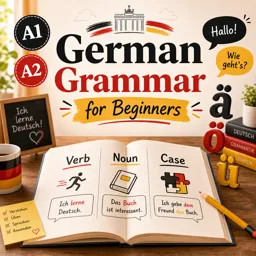
Build confidence speaking German from day one with this free online course: greetings, numbers, verbs and sentence structure—plus exercises to learn faster.
In this free course, learn about
Common German greetings and the most used greeting in Germany
Everyday phrases, including formal ways to ask someone to repeat
Counting in German: 0–20, 21–100, and numbers above 100 (e.g., 23, 500)
German alphabet knowledge, including extra letters (ä, ö, ü, ß) and total count
How to introduce yourself formally and informally in German
How to get to know someone and ask/answer “Wie geht’s?”
Basic German word order: core sentence structure and verb position rules
Verb conjugation basics, including what changes with “du” forms
Personal pronouns, including 1st person plural (wir) and 3rd person singular (er/sie/es)
Core verb conjugations for “sein” and “haben” in the present tense
What a verb is in German and how verb forms are built/used
Regular verb conjugation patterns (e.g., “ich tanze”) in present tense
Irregular verb conjugation: common stem/vowel changes and pattern differences
Adjectives and opposites, plus effective strategies for memorizing adjectives
German articles in nominative: definite, indefinite, and negation (ein/eine, kein/keine)
About the free online course
Start speaking German with confidence by building a strong A1 foundation step by step. This free online course is designed for absolute beginners who want practical, everyday language they can use right away. You will learn how to greet people appropriately, introduce yourself and others, and handle common small-talk moments such as asking how someone is doing or getting to know someone for the first time.
To help you feel comfortable with real-life situations, the course also strengthens your core language skills. You will practice German numbers from 0 upward, master the German alphabet, and develop the ability to say information clearly and accurately. Along the way, you will train your ear and your memory with targeted exercises, so new words and patterns stick instead of being forgotten after the lesson ends.
Grammar is introduced in a beginner-friendly way, focusing on what matters most for making correct sentences. You will understand how German sentence structure works, where the verb belongs, and how to use personal pronouns naturally in conversation. You will also work with two of the most important verbs in German, haben and sein, and learn how verb conjugation works for regular and irregular verbs so you can talk about yourself, others, and everyday actions with fewer mistakes.
To round out your A1 toolkit, you will get comfortable with articles in the nominative case and learn how they affect the nouns you use daily. You will also expand vocabulary through adjectives and opposites, a powerful way to remember words in pairs and express yourself more precisely. By the end, you will have a solid base for further German study and more confidence to interact in common personal and travel contexts.
Course content
Video class: A1 - Lesson 1 | Begrüßungen | Greetings | German for beginners | Learn German10m
Exercise: What is the most commonly used form of greeting in Germany?
Video class: A1 - Lesson 2 | Common Phrases | German for beginners | Learn German10m
Exercise: What is a formal way to ask someone to repeat something in German?
Video class: A1 - Lesson 3 | Numbers 0-20 | Zahlen | German for beginners | Learn German10m
Exercise: What is the German word for the number 'ten'?
Video class: REVISED: A1 - Lesson 4 | Numbers 21-100 | Zahlen | German for beginners | Learn German11m
Exercise: What is the correct way to say the number 23 in German?
Video class: REVISED: A1 - Lesson 5 | Alphabets | das Alphabet | German for beginners | Learn German10m
Exercise: How many characters are in the German alphabet including additional ones?
Video class: REVISED: A1 - Lesson 6 | sich vorstellen | introducing yourself in German | Learn German10m
Exercise: What is the German formal way to introduce your name?
Video class: REVISED: A1 - Lesson 7 | jemanden kennenlernen | Getting to know someone | Learn German10m
Video class: REVISED: A1 - Lesson 8 | Wie geht's? | How are you? | Learn German06m
Video class: REVISED: A1 - Lesson 9 | Satzstruktur | Sentence Structure Part 1 | Learn German10m
Exercise: What is the basic rule regarding verb placement in German sentences?
Video class: REVISED: A1 - Lesson 10 | Satzstruktur | Sentence Structure Part 2 | Learn German06m
Exercise: What is the verb conjugation for "du" in German?
Video class: REVISED: A1 - Lesson 11 | Personalpronomen | Personal pronouns ich du wir | Learn German10m
Exercise: What is the 1st person plural pronoun in German?
Video class: REVISED: A1 - Lesson 12 | haben und sein | Verb conjugation | Learn German10m
Exercise: Conjugating the verb 'sein' in German
Video class: REVISED: A1 - Lesson 13 | Was ist ein Verb? | Verb structure in German | Learn German10m
Exercise: What is a verb in German?
Video class: REVISED: A1 - Lesson 14 | Regelmäßige Verben | Regular Verbs in German | Learn German15m
Exercise: What is the correct conjugation of the German verb 'tanzen' in the first person singular (ich) in present tense?
Video class: REVISED: A1 - Lesson 15 | Unregelmäßige Verben | Irregular Verbs in German | Learn German13m
Exercise: What changes occur in irregular German verb conjugation?
Video class: REVISED: A1 - Lesson 16 | Numbers above 100 in German | Zahlen Teil 3 | Learn German11m
Exercise: What is the correct way to read the number 500 in German?
Video class: REVISED: A1 - Lesson 17 | Adjectives and Opposites | Adjektive und Gegenteile | Learn German10m
Exercise: How should you learn adjectives for better recall?
Video class: REVISED: A1 - Lesson 18 | Introducing someone in German | jemanden vorstellen | Learn German08m
Exercise: Which pronouns are used in the third person singular in German?
Video class: REVISED: A1 - Lesson 19 | Articles in German | Bestimmte Artikel im Nominativ | Learn German08m
Exercise: What are the three types of articles in German used with the nominative case?
Video class: REVISED: A1 - Lesson 20 | Indefinite Articles in German | Unbestimmte Artikel | Learn German06m
Exercise: What is the indefinite article in German for a masculine singular noun in the nominative case?
Video class: REVISED: A1 - Lesson 21 | Negative Articles in German | Negative Artikel | Learn German05m
Video class: REVISED: A1 - Lesson 22 | official time in German | Zeit offiziell | Learn German10m
Exercise: What are the two formats used for reading time in Germany and in which situations are they used?
Video class: Learn German | Time (unofficial) | How to tell time? | Zeit | German for beginners | A1 - Lesson 2310m
Video class: Learn German | Possessive Pronouns | Nominative case | German for beginners | A1 - Lesson 2413m
Video class: Learn German | Family | Meine Familie | German for beginners | A1 - Lesson 2506m
Exercise: What is the possessive article for "father" in German?
Video class: Learn German | Accusative case | Articles | Akkusativ | German for beginners | A1 - Lesson 2611m
Video class: Learn German | Possessive Pronouns | Accusative case | German for beginners | A1 - Lesson 2710m
Video class: Learn German | möchten | Modal verbs | Modalverben | German for beginners | A1 - Lesson 2806m
Exercise: What is the most common use of the verb "mission" in German?
Video class: Learn German | W-Questions | W-Fragen | German for beginners | A1 - Lesson 2905m
Video class: Learn German | Ordering in a Restaurant | das Restaurant | German for beginners | A1 - Lesson 3010m
Video class: Learn German | Personal Pronouns | Accusative Case | German for beginners | A1 - Lesson 3111m
Exercise: What is the accusative personal pronoun for the third person masculine?
Video class: Learn German | Artikel im Dativ | Dative Case | German for beginners | A1 - Lesson 3210m
Video class: Learn German | Ordinalzahlen | Ordinal numbers | German for beginners | A1 - Lesson 3313m
Video class: Learn German | Zeit - Fragewörter | Time related questions | German for beginners | A1 - Lesson 3410m
Exercise: What are some examples of how to answer questions related to time in German?
Video class: Learn German | Dative case | Possessive pronouns | German for beginners | A1 - Lesson 3512m
Video class: Learn German | Dative case | Personal pronouns | German for beginners | A1 - Lesson 3611m
Video class: Learn German | Trennbare Verben | Separable verbs | German for beginners | A1 - Lesson 3711m
Exercise: What are separable verbs in German?
Video class: Learn German | Tagesablauf | Daily routine | German for beginners | A1 - Lesson 3811m
Video class: Learn German | Imperativ | Imperative | German for beginners | A1 - Lesson 3912m
Video class: Learn German | Wegbeschreibung | Directions | German for beginners | A1 - Lesson 4010m
Exercise: What are the three important terms required for giving directions in German?
Video class: Learn German | war oder hatte | German for beginners | A1 - Lesson 4110m
Video class: Learn German | untrennbare Verben | German for beginners | A1 - Lesson 4210m
Video class: Learn German | krank sein | German for beginners | A1 - Lesson 4311m
Video class: Learn German | Perfekt | Past tense | Part 1 | German for beginners | A1 - Lesson 4411m
Video class: Learn German | Perfekt | Past tense | Part 2 | German for beginners | A1 - Lesson 4512m
Video class: Learn German | Perfekt | Past tense | Part 3 | German for beginners | A1 - Lesson 4612m
Exercise: What is the basic rule for forming perfect in German?
Video class: Learn German | Perfekt | Was hast du im Urlaub gemacht? | German for beginners | A1 - Lesson 4711m
Video class: Learn German | Im Supermarkt | In the supermarket | German for beginners | A1 - Lesson 4811m
Video class: Learn German | Wie ist das Wetter? | How's the weather? | German for beginners | A1 - Lesson 4910m
Exercise: What is the most common question when talking about weather in Germany?
Video class: Learn German | Verabredungen | Appointments | German for beginners | A1 - Lesson 5010m
Video class: Learn German | Brief schreiben-Einladung | Letter writing-Invitation | A1 - Lesson 5110m
Video class: Learn German | Gefallen und Missfallen ausdrücken | Express likes04m
Exercise: What are some adverbs that can be used to express liking in German?
Video class: Learn German | Fragepronomen welch- | Interrogative pronoun | A1 - Lesson 5310m
Programming, English, Digital Marketing and much more! Learn whatever you want, for free.
Study plan with AI
Our app's Artificial Intelligence can create a study schedule for the course you choose.
From zero to professional success
Improve your resume with our free Certificate and then use our Artificial Intelligence to find your dream job.
You can also use the QR Code or the links below.
Course comments: A1 | Learn German for beginners
Students found the free online course excellent, useful, well-structured, and easy to understand. They described it as an amazing experience and especially helpful for A1 learners.
BG
Bharti Gahlot
well structured step by step
ET
Evgjeni Tase
Very useful course!
KS
KASHVI SINHA
It was a amazing experience and I understood very well !!! Thank you !❤️




















Course comments: A1 | Learn German for beginners
Students found the free online course excellent, useful, well-structured, and easy to understand. They described it as an amazing experience and especially helpful for A1 learners.
Bharti Gahlot
well structured step by step
Evgjeni Tase
Very useful course!
KASHVI SINHA
It was a amazing experience and I understood very well !!! Thank you !❤️
Valentina Zafirovska
Excellent! Great course, love it ❤
Nehal kapgate
best cour
Arun Jamadar
Great
Vijaya Durga Prasad Tadala
excellent
Humaira Elessay
It's amazing thanks for this course
Gaurav Kumar
amazing
Amit kumar
Really great course for A1