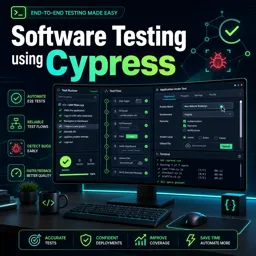

Free ebook on Cypress end-to-end testing: build stable UI tests with reliable selectors, fixtures, network stubs, and debugging practices.
Free ebook content
-

Cypress End-to-End Testing Basics: What E2E Tests Cover and How Cypress Runs Them
+ Exercise: Which approach best matches how to make Cypress E2E UI tests stable?
-
Setting Up a Cypress Project for Reliable Web App Testing
+ Exercise: In a Cypress project, what is the main benefit of setting baseUrl in the Cypress configuration?


-
Selectors That Keep Cypress UI Tests Stable (data-* Attributes, Roles, and Text)
+ Exercise: Which selector approach best keeps Cypress UI tests stable when the UI layout and CSS classes are refactored?
-
Writing Your First Maintainable Cypress Tests (Arrange–Act–Assert and Clear Assertions)
+ Exercise: Which approach best improves maintainability when refactoring a Cypress test for adding an item to the cart?
-
Fixtures and Test Data in Cypress: Repeatable Inputs Without Flakiness
+ Exercise: Which approach is recommended to stub an API response with fixture data in Cypress while avoiding timing issues and keeping the intercept setup concise?
-
Network Stubbing Basics with cy.intercept for Deterministic Cypress E2E Tests
+ Exercise: In Cypress UI tests, what is the main benefit of aliasing an intercepted request and waiting on it (for example, using cy.intercept(...).as('search') and cy.wait('@search'))?
-
Handling Waits Correctly in Cypress: Auto-Retry, Timeouts, and Avoiding Arbitrary Delays
+ Exercise: A test clicks a button that triggers async work, and the next assertion is flaky. Which approach best improves stability in Cypress?
-
Testing Page Flows: Navigation, Forms, and Multi-Step User Journeys in Cypress
+ Exercise: When a Cypress test clicks something that should navigate to another page, what is the most reliable way to confirm the navigation succeeded?
-
Organizing Cypress Tests for Readability: Spec Structure, Custom Commands, and Page Objects (Lightweight)
+ Exercise: When creating Cypress helpers (custom commands or lightweight page modules), what is the recommended approach for handling assertions to keep tests readable and maintainable?
-
Debugging and Hardening Cypress UI Tests: Common Failure Patterns and Fixes
+ Exercise: A Cypress test passes when run alone but fails when run with the full suite, and the failure seems to depend on test order. What is the most likely underlying issue to investigate first?
About the free ebook
Cypress End-to-End Testing Basics: Stable UI Tests for Web Apps
This free ebook introduces practical Cypress end-to-end testing for web applications, with an emphasis on creating UI tests that are reliable, readable, and useful in everyday development.
Build confidence in real user journeys
Learn how Cypress runs tests in the browser and how end-to-end checks validate the behavior users actually experience. The ebook uses clear testing patterns for navigation, forms, and multi-step flows, helping you verify important application behavior without relying on fragile test code.
Reduce flaky tests at the source
Stable UI testing starts with intentional choices. Explore durable selectors based on data-* attributes, accessible roles, and meaningful text. See how repeatable fixtures, controlled network responses, and Cypress auto-retry behavior can make tests deterministic instead of dependent on timing or changing backend data.
Write tests your team can maintain
The ebook demonstrates a practical structure for Cypress specs using Arrange–Act–Assert, focused assertions, and lightweight reuse patterns. It also explains when custom commands and page objects can improve clarity without adding unnecessary abstraction.
Debug failures with a systematic approach
UI test failures are easier to solve when tests expose clear intent. Learn to identify common causes such as unstable selectors, premature assertions, uncontrolled API calls, and arbitrary delays. Use Cypress tools and test design techniques to turn failures into actionable feedback.
What you will be able to do
- Set up a Cypress project for dependable web app testing.
- Create selectors and assertions that resist routine UI changes.
- Stub network requests with cy.intercept for predictable scenarios.
- Handle asynchronous behavior without unnecessary fixed waits.
- Organize, debug, and strengthen a growing Cypress test suite.
Designed for developers and QA professionals, this ebook provides a focused foundation for delivering trustworthy Cypress UI tests in modern web applications.
How do data-* selectors make Cypress tests more stable?
They create test-specific hooks that are less likely to change when styling, layout, or visible wording changes.
When should cy.intercept be used in Cypress end-to-end tests?
Use it to observe, stub, or control API requests when a test needs predictable network responses and test data.
Why should Cypress tests avoid arbitrary cy.wait delays?
Fixed delays slow tests and can still fail on slower environments; Cypress assertions and intercept aliases retry until conditions are met.
This ebook includes:

10 content chapters

Digital certificate of course completion (Free)

Exercises to train your knowledge

100% free, from content to certificate
Ready to get started?

 recommended
In the app you will also find...

Over 5,000 free courses
Programming, English, Digital Marketing and much more! Learn whatever you want, for free.

Study plan with AI
Our app's Artificial Intelligence can create a study schedule for the course you choose.

From zero to professional success
Improve your resume with our free Certificate and then use our Artificial Intelligence to find your dream job.
You can also use the QR Code or the links below.