
Free ebook on software testing foundations: turn requirements into tests, identify risks, report defects, and improve quality.
Free ebook content
-

The Purpose of Software Testing and Quality Thinking
+ Exercise: Which statement best reflects quality thinking about the purpose of software testing?
-
Risk-Based Testing: Deciding What Matters Most
+ Exercise: Which statement best describes how Risk-Based Testing prioritizes and defines completion of testing work?
-
Turning Requirements into Testable Statements
+ Exercise: Which rewrite best turns a vague requirement into a testable statement?


-
Test Levels: Unit, Integration, System, and Acceptance
+ Exercise: A team wants to confirm that the product is ready for release by validating that it meets acceptance criteria and that operational readiness items like monitoring and rollback procedures are in place. Which test level best fits this goal?
-
Test Types: Functional and Non-Functional Coverage
+ Exercise: When building a balanced test plan for a feature, what best describes how functional and non-functional test types should be applied?
-
Core Test Design Techniques for Beginners
+ Exercise: When applying Boundary Value Analysis to a numeric field with an allowed inclusive range, which set of test inputs best targets the most defect-prone areas?
-
Building Practical Test Cases and Lightweight Test Notes
+ Exercise: Which situation best justifies creating a more structured, repeatable test case instead of relying mainly on lightweight test notes?
-
Defects and Failures: Recognizing and Isolating Problems
+ Exercise: While isolating a checkout problem, the UI shows an error banner but the API request succeeds and returns correct data. Which layer is the most likely suspect to investigate next?
-
Defect Lifecycle: From Discovery to Verification
+ Exercise: What is the main purpose of having a distinct Ready for Test state in a defect lifecycle?
-
Writing Clear Bug Reports with Reproducible Steps
+ Exercise: Which bug report description is most likely to be actionable because it supports reliable reproduction?
-
Communicating Findings and Supporting Team Decisions
+ Exercise: Which message best follows the recommended approach for communicating a testing finding to support a team decision?
-
Personal Testing Workflow for Consistent Execution
+ Exercise: What is the main purpose of converting findings from an exploratory session into repeatable verification?
About the free ebook
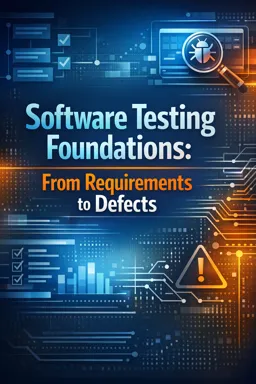
Software Testing Foundations: From Requirements to Defects
This free ebook introduces the practical mindset and core methods behind effective software testing. Learn how testing supports product quality by uncovering meaningful risks, validating expected behavior, and giving teams reliable evidence for decisions.
Build a quality-focused testing approach
Explore how to assess risk, translate requirements into testable statements, and select appropriate test levels and test types. The ebook explains how functional checks work alongside non-functional concerns such as performance, usability, reliability, and security.
Design tests that reveal useful information
Develop confidence with accessible test design techniques and practical test cases. You will see how clear conditions, expected results, and lightweight notes can make execution more consistent while helping testers focus on the areas where failures would have the greatest impact.
Investigate, report, and communicate defects
Understand the difference between defects and failures, how to isolate a problem, and how a defect moves from discovery through verification. Learn to write bug reports with reproducible steps, relevant evidence, and a clear description of actual versus expected behavior.
Create a repeatable personal workflow
Use a structured but adaptable workflow to prepare testing, record findings, communicate risks, and support collaborative decisions. Software Testing Foundations is a practical starting point for anyone who wants to test software with greater clarity, purpose, and consistency.
How do you turn a software requirement into a test case?
Identify the expected behavior, conditions, inputs, and observable result, then define steps that verify them.
What is the difference between a defect and a failure?
A defect is a flaw in a work product; a failure is incorrect behavior observed when the software runs.
What should a reproducible bug report include?
Include the environment, clear steps, expected and actual results, severity or impact, and useful evidence.
This ebook includes:

12 content chapters

Digital certificate of course completion (Free)

Exercises to train your knowledge

100% free, from content to certificate
Ready to get started?

 recommended
In the app you will also find...

Over 5,000 free courses
Programming, English, Digital Marketing and much more! Learn whatever you want, for free.

Study plan with AI
Our app's Artificial Intelligence can create a study schedule for the course you choose.

From zero to professional success
Improve your resume with our free Certificate and then use our Artificial Intelligence to find your dream job.
You can also use the QR Code or the links below.