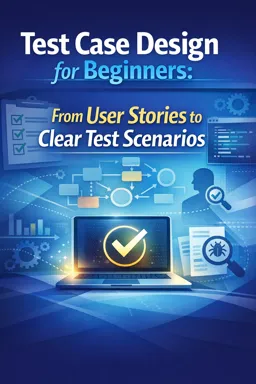
A test strategy defines the overall testing approach, scope, risks, and methods; a test plan details the schedule, resources, tasks, and deliverables for a specific project.

Duration of the online course: 8 hours and 2 minutes
4.4


(44)
Build job-ready QA skills with a free software testing course: test cases, strategies, defect reports, Agile vs Waterfall, and techniques—learn fast, apply today.
Improve the reliability of any product you work on by learning how professional software testing is done from the ground up. This free online course helps you develop a practical QA mindset: how to think critically about quality, spot risk early, and communicate findings in a way that developers and stakeholders can act on. Whether you are aiming for your first testing role, moving from development to QA, or simply wanting to ship more stable features, you will gain a clear workflow you can reuse on real projects.
You will connect the foundations of quality and requirements with the way teams actually build software, including plan-driven approaches and Agile contexts. Along the way, you learn how to turn ideas into structured test strategies and realistic plans, and how to write effective test cases quickly without missing important coverage. The course also focuses on choosing and preparing meaningful test data, validating system behavior end to end, and protecting releases with regression testing that targets what is most likely to break.
Strong testers are valued not only for finding defects, but for making defects easy to fix. You will practice describing issues with the right level of detail, understanding severity versus priority, and reporting status clearly through test reporting. You also build analytical skill with classic test design techniques such as equivalence partitioning, boundary value analysis, decision tables, use case testing, and state transition thinking, so you can test smarter, not just more.
Beyond core QA execution, the course helps you grow professionally by showing how to develop domain knowledge, approach testing when documentation is weak, estimate testing work, and apply basic risk management concepts that guide decisions under pressure. You will also get exposure to common technical topics that frequently appear in testing conversations, including security basics, software architecture, memory leaks, race conditions, and off-by-one errors—useful context for asking better questions and designing more relevant tests.
By the end, you should feel confident taking a feature, analyzing its intent, designing efficient coverage, reporting results, and explaining quality trade-offs with clarity. The result is a repeatable approach to software testing you can bring to interviews, team collaboration, and day-to-day delivery.

8 hours and 2 minutes of online video course

Digital certificate of course completion (Free)

Exercises to train your knowledge

100% free, from content to certificate
What is the difference between a test strategy and a test plan?
A test strategy defines the overall testing approach, scope, risks, and methods; a test plan details the schedule, resources, tasks, and deliverables for a specific project.
How do equivalence partitioning and boundary value analysis reduce the number of test cases?
They group similar inputs into representative partitions and focus on values at range boundaries, where defects are most likely, instead of testing every possible input.
What should a software bug report include?
A useful bug report includes a clear title, steps to reproduce, expected and actual results, severity, environment details, and supporting evidence such as screenshots or logs.
Ready to get started?Download the app and get started today.
Install the app now
to access the course
Over 5,000 free courses
Programming, English, Digital Marketing and much more! Learn whatever you want, for free.

Study plan with AI
Our app's Artificial Intelligence can create a study schedule for the course you choose.

From zero to professional success
Improve your resume with our free Certificate and then use our Artificial Intelligence to find your dream job.
You can also use the QR Code or the links below.



Video Courses
 Advanced
 recommended
Exercises
Assess your knowledge of JMeter test plans, workloads, metrics, correlation, distributed testing, and performance analysis.
Start exercisesTest your knowledge of advanced regression testing techniques, automation, test suite optimization, prioritization, and software quality assurance.
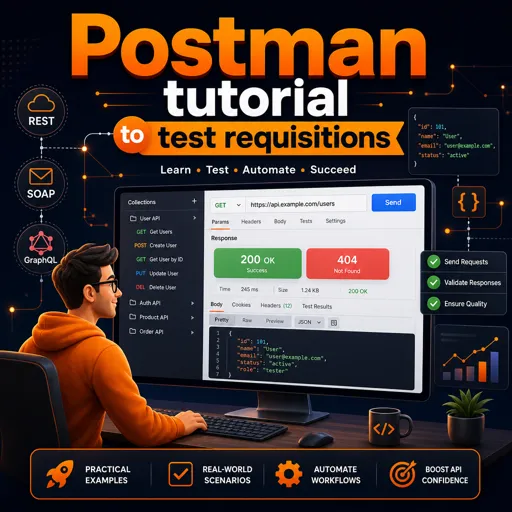
Start exercisesTest your API testing basics with Postman, including HTTP methods, collections, variables, scripts, response validation, and status codes.
Start exercisesCarry knowledge in your pocket.
Download the Cursa app.
There are hundreds of free courses available, with a free certificate of completion that is saved in your mobile image gallery.
Download the app to access the Course Completion Certificate for Free.


+ 10 million
students

Free and Valid
Certificate

60 thousand free
exercises

4.8/5 rating in
app stores

Free courses in
video and ebooks