
Free ebook on test case design: turn user stories into clear scenarios using boundaries, partitions, decision tables, and traceability.
Free ebook content
-

Turning User Stories into Test Scenarios
+ Exercise: When rewriting acceptance criteria into test scenarios, what should you do if one criterion contains multiple conditions or outcomes that can vary independently?
-
Test Case Structure: Writing Clear, Repeatable Checks
+ Exercise: Which expected result is written in an observable, verifiable way for a failed login attempt?
-
Positive and Negative Paths from the Same Scenario
+ Exercise: When deriving negative-path tests from a baseline scenario (e.g., login), what is the best way to design each negative test so the failure reason is clear and the system’s response can be verified?


-
Boundary Value Analysis for Better Edge Coverage
+ Exercise: A requirement says: "Quantity must be an integer from 1 to 99 (inclusive)." Which set best represents the classic Boundary Value Analysis test values around both ends of the range?
-
Equivalence Partitioning to Reduce Redundancy
+ Exercise: When mapping equivalence partitions into a minimal set of test cases, which approach best helps reduce redundancy while keeping failures easy to diagnose?
-
Decision Tables for Rule-Based Scenarios
+ Exercise: In the shipping-fee decision table practice, what should the expected outcome be when the cart contains an oversized item and the delivery address is a PO box?
-
Traceability: Linking User Stories, Criteria, Scenarios, and Test Cases
+ Exercise: In a lightweight traceability matrix, what is the main benefit of creating one row per acceptance criterion instead of starting from the existing tests?
-
Quality Review: Making Test Cases Unambiguous and Maintainable
+ Exercise: During a quality review, which change best turns a vague expected result into an observable, verifiable check?
About the free ebook
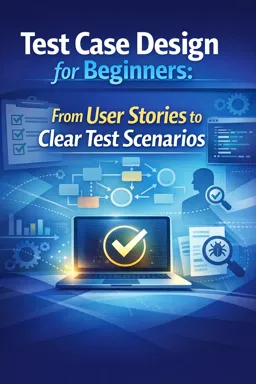
Test Case Design for Beginners: From User Stories to Clear Test Scenarios
This free ebook introduces practical test case design for aspiring software testers, QA analysts, developers, and product teams. Learn how to turn a user story and its acceptance criteria into checks that are clear, repeatable, and useful for finding defects before release.
Design tests with purpose
Strong test cases describe a realistic starting point, focused actions, and observable expected results. The ebook explains how to write scenarios that another tester can execute consistently, while keeping wording precise enough to support maintenance as the product changes.
Cover normal behavior and risk
Testing is not limited to confirming that a feature works under ideal conditions. Explore how positive and negative paths can be derived from the same requirement, helping you verify valid behavior as well as invalid inputs, missing data, blocked actions, and error handling.
Use efficient test design techniques
Learn accessible ways to improve coverage without creating unnecessary duplicate tests. Boundary value analysis helps identify high-risk values at the edges of an allowed range. Equivalence partitioning groups inputs that should behave similarly. Decision tables make combinations of business rules easier to analyze and test.
Maintain confidence as requirements evolve
The ebook also shows why traceability matters: connecting user stories, acceptance criteria, scenarios, and test cases makes it easier to identify what needs review when a requirement changes. A quality review mindset helps remove ambiguity, clarify test data and preconditions, and keep your test suite maintainable.
What you will be able to do
- Translate user-facing requirements into testable scenarios.
- Write structured test cases with clear expected outcomes.
- Choose boundary, partitioning, and rule-based techniques appropriately.
- Review tests for completeness, clarity, and traceability.
Use these methods to create test documentation that supports reliable releases and productive collaboration across the delivery team.
How do you turn a user story into test scenarios?
Identify the user goal, acceptance criteria, preconditions, actions, expected results, and important failure paths.
What is boundary value analysis in software testing?
It is a technique that tests values at and around input limits, where defects commonly occur.
When should decision tables be used for test cases?
Use them when outcomes depend on multiple business rules or combinations of conditions.
This ebook includes:

8 content chapters

Digital certificate of course completion (Free)

Exercises to train your knowledge

100% free, from content to certificate
Ready to get started?

 recommended
In the app you will also find...

Over 5,000 free courses
Programming, English, Digital Marketing and much more! Learn whatever you want, for free.

Study plan with AI
Our app's Artificial Intelligence can create a study schedule for the course you choose.

From zero to professional success
Improve your resume with our free Certificate and then use our Artificial Intelligence to find your dream job.
You can also use the QR Code or the links below.