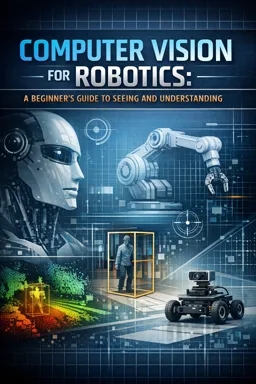

Free ebook on computer vision for robotics, covering cameras, image processing, depth sensing, object detection, and navigation tasks.
Free ebook content
-

How Robots See: Camera Perception for Robotics Vision
+ Exercise: In an end-to-end robot vision perception loop, which stage primarily converts algorithm outputs (like 2D boxes or keypoints) into robot-relevant quantities such as obstacle distance or dock pose for planning and control?
-
Image Fundamentals for Robotics: Pixels, Color, and Noise
+ Exercise: A robot computes a feature point at (x=120, y=50) in image coordinates, but the overlay appears in the wrong location. Which fix best matches common robotics image conventions for accessing the pixel value at that point?
-
Lenses, Field of View, Focus, and Distortion in Robot Cameras
+ Exercise: A robot needs accurate pose estimation from a planar fiducial marker while moving. Which approach best improves geometric reliability under motion?
-
Lighting and Exposure Control for Reliable Robot Vision
+ Exercise: A robot vision system shows periodic brightness pulsing and occasional horizontal banding under LED lighting. Which adjustment is the most appropriate first step to improve measurement stability?
-
Camera Calibration and Coordinate Frames for Robotics Integration
+ Exercise: When converting a 3D point measured in the camera frame into the world frame, which transform chain is consistent with the stated naming convention?


-
Filtering and Preprocessing Pipelines for Real-Time Vision
+ Exercise: When designing a real-time vision preprocessing pipeline for closed-loop robot control, what approach best supports stable control behavior under strict latency budgets?
-
Feature Detection and Tracking: Corners, Edges, and Optical Flow
+ Exercise: A robot tracks many corner features between frames using Lucas–Kanade, but some tracks are wrong due to occlusion and repeated textures. What is the main purpose of applying RANSAC next?
-
From Pixels to Objects: Segmentation and Object Detection Concepts
+ Exercise: In a robotics vision pipeline, why might you apply temporal smoothing and persistence rules after running an object detector on each frame?
-
Depth Sensing Options: Stereo, Structured Light, Time-of-Flight, and Monocular Cues
+ Exercise: Why does passive stereo depth estimation typically become less precise at longer distances, even when calibration is good?
-
Robotics Vision Task: Line Detection and Following
+ Exercise: Why might you keep two separate regions of interest (ROIs)—a near ROI and a far ROI—when following a line?
-
Robotics Vision Task: Fiducial Markers for Localization and Docking
+ Exercise: Which combination of detector outputs is sufficient to estimate a fiducial marker’s 6-DoF pose relative to the camera using PnP (assuming camera intrinsics and marker size are known)?
-
Robotics Vision Task: Obstacle Detection and Free-Space Estimation
+ Exercise: In a navigation costmap built from depth measurements, what is the purpose of ray tracing from the sensor origin to each measured point?
-
Integrating Vision with Control and Navigation: Latency, Fusion, and Reliability
+ Exercise: In a robot that fuses vision with IMU/odometry, what is the correct way to use the two timestamps associated with a vision estimate to reduce time-skew problems?
-
Testing, Debugging, and Deployment Constraints in Robotics Computer Vision
+ Exercise: A robotics vision pipeline averages 30 FPS but occasionally drops to 5 FPS during peak load. Which action best aligns with treating compute as a fixed budget under real robot constraints?
About the free ebook
Computer Vision for Robotics: A Beginner’s Guide to Seeing and Understanding
This free ebook introduces the practical foundations that help robots turn camera data into useful decisions. It explains how robotic vision systems capture images, handle imperfect lighting and lens effects, and interpret visual information for movement, localization, and safer operation.
Build a practical understanding of robot perception
Learn how pixels, color, noise, exposure, focus, and camera geometry affect what a robot can detect. The ebook connects visual concepts to real robotics challenges, showing why calibration, coordinate frames, and efficient preprocessing are essential when cameras must support responsive behavior.
It also explores the ideas behind feature tracking, segmentation, object detection, and depth estimation. These approaches allow a robot to recognize useful landmarks, identify obstacles, estimate free space, and understand elements of its environment from image data.
Apply vision to common robotics tasks
Practical examples focus on vision-driven tasks such as following a line, using fiducial markers for docking or localization, and detecting obstacles. You will see how perception connects with control and navigation, including the importance of latency, sensor fusion, reliability, testing, and deployment constraints.
What you will gain
- A clear view of how robot cameras form and process images
- An introduction to 2D and depth-based perception methods
- Context for selecting vision techniques for navigation and interaction
- Awareness of real-world issues that affect robotics vision performance
Designed for robotics enthusiasts and drone learners, this ebook provides a structured starting point for understanding how machines can see, interpret, and respond to the world around them.
What is camera calibration in robotics?
Camera calibration estimates a camera’s internal properties and position so image measurements can be related accurately to the robot and its environment.
How can a robot detect obstacles with a camera?
It can use segmentation, object detection, optical flow, or depth cues to identify occupied areas and estimate safe free space.
What depth sensing methods are used in robotics?
Common methods include stereo vision, structured light, time-of-flight sensors, and monocular depth cues.
This ebook includes:

14 content chapters

Digital certificate of course completion (Free)

Exercises to train your knowledge

100% free, from content to certificate
Ready to get started?

 recommended
In the app you will also find...

Over 5,000 free courses
Programming, English, Digital Marketing and much more! Learn whatever you want, for free.

Study plan with AI
Our app's Artificial Intelligence can create a study schedule for the course you choose.

From zero to professional success
Improve your resume with our free Certificate and then use our Artificial Intelligence to find your dream job.
You can also use the QR Code or the links below.