From Pixels to Decisions: The Practical Goal
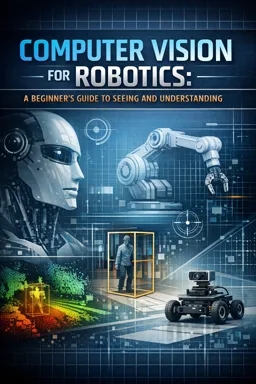
In robotics, computer vision is not just about “understanding images.” The practical goal is to convert camera pixels into decisions a robot can execute safely and repeatably. A useful way to think about this is an end-to-end perception loop: sensing (what the camera captures), processing (how we compute features and predictions), interpretation (what those predictions mean for the robot’s state and environment), and action (how control and navigation use them).
When this loop is designed well, you can answer questions like: “Where is the lane line relative to my robot?”, “Is there an obstacle in my path?”, “What is the pose of the docking station?”, and “How should I steer right now?”
The End-to-End Perception Loop
1) Sensing: Camera, Optics, and Lighting
Sensing is the foundation. If the image is unreliable, downstream algorithms will struggle regardless of how advanced they are. In robotics, sensing includes the camera, lens, exposure settings, synchronization, and the lighting conditions in the environment.
Key sensing choices that affect robot performance
- Camera type: monocular (one camera), stereo (two cameras), RGB-D (color + depth), fisheye/wide-angle for large field-of-view.
- Frame rate and exposure: higher frame rate reduces motion between frames; shorter exposure reduces motion blur but needs more light (or higher gain, which adds noise).
- Rolling vs global shutter: rolling shutter can distort fast motion; global shutter is preferred for quick maneuvers and high-speed platforms.
- Field of view (FOV): wider FOV sees more context but increases distortion and reduces pixel density on distant objects.
- Lighting: backlighting, glare, shadows, and flicker can change appearance dramatically.
Practical sensing checklist (step-by-step)
- Verify camera time and sync: ensure timestamps are monotonic and aligned with IMU/odometry if used.
- Set exposure strategy: start with auto-exposure for prototyping, then consider fixed exposure in controlled lighting to reduce variability.
- Inspect raw frames: log and view unprocessed images to confirm focus, blur, and saturation.
- Check lens cleanliness and mounting: smudges and vibration create artifacts that look like “algorithm bugs.”
- Confirm resolution vs compute budget: choose the smallest resolution that still captures needed detail (e.g., lane markings or fiducials).
2) Processing: Algorithms That Turn Images into Signals
Processing is where the robot computes useful intermediate representations from images. These can be classical methods (thresholding, edges, feature tracking) or learned models (CNN-based detectors, keypoint networks). The processing stage should be chosen based on the task requirements: latency, robustness, interpretability, and available compute.
Common processing building blocks
- Preprocessing: undistortion, resizing, color conversion, denoising, contrast normalization.
- Feature extraction: corners/keypoints, descriptors, line segments, gradients.
- Motion estimation: optical flow, frame-to-frame tracking, visual odometry.
- Depth estimation: stereo matching, RGB-D alignment, monocular depth networks (when appropriate).
- Object inference: 2D detection, instance segmentation, keypoint detection.
Latency and determinism matter
Robots act in real time. A vision pipeline that produces accurate results but arrives too late can be worse than a simpler method that is timely. Track and log: capture time, processing time per stage, and end-to-end latency. If the robot uses a control loop at 30 Hz, a 200 ms vision delay can cause overshoot, oscillations, or collisions.
- Listen to the audio with the screen off.
- Earn a certificate upon completion.
- Over 5000 courses for you to explore!

Download the app
3) Interpretation: Turning Outputs into Robot-Relevant Quantities
Interpretation converts algorithm outputs into quantities that directly support planning and control. This is where you move from “the network says there is a box at (x, y, w, h)” to “the obstacle is 1.2 m ahead in my path” or “the docking station pose is (x, y, z, roll, pitch, yaw).”
Common outputs used in robotics (and what they mean)
| Output | What it is | Typical use in robotics |
|---|---|---|
| 2D detections (bounding boxes) | Rectangles around objects in image coordinates | Obstacle presence, target tracking, triggering a closer inspection |
| Keypoints / landmarks | Distinct points (e.g., corners, joints, fiducial corners) | Pose estimation, tracking, alignment to known patterns |
| Optical flow | Per-pixel or sparse motion vectors between frames | Time-to-collision cues, ego-motion hints, tracking in low-feature scenes |
| Depth (per-pixel or sparse) | Distance from camera to scene points | Obstacle avoidance, free-space estimation, docking distance control |
| 6D pose | 3D position + 3D orientation of an object/camera | Docking, grasping, precise alignment, AR-style overlays for debugging |
How outputs connect to decisions
Robotic decisions usually need quantities in the robot’s coordinate frame (or a map frame). That means interpretation often includes:
- Geometry: projecting pixels to rays, using depth to get 3D points, estimating pose from keypoints.
- Filtering: smoothing noisy estimates (e.g., moving average, Kalman-style filtering) to stabilize control.
- Data association: matching detections across frames to maintain object tracks.
- Gating and confidence: ignoring low-confidence outputs, requiring persistence over N frames before acting.
4) Action: Using Vision in Control and Navigation
Action is where perception becomes robot behavior. The same vision output can drive different actions depending on the controller and safety logic. A good practice is to separate: (1) the perception estimate, (2) the decision policy, and (3) the low-level control, so you can debug each independently.
Task Examples: From Vision Output to Robot Behavior
Example A: Following a Line (2D geometry to steering)
Goal: keep the robot centered on a painted line or tape on the floor.
Typical outputs: line pixels or a fitted line in image coordinates; optionally a vanishing point or line angle.
Step-by-step pipeline
- Sensing: mount camera angled down; ensure consistent exposure so the line contrasts with the floor.
- Processing: crop a region of interest (lower part of the image), threshold or segment the line, fit a line or compute centroid.
- Interpretation: compute lateral error (pixels from image center) and heading error (line angle).
- Action: use a controller (often PID) to set angular velocity based on error; reduce speed if confidence drops.
// Conceptual control signal (not tied to a specific framework) angle_cmd = Kp * heading_error + Kd * d(heading_error)/dt + Ki * integral(heading_error) speed_cmd = base_speed * confidenceExample B: Docking to a Station (keypoints/6D pose to alignment)
Goal: align and approach a docking station for charging.
Typical outputs: detected fiducial marker corners (keypoints) or a direct 6D pose estimate of the dock.
Step-by-step pipeline
- Sensing: ensure the dock is well-lit or has active markers; avoid reflective materials near the marker.
- Processing: detect the marker and extract its corner keypoints; reject detections with inconsistent geometry.
- Interpretation: estimate dock pose relative to camera; transform to robot base frame; compute alignment error (lateral offset + yaw).
- Action: run a staged controller: rotate to face dock, translate forward while maintaining yaw, slow down near contact, stop if pose confidence drops.
Example C: Avoiding Obstacles (depth/flow to safe navigation)
Goal: avoid collisions while moving through an environment.
Typical outputs: depth map, free-space mask, or optical flow magnitude (as a proxy for approaching obstacles).
Step-by-step pipeline
- Sensing: choose a camera with sufficient FOV; ensure exposure handles indoor/outdoor transitions.
- Processing: compute depth (stereo/RGB-D) or optical flow; optionally segment ground plane.
- Interpretation: build a local cost map or estimate time-to-collision; identify a safe corridor ahead.
- Action: adjust velocity and steering to minimize cost; enforce safety stops if near-field depth is below a threshold.
Designing the Loop: What to Log and Visualize
To make the perception loop debuggable, log both inputs and intermediate outputs. Many “vision failures” are actually sensing failures or timing issues that only show up when you inspect the right signals.
Recommended logs
- Raw images (or periodic snapshots) with timestamps.
- Processed overlays: bounding boxes, keypoints, flow vectors, depth colormap.
- Confidence metrics: detection scores, number of tracked features, inlier counts for pose estimation.
- Timing: per-stage runtime and end-to-end latency.
- Control signals: commanded vs measured velocity/steering to see if perception noise causes oscillations.
Typical Failure Modes (and How to Recognize Them)
Motion blur
What it looks like: edges smear; keypoints disappear; detectors become unstable frame-to-frame.
Common causes: long exposure, fast motion, vibration.
How to recognize in logs/visualizations:
- Raw frames show streaking, especially during turns or bumps.
- Feature tracker shows sudden drop in tracked points.
- Pose estimation inlier count collapses intermittently.
Mitigations: shorten exposure, increase lighting, use global shutter, stabilize mount, reduce speed during high-precision maneuvers.
Glare and specular reflections
What it looks like: saturated white patches; false edges; detectors latch onto reflections.
Common causes: shiny floors, sunlight, reflective tape, headlights.
How to recognize:
- Histogram shows clipping (many pixels at max intensity).
- Segmentation masks “explode” in bright regions.
- Depth sensors may return invalid/zero depth in reflective areas (depending on modality).
Mitigations: adjust camera angle, add a hood/polarizer (when appropriate), tune exposure, redesign markers/materials to be less reflective.
Low texture / repetitive texture
What it looks like: tracking drifts; optical flow becomes noisy; pose estimates jump.
Common causes: blank walls, uniform floors, corridors with repeating patterns.
How to recognize:
- Few detected features; features cluster in small areas.
- High uncertainty or frequent relocalization events (if using a mapping/localization stack).
- Flow vectors appear random or inconsistent across frames.
Mitigations: widen FOV to include more structure, add artificial landmarks (fiducials), fuse with other sensors, slow down in low-texture zones.
Low light and sensor noise
What it looks like: grainy images; flickering detections; color shifts.
How to recognize:
- High gain/ISO settings; noisy dark regions in raw frames.
- Detections appear and disappear with small lighting changes.
Mitigations: add illumination, use a more sensitive sensor, reduce frame rate to allow shorter exposure trade-offs, prefer robust features or learned models trained for low light.
Rolling shutter distortion
What it looks like: vertical lines bend during motion; pose estimation inconsistent during fast turns.
How to recognize:
- Straight structures appear skewed in raw frames only when moving.
- Tracking works when stationary but fails during rapid rotation.
Mitigations: use global shutter, reduce angular velocity, increase frame rate, synchronize with IMU and compensate (advanced).
Putting It Together: A Practical Perception Loop Template
When building a robotics vision feature, structure your implementation and debugging around the loop:
- Sensing: verify image quality and timing first.
- Processing: ensure intermediate outputs are visualizable (overlays) and fast enough.
- Interpretation: convert to robot-frame quantities with confidence and filtering.
- Action: design controllers that degrade gracefully (slow down, stop, or switch modes) when confidence drops.