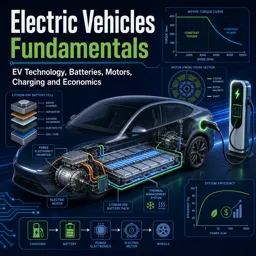
Free Course Image Electric Vehicles Fundamentals: EV Technology, Batteries, Motors, Charging and Economics

Free online courseElectric Vehicles Fundamentals: EV Technology, Batteries, Motors, Charging and Economics

Duration of the online course: 33 hours and 11 minutes

New

Free EV fundamentals course covering batteries, motors, drivetrains, charging infrastructure, BMS design, efficiency, and EV economics with practical context.

In this free course, learn about

  • Course Introduction and EV Landscape in India
  • Scaling EV Adoption in India: Strategy, Charging and Lithium Supply
  • Vehicle Dynamics, Road Loads, and Drive Cycles
  • EV Drivetrain Design Fundamentals
  • Battery Fundamentals: Parameters, Chemistries, Cells, SOC/SOH
  • Battery Pack Development, Costing, and Pack-Level Fundamentals
  • Battery Pack Design: Mechanical, Thermal, and Electrical Engineering
  • Battery Management System (BMS) Design and Protection
  • EV Motors and Control: Principles, Modeling, and Field-Oriented Control
  • Motor Thermal Design, Engineering Considerations, and Future Frontiers
  • EV Charging, Standards, Public Infrastructure, and Battery Swapping
  • Charging Business Economics, Analytics, and Course Wrap-Up

Course Description

Electric Vehicles Fundamentals: EV Technology, Batteries, Motors, Charging and Economics is a free online course that builds a practical foundation in how modern electric vehicles are engineered and evaluated. Designed for learners in Professional Skills with a focus on Mechanical and Industrial Basics, it connects core vehicle physics with real-world EV architecture and decision-making.

You will develop a clear understanding of EV subsystems, including drivetrain layout, vehicle forces and resistance, power and torque needs, and how drive cycles influence energy use per kilometer. The course also explains how these fundamentals guide component sizing and performance trade-offs for different driving conditions.

A major focus is battery technology and pack development. You will explore key battery parameters, why lithium-ion dominates today, what future chemistries may bring, and how to think about state of charge and state of health. The course also introduces cell-to-pack engineering, including mechanical, thermal, and electrical design considerations, along with the role of battery management systems in safety, longevity, and performance.

Motor and controller fundamentals are covered with an emphasis on efficiency, torque production, speed characteristics, back EMF, and essential control concepts. You will also learn how charging works in practice, from slow and fast charging approaches to public charging infrastructure, onboard charging, standardization, and battery swapping concepts.

To support informed planning and deployment, the course addresses economics and analytics around charging infrastructure, including factors that influence cost effectiveness and operational choices. With an India-focused perspective on EV adoption and scaling, it offers context for technology, supply constraints, and infrastructure strategy while remaining broadly applicable to EV systems worldwide.

Course content

  • Video class: Introduction to the Course 01m
  • Exercise: What is identified as the biggest challenge for electric vehicles?
  • Video class: Lecture 1: Overview of Electric Vehicles in India 32m
  • Video class: Lecture 2: Can India Drive its EV program Innovatively and Differently and scale? - Part 1 22m
  • Exercise: Which factor is emphasized as the dominant reason EVs have a high up-front cost compared to petrol vehicles?
  • Video class: Lecture 3 - Can India Drive its EV program Innovatively and Differently and scale? - Part 2 36m
  • Video class: Lecture 4 - A bit about batteries 25m
  • Exercise: Which factor is identified as the biggest constraint for electric vehicles in terms of matching the stored energy of petrol for the same driving range?
  • Video class: Lecture 5: Charging and SwappingInfrastructure 19m
  • Video class: Lecture 6: Where will we get Lithium for batteries? 18m
  • Exercise: Which set of items correctly matches the three main contributors to a battery’s value and their approximate shares?
  • Video class: Lecture 7: EV Subsystems 30m
  • Video class: Lecture 8 - Forces acting when a vehicle move 36m
  • Exercise: Which expression correctly gives the aerodynamic drag force on a vehicle?
  • Video class: Lecture 9 - Aerodynamic drag, Rolling Resistance and Uphill Resistance 21m
  • Video class: Lecture 10 - Power and Torque to accelerate 15m
  • Exercise: For constant (linear) acceleration from 0 to a final speed vf reached in time t, what is the peak acceleration power at the moment the vehicle reaches vf (ignoring other resistances)?
  • Video class: Lecture 11 - Putting it all together - 1 27m
  • Video class: Lecture 12 - Putting it all together - 2 30m
  • Exercise: In an e-rickshaw designed to operate around 25 km/h, which statement best describes the effect of aerodynamic drag at that speed?
  • Video class: Lecture 13 - Concept of Drive Cycle - 1 31m
  • Video class: Lecture 14 - Concept of Drive Cycle - 2 30m
  • Exercise: What is the main purpose of using a standardized drive cycle for vehicle testing?
  • Video class: Lecture 15 - Drive Cycles and Energy used per km - Part 1 26m
  • Video class: Lecture 16 - Drive Cycles and Energy used per km - Part 2 34m
  • Exercise: Why do higher-voltage EV drivetrains (e.g., 350 V or 750 V) help reduce losses for a given power level?
  • Video class: Lecture 17 - EV Subsystem: Design of EV Drive Train - Part 1 34m
  • Video class: Lecture 18 - EV Subsystem: Design of EV Drive Train - Part 2 46m
  • Exercise: In an EV, what mainly distinguishes a motor/controller's "peak" torque/power rating from its "nominal" rating?
  • Video class: Lecture 19 - Introduction to Battery Parameters - Part 1 21m
  • Video class: Lecture 20 - Introduction to Battery Parameters - Part 2 28m
  • Exercise: Which set of factors most strongly affects lithium-ion battery cycle life in an EV?
  • Video class: Lecture 21 - Why Lithium Ion Battery? - Part 1 30m
  • Video class: Lecture 22 - Why Lithium Ion Battery? - Part 2 20m
  • Exercise: In lithium-ion batteries, what does the label NMC 811 indicate?
  • Video class: Lecture 23 - Batteries in Future 18m
  • Video class: Lecture 24 - Li-Ion Battery Cells 18m
  • Exercise: Which feature helps cylindrical lithium-ion cells more often fail in an open condition rather than a short during abnormal current/pressure events?
  • Video class: Lecture 25 - SoH and SoC estimation and Self Discharge - Part 1 17m
  • Video class: Lecture 26 - SoH and SoC estimation and Self Discharge - Part 2 23m
  • Exercise: Why is coulomb counting alone insufficient to determine the absolute State of Charge (SOC) in a lithium-ion battery?
  • Video class: Lecture 27 - Battery Pack Development - Part 1 21m
  • Video class: Lecture 28 - Battery Pack Development - Part 2 23m
  • Exercise: Why is the “m in series, then n strings in parallel” (MSNP) battery pack configuration generally not preferred?
  • Video class: Lecture 29 - Computation of Effective cost of battery - Part 1 23m
  • Video class: Lecture 30 - Computation of Effective cost of battery - Part 2 28m
  • Exercise: Which factor is highlighted as the biggest determinant of effective battery usage cost per kWh when financing is involved?
  • Video class: Lecture 31 - Charging Batteries 13m
  • Video class: Lecture 32 - Fundamentals of Battery Pack Design 30m
  • Exercise: Which subdomain is described as the heart of a battery pack because it controls current flow, communicates with subsystems, and can cut off energy during unsafe conditions?
  • Video class: Lecture 33 - Mechanical Design - Part 1 29m
  • Video class: Lecture 34 - Mechanical Design - Part 2 29m
  • Exercise: For a 75 km electric scooter consuming 16.5 Wh/km for traction and 2 Wh/km for auxiliaries, and using 80% depth of discharge, what battery pack energy (kWh) should be selected?
  • Video class: Lecture 35 - Mechanical Design - Part 3 33m
  • Video class: Lecture 36 - Mechanical Design - Part 4 38m
  • Exercise: In EV battery-pack mechanical design, which vibration test standard is commonly used in India for harmonic (steady-state sinusoidal) vibration qualification?
  • Video class: Lecture 37 - Thermal Design - Part 1 31m
  • Video class: Lecture 38 - Thermal Design - Part 2 24m
  • Exercise: In battery pack thermal design, which change most effectively reduces heat generation from internal resistance during discharge, given heat is proportional to i²R?
  • Video class: Lecture 39 - Thermal Design - Part 3 37m
  • Video class: Lecture 40 - Thermal Design - Part 4 26m
  • Exercise: In a small EV battery pack, which cooling method can achieve the lowest pack temperature in the discussed comparison?
  • Video class: Lecture 41 - Electrical Design - Part 1 34m
  • Video class: Lecture 42 - Electrical Design - Part 2 25m
  • Exercise: In bus bar sizing for an EV battery pack, which relationship is used to compute the required cross-sectional area once the allowable resistance and length are specified?
  • Video class: Lecture 43 - Electrical Design - Part 3 32m
  • Video class: Lecture 44 - BMS Design of Electric Vehicle - Part 1 35m
  • Exercise: What is the primary reason a Battery Management System (BMS) is included in an EV battery pack?
  • Video class: Lecture 45 - BMS Design of Electric Vehicle - Part 2 24m
  • Video class: Lecture 46 - BMS Design of Electric Vehicle - Part 3 35m
  • Exercise: What is the main purpose of a pre-charge circuit in an EV battery pack?
  • Video class: Lecture 47 - EV Motors and Controllers - Understanding Flow - Part 1 20m
  • Video class: Lecture 48 - EV Motors and Controllers - Understanding Flow - Part 2 20m
  • Exercise: In a magnetic circuit, what is the correct analogue of electrical resistance that opposes the flow of magnetic flux?
  • Video class: Lecture 49 - Power and Efficiency 25m
  • Video class: Lecture 50 - Torque Production - Part 1 24m
  • Exercise: In a PMDC motor, why is commutation (reversing current) necessary during rotation?
  • Video class: Lecture 51 - Torque Production - Part 2 25m
  • Video class: Lecture 52 - Torque Production - Part 3 21m
  • Exercise: In an IPMSM, why is the d-axis current (id) deliberately made negative in MTPA operation?
  • Video class: Lecture 53 - Speed and Back EMF 28m
  • Video class: Lecture 54 - The d-q Equivalent circuit - Part 1 20m
  • Exercise: In the dq (rotor) reference frame of an IPMSM/PMSM, what are the typical roles of the d-axis and q-axis current components?
  • Video class: Lecture 55 - The d-q Equivalent circuit - Part 2 24m
  • Video class: Lecture 56 - Field-oriented Control 35m
  • Exercise: Why is the derivative (D) term often set to zero in motor speed control loops for EV drives?
  • Video class: Lecture 57 - Three phase AC - Part 1 26m
  • Video class: Lecture 58 - Three phase AC - Part 2 15m
  • Exercise: Why are Clarke and Park transforms used in field-oriented control of a PMSM motor drive?
  • Video class: Lecture 59 - Thermal Design - Part 1 24m
  • Video class: Lecture 60 - Thermal Design - Part 2 26m
  • Exercise: Why are fins added to a motor housing in a thermal design?
  • Video class: Lecture 61 - Engineering Considerations - Part 1 26m
  • Video class: Lecture 62 - Engineering Considerations - Part 2 26m
  • Exercise: Which motor-design approach helps reduce both cogging torque and torque ripple by ensuring magnetic alignment does not occur at the same time along the rotor length?
  • Video class: Lecture 63 - Future Frontiers 26m
  • Video class: Lecture 64 - EV Chargers: Introduction 23m
  • Exercise: What is the key difference between an on-board charger and an off-board charger in EV charging?
  • Video class: Lecture 65 - EV Chargers: Slow or Fast - Part 1 26m
  • Video class: Lecture 66 - EV Chargers: Slow or Fast - Part 2 25m
  • Exercise: What is the most important factor that determines whether an EV battery can be fast-charged safely (with acceptable life impact)?
  • Video class: Lecture 67 - Battery Swapping 23m
  • Video class: Lecture 68 - Standardization and On board Chargers 19m
  • Exercise: Which set of items represents the key *minimum* standardization needs for public off-board EV chargers so that any vehicle can use any charger?
  • Video class: Lecture 69 - Public Chargers - Part 1 35m
  • Video class: Lecture 70 - Public Chargers - Part 2 14m
  • Exercise: In Bharat public charging, what is the key difference in communication/protocol usage between Bharat AC-001 and Bharat DC-001?
  • Video class: Lecture 71 - Bulk Chargers/Swap Stations - Part 1 07m
  • Video class: Lecture 72 - Bulk Chargers/Swap Stations - Part 2 23m
  • Exercise: In battery swapping, what is the key feature of a hub-and-spoke architecture compared to a standalone model?
  • Video class: Lecture 73 - Economics of Public Chargers in context 25m
  • Video class: Lecture 74 - Analytics - Part 1 25m
  • Exercise: Which of the following is NOT one of the three main purposes of analytics for EV subsystems?
  • Video class: Lecture 75 - Analytics - Part 2 18m
  • Video class: Lecture 76- Course Summary 22m
  • Exercise: Why is energy-efficient vehicle design especially important for improving the economic viability of electric vehicles?

This free course includes:

33 hours and 11 minutes of online video course

Digital certificate of course completion (Free)

Exercises to train your knowledge

100% free, from content to certificate

Ready to get started?Download the app and get started today.

Install the app now

to access the course
Icon representing technology and business courses

Over 5,000 free courses

Programming, English, Digital Marketing and much more! Learn whatever you want, for free.

Calendar icon with target representing study planning

Study plan with AI

Our app's Artificial Intelligence can create a study schedule for the course you choose.

Professional icon representing career and business

From zero to professional success

Improve your resume with our free Certificate and then use our Artificial Intelligence to find your dream job.

You can also use the QR Code or the links below.

QR Code - Download Cursa - Online Courses

More free courses at Mechanical and Industrial Basics

Download the App now to have access to + 5000 free courses, exercises, certificates and lots of content without paying anything!

  • 100% free online courses from start to finish

    Thousands of online courses in video, ebooks and audiobooks.

  • More than 60 thousand free exercises

    To test your knowledge during online courses

  • Valid free Digital Certificate with QR Code

    Generated directly from your cell phone's photo gallery and sent to your email

Cursa app on the ebook screen, the video course screen and the course exercises screen, plus the course completion certificate